Showing posts with label Wikipedia. Show all posts

Qui est Ben Heine? Les œuvres de cet artiste belge ont fait le tour du monde (Article paru sur RTL INFO - 2017)


(Voir l'article original paru sur RTL INFO le 24 mars 2017)

Dès son plus jeune âge, Ben Heine passait beaucoup de temps à dessiner. Petit à petit, il a développé un style et un talent qui lui permettent aujourd’hui de vivre de son art. Dans son studio de Rochefort, cet ancien Bruxellois travaille actuellement à des projets qui mêlent musique et art graphique. 

Le jeune homme de 33 ans, qui habite avec sa femme et ses deux enfants à Rochefort, se présente comme "artiste plasticien et musical belge". Entre 2010 jusqu'à récemment, certaines de ses œuvres ont fait l’objet d’articles dans des médias étrangers à très forte audience tels que le Daily Mail ou le Telegraph, et lui ont permis de lancer sa carrière. Elles ont été exposées dans de nombreuses galeries à Bruxelles, mais aussi à l'étranger. Depuis, Ben s’est lancé dans bien d’autres projets, de la composition musicale au street art, en passant par le body painting. Nous avons interviewé cet artiste touche-à-tout afin de retracer son parcours. 

Une passion pour le dessin qui remonte à l’enfance 

Benjamin est né en 1983 en Côte d’Ivoire. Il a vécu à Bruxelles à partir de l’âge de 7 ans. Issu d’une fratrie de 4 enfants, Ben est le seul à s’être dirigé vers le monde de l’art. Si son père est un ancien ingénieur commercial à Tractebel, sa mère a une certaine fibre artistique puisqu’elle est chorégraphe et dirige sa propre compagnie de danse. Dès l’âge de 10, 11 ans, il a commencé à dessiner pour ne plus jamais arrêter. Enfant, il était un garçon solitaire qui aimait "tuer le temps", dit-il, en dessinant. Une activité "rassurante", confie-t-il. Dès qu’il rentrait de l’école, il se mettait à l’ouvrage, passant beaucoup de temps à développer sa technique. C’est ce qu’il a fait durant toute sa scolarité sans pour autant se décider à poursuivre des études dans ce domaine. 

Il se dirige d’abord vers la communication... 

À la fin de ses études secondaires, Ben est parti en Angleterre pour une année sabbatique. Il a appris l’anglais et suivi quelques cours de peinture et de sculpture. De retour en Belgique, Ben ne savait pas quelle orientation choisir pour son avenir. Il a finalement poursuivi des études de journalisme à l’Ihecs qui "ne correspondaient pas vraiment à son profil". "Il y a des jeunes qui savent ce qu’ils veulent faire à 15 ans, moi à 20 ans j’hésitais encore. J’ai fait ça un peu pour avoir un diplôme en poche", explique-t-il. Sorti de cette école, Ben se sentait "un peu perdu" et toujours "tiraillé" entre le choix d’un métier plus traditionnel, comme le journalisme, et celui de ses projets artistiques, plus risqué au niveau financier. 

…puis se lance pleinement dans l’art 

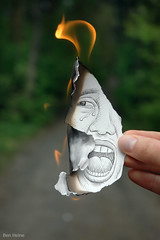
Pendant deux ou trois ans, de 2006 à 2009, Ben a enchaîné les "petits jobs dans des boîtes de com", raconte-t-il. Le jeune homme a aussi donné quelques heures de cours (langues, histoire, religion) dans des écoles publiques. En parallèle, il développait ses projets artistiques gratuitement. Peu à peu, les œuvres se sont accumulées et Ben s’est construit un réseau. "J’ai pu commencer à exposer. J’ai un ami qui a joué le rôle de manager, qui m’a bien lancé dans les galeries, on a gagné notre croûte sur mon travail artistique pendant environ 2 ans", poursuit-il. En 2010, le lancement d’une série intitulée "Pencil vs Camera", qui mélange photos et dessins, marque un tournant : ces images rencontrent un succès énorme, un "gros buzz" qui lui permet d’exposer un peu partout. "Ça a été fantastique, j’ai eu beaucoup de chance à ce niveau-là", confie-t-il. "Aujourd’hui encore des gens me contactent de je ne sais où parce qu’ils ont vu ces images quelque part", s’étonne-t-il.

Son concept "Pencil Vs Camera" est enseigné dans les écoles

Depuis lors, Ben a pu commencer à vivre de son art. Pendant trois ans, il a participé à des foires d’art, jusqu’à 4 ou 5 par mois, à Londres, à Berlin… partout en Europe. Il est devenu papa et a quitté Bruxelles pour une maison à Rochefort où il a installé son studio de création en 2012. Il se consacre désormais presque uniquement à ses activités artistiques, même s’il continue de donner quelques heures de cours de temps en temps. "Mais mon vrai gagne-pain, c’est l’art", précise-t-il. Des galeries de Bruxelles et de l’étranger vendent ses œuvres. De plus, il touche des cachets pour ses performances artistiques, "un peu comme un musicien qui donne un concert". En revanche, Ben ne bénéficie pas du statut d’artiste. Il n’a pas fait les démarches pour l’obtenir parce que "tout ce qui est administratif l’horripile au plus haut point". Son concept "Pencil Vs Camera" est devenu si populaire qu'il est à présent enseigné dans de nombreuses écoles de par le monde. A côté de son travail en dessin et en peinture, Ben développe aussi un certain talent en photographie en capturant des clichés aux quatre coins du monde. 

On le demande pour des événements organisés un peu partout 

Le succès de sa série "Pencil vs Camera" continue de lui valoir des sollicitations ces dernières années. Il suppose que les articles le concernant étant toujours en ligne, il apparaît dans les résultats des moteurs de recherche. "Je suis contacté comme ça, je reçois par exemple un mail d'une agence à Hong Kong me proposant de venir sur place le mois suivant pour travailler sur un projet génial", s’amuse-t-il. Ben est ainsi allé à Hong-Kong, en 2015, pour une collaboration avec le chocolatier Galler. Un projet auquel il a consacré presqu’un an de travail. En 2016, il a été invité à participer à une exposition itinérante en Russie. Il y a exposé ses œuvres graphiques, mais aussi des installations interactives. Au mois d’octobre, Ben a été convié à l'exposition de street art "Magic City" en Allemagne, parmi 40 artistes internationaux tels que ROA, Banksy, Shepard Fairey ou SpY. Début 2017, il s’est rendu à Ankara en Turquie pour mettre en place une performance dans le plus grand centre commercial de la ville (Ankamall). Jusqu’à présent, ce sont toujours les organisateurs d’événements qui l’ont contacté mais, dorénavant, Ben souhaite être plus "pro-actif" et arriver avec des propositions, des "idées concrètes" et choisir en amont ses partenaires. 

Il acquiert les connaissances pour ajouter le son à l’image 

Depuis 3, 4 ans, la musique occupe une place de plus importante dans son travail. Il compose des morceaux qu’il qualifie d'"électro-pop". Une nouvelle dimension de son art qui a nécessité l’acquisition de nouvelles compétences. "En musique, il y a pleins d’aspects différents : ingénierie du son, mastering, composition, solfège, gestion des programmes informatiques", souligne-t-il. La démarche est donc "beaucoup plus complexe" que celle de dessiner ou de prendre des photos, estime-t-il. L’apprentissage du solfège et la maîtrise des logiciels de production musicale a demandé des années de travail. "Comme je fais tout tout seul, j’ai commencé par faire des trucs vraiment merdiques et là j’arrive à faire des trucs beaucoup plus pros", raconte-t-il. "Il faut bien se former", note-t-il. "J'aime partager avec les gens, même les choses expérimentales, c'est à prendre ou à laisser, la progression m'intéresse", ajoute-t-il.  

La musique, "sa seule priorité" à l’heure actuelle 

Dans ce domaine, Ben doit encore trouver son public : "Les gens qui aiment mon art graphique n’aiment pas forcément ma musique, et inversement, c'est comme ça". Mais c’est cet aspect musical qui le passionne le plus pour le moment, "sa seule priorité", dit-il. Cette activité n’étant pas encore rentable, elle l’oblige à puiser dans ses ressources financières qu’il doit à son art graphique. "J'investis quand même pas mal de sous et de temps pour faire des clips de qualité, dans la mesure du possible", souligne-t-il. Néanmoins, Ben essaye désormais de mêler sa création musicale à son art visuel. Par exemple, il peint des modèles vivants, des danseurs qui dansent sur sa musique. Et à chaque exposition, il demande désormais systématiquement que ses morceaux musicaux soient diffusés. Ceux-ci font désormais partie intégrante de son univers. 

L’envie de surprendre continue de guider sa démarche artistique 

L’association du son à l’image renforce sa démarche dont le but premier est de "surprendre les gens, les faire rêver pour leur permettre de s’évader de leur quotidien". Ben ne cherche pas à faire passer un message politique, estimant que ce n’est pas aux artistes de le faire. Il veut au contraire proposer "un rayon de soleil", un peu de divertissement dans le quotidien des gens, marqué par les tracas du travail. Ci-dessous, quelques exemples de ses réalisations. Et ces musiques peuvent être écoutées sur son Soundcloud.

Article paru sur RTL INFO le 24 mars 2017.


Ben Heine Art

Ben Heine Art

Ben Heine Art

Ben Heine Art

Ben Heine Art
Ben Heine Art


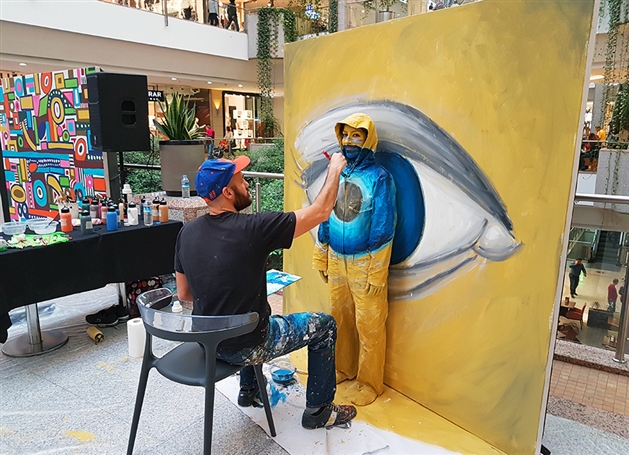
flesh and acrylic - body painting - ankamall

Ben Heine Art

Ben Heine Biography (2014)

A Prolific Self-Taught Multidisciplinary Artist 
Ben Heine is a Belgian artist who has produced through the years a huge number of artworks. He is currently best known for his original series "Pencil Vs Camera", "Digital Circlism" and "Flesh and Acrylic". He has a degree in Journalism and is a self-taught person in drawing, digital photography and music (piano and drums). His graphic creations have been exhibited widely in Europe and more recently in Asia. His favorite art movements are Surrealism, Pop Art, Geometric Abstraction, Expressionism and Social Realism. He started creating electronic music in 2011. A documentary about his work was released in 2012. Ben is married to Marta and their son Theodor was born in August 2012. 

A Belgian Boy Born in Ivory Coast With an Interest in Drawing 

Ben was born in 1983 in Abidjan, Ivory Coast, where he spent the first seven years of his life, with his parents and three sisters. The whole family relocated in Brussels, Belgium, in 1990. His father was a commercial engineer and his mother a choreographer and a dance teacher. As a young boy, Heine was attracted by the things young men are happy to explore such as sport, music and friends. Heine started drawing at 11 year old and quickly understood that graphic art was a powerful tool of communication and expression. At that time until recently, his curiosity for drawing was his keenest interest. 

Academic Background and Love for Languages, Art and Music 

Heine undertook studies in different countries, including Ivory Coast, Belgium, the UK and the Netherlands. Ben has a diploma in Journalism completed with distinction at IHECS school of Journalism in Brussels. He also studied History of Art, Painting and Sculpture at Hastings College of Arts & Technology in the UK and at the Académie Royale des Beaux Arts in Brussels. Throughout his academic training, he was also able to learn several music instruments (drums and piano) and several languages. Besides perfectly speaking French and English, the artist is quite fluent in Dutch and Polish and speaks some bits of Spanish and Russian. 

A Popular Artist With an International Mindset 

Hundreds of millions of people have seen Heine’s creations. He has exhibited and published his artworks all over the world since 2006. The artist presented his pieces of art in countless fairs and galleries in Belgium, South Korea, the UK, Romania, The Netherlands, Italy, Germany, France, Canada, the US, Turkey, Brazil, and Spain. His pictorial works have been published in some of the most famous newspapers and magazines (see "Press" and "Exhibitions" for more info). Moreover, Heine has a huge presence on the Internet as well, and his works continually pop here and there on social media and online news outlets, making him one of the most watched artists on the web today. Ben is an enthusiastic traveller, he has visited hundreds of cities and countries, each one of them being a huge source of inspiration for his creative projects. 

Pencil Vs Camera: When Imagination Meets Reality 

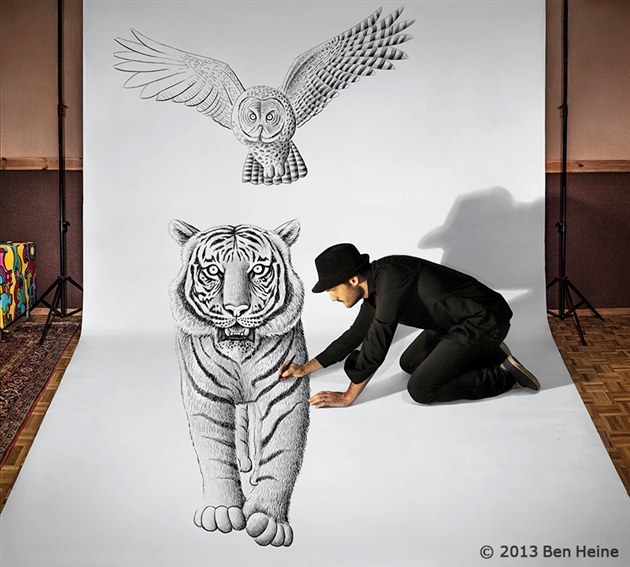
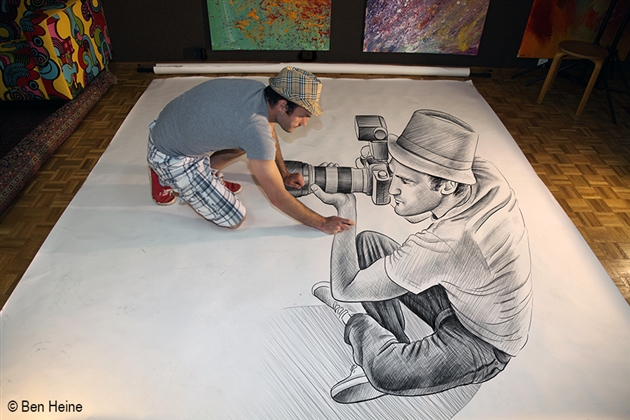
Pencil Vs Camera is an original visual concept invented and popularized by Ben Heine in April 2010. It is the artist’s special trademark and one of the most creative art concepts of the 21st century that has influenced a big number of other creators. Pencil Vs Camera blends drawing and photography in a unique way. The idea was the result of a long artistic exploration and a logic outcome of Ben's evolution: "I wasn’t satisfied with only drawing or only photography, so I had to find a way to merge the two and this is how Pencil Vs Camera was born." ("Cultural Voices" June 2014). Ben’s hand is always visible because it represents the connection between the viewer, the artist and the artwork. In these images, everything seems possible and Ben likes to tell a story and convey timeless messages using imagination, illusion, poetry and surrealism. Starting with simple sketches, Ben brought major innovations to the concept in 2012 and 2013, adding colors and black paper or increasing the drawings’ size (more info in the comprehensive chronological bio below). Since 2012, several smartphone applications emulate Heine’s Pencil Vs Camera’s style. Many creators have borrowed from Heine’s brilliance and started to fashion for themselves, something of a replica. They say imitation is the highest form of flattery. (see "Interviews" for more info) 


.
Article de Serge Bonhomme

Publié en français et en néerlandais ("Loewe Magazine", Nov 2011)

L’artiste Ben Heine connaît une jeunesse turbulente. Fils d’un ingénieur commercial belge, il voit le jour en 1983 à Abidjan en Côte d’Ivoire. À sept ans, il déménage avec sa famille à Bruxelles, où les premiers temps d’acclimatation sont difficiles. Après une période de hauts et de bas, il trouve un intérêt et sa voie dans toutes sortes de projets visuels.

Enfance de Ben en Côte d'Ivoire

Outre des dons pour la poésie, la musique et le basketball, il manifeste progressivement des talents pour le dessin et la peinture. C’est cette dernière passion qui finit par prendre le dessus. Ses études en journalisme, photographie, langues, dessin, peinture et sculpture élargissent ses horizons et lui ouvrent la voie d’une carrière professionnelle variée. Finalement, il opte pour la vie d’artiste.

En 2006, ses créations artistiques commencent à percer au niveau international. Ses œuvres sont publiées à maintes reprises dans des journaux et magazines tant en Belgique qu’à l’étranger et touchent dès lors des millions de lecteurs dans le monde. Avec des expositions en Belgique, en Angleterre, en France, en Allemagne, en Turquie, en Roumanie, en Espagne, au Brésil, au Canada et aux États-Unis, ses œuvres se déplacent continuellement d’un endroit à l’autre. Le circuit des galeries découvre également l’œuvre de Ben Heine, aussi bien chez nous qu’au-delà de nos frontières. Il devient une valeur sûre à la «Gallery Garden» et l'«Appart Gallery» à Bruxelles, à «Start/Stuff&Art» au Cap-Vert, à «Art Movement» à Londres, à la «Next Gallery» à Jacksonville et à «Radeski Gallery» à Liège. Divers événements artistiques internationaux comme «Affordable Art Fair», «Berliner List», «Accesible Art Fair» et «Music for Life» portent sa marque.

Affordable Art Fair, Londres, 2011

Au fil des ans, il développe un style bien à lui, souvent basé sur une combinaison unique de dessins et de photos. Un style qui est aussi un mélange bigarré de magie, d’illusion, de poésie et de surréalisme. Sa marque commerciale «Pencil Vs Camera» est le résultat de ses formations variées, de l’exploration graphique et de son évolution artistique. Généralement, ses œuvres naissent à partir d’un projet dessiné à la main. Une main qui est souvent très présente dans son œuvre et qui donne l’impression d’être toujours en phase d’élaboration. Il crée de la sorte une interaction entre le spectateur, l’œuvre et l’artiste en action. Au moyen d’une technique de son cru, il transfère son dessin en noir et blanc dans une photographie très colorée, ce qui accentue le contraste entre les deux disciplines ainsi combinées… Le spectateur s’en trouve happé dans le monde des expériences de l’artiste et est soumis à une confrontation brutale entre la forme et le contenu de l’œuvre.

Pencil Vs Camera - 12

Les sujets des œuvres de Ben Heine sont très divers. Il s’agit le plus souvent de portraits humains ou animaliers. Mais son œuvre est également traversée, tel un fil rouge, par l’architecture, la nature et même des thèmes plus abstraits comme la vie, la liberté, l’amitié et la mort. Il le décrit par ces mots: «Je fais de l’art pour les gens qui le regardent et non pour moi-même. Je veux créer pour eux un monde imaginaire qui les libère des tracas de la vie quotidienne. Jadis, j’écrivais de la poésie. À présent, je fais passer mes idées poétiques et philosophiques par le biais de mes images. Chaque nouvelle création raconte une histoire et suscite, comme un poème ou une chanson, une émotion intense».

Pencil Vs Camera - 57

Le monde artistique est unanime pour décrire son art comme unique et transcendant les frontières. Lorsque nous avons été confrontés pour la première fois aux œuvres de Ben Heine dans la mondaine Saint-Tropez, il dépassait les autres artistes exposés de la tête et des épaules. Ses multiples facettes et l’expressivité pénétrante de son œuvre ne se retrouvent d’ailleurs pas seulement dans ses œuvres «Pencil Vs Camera». Les résultats de son «Digital Circlism» sont au moins aussi uniques : pour y parvenir, il utilise toutes sortes de techniques numériques, en donnant sa propre interprétation du Pop Art et du Pointillisme. Les portraits de Bob Marley, Freddie Mercury, Eminem, Elvis Presley, Lady Gaga, Marilyn Monroe et beaucoup d’autres célébrités du grand écran et de la politique internationale y acquièrent une touche artistique originale au plus haut point.

Lady Gaga - Digital Circlism

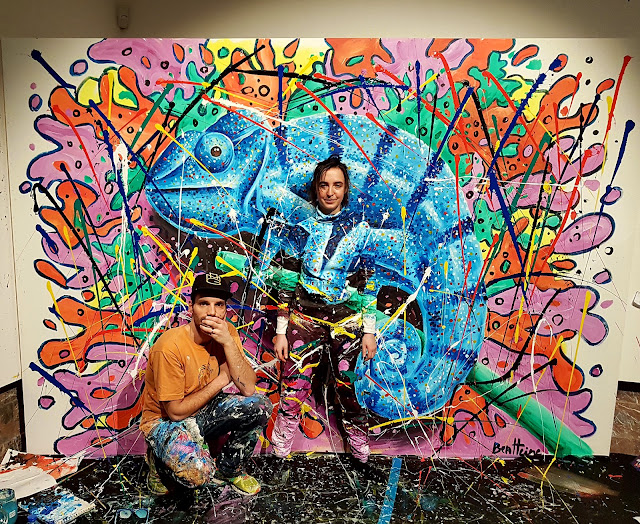
Cette année, Ben Heine lance un nouveau projet artistique : «Flesh and Acrylic». Il commence par réaliser des peintures abstraites à l’acrylique sur panneaux en bois, il intègre ensuite un modèle vivant dans la composition, un modèle sur lequel il peint également des motifs abstraits. Le résultat est une interprétation très personnelle du body-painting.

Flesh and Acrylic

Les expériences artistiques variées de Ben Heine sont exposées pratiquement en permanence dans la galerie «Art Gallery Radeski» au centre de Liège. Une galerie de 450 m² qui met à l’honneur des artistes contemporains novateurs. Ce temple artistique est situé dans un vieux complexe hôtelier transformé en un centre commercial de plus de 3 000 m², où l’on trouve également une jolie Loewe Gallery.

«Art Gallery Radeski» propose toutes les six semaines une nouvelle exposition, présentant chaque fois l’œuvre de quatre artistes de renommée internationale. Un must, à combiner avec une visite du centre de Liège qui a été rénové récemment !

Ben Heine et Serge Bonhomme à la Galerie Radeski en 2011

Silvia Monfort
.
© 2008 - Ben Heine
.
Silvia Monfort (1923, 1991) was a French actress and theatre director. Daughter of the sculptor Charles Favre-Bertin and wife of Pierre Gruneberg, this talented actress was an undying champion of the popular theatre. She was named Knight of the Legion of Honor in 1973, Officer of Arts and Letters in 1979 and then Commander of Arts and Letters in 1983. She is buried in the Père Lachaise cemetery.

A precocious vocation

She was born in the neighborhood of Le Marais, on Rue Elzévir, a short distance away from Rue de Thorigny, where she would set up her first theatre much later. Her family had lived in this Parisian neighborhood for seven generations. She lost her mother very early and her father put her in a boarding school. She undertook her secondary studies first at lycée Victor Hugo and then at lycée Victor Duruy. She obtained her baccalauréat at 14½ with special permission. Her father had intended for her career to be spent at the Gobelin manufactory but she preferred the theatre and took classes with Jean Hervé and Jean Valcourt. In 1939, aged 16, she met Maurice Clavel, who directed the Resistance network in Eure-et-Loir. Under the pseudonym "Sinclair" (the name of a hill that looms over Sète, Maurice Clavel's native town), she involved herself at his side and participated in the liberation of Nogent-le-Rotrou and of Chartres in 1944. She was one of the notables who welcomed General De Gaulle on the square in front of the Cathedral of Chartres. Once the war ended, she married Maurice Clavel. She was decorated with the Croix de guerre by General De Gaulle and with the Bronze Star Medal by General Patton.

Cocteau, Vilar and the TNP

In 1945, she attracted notice for her acting in a play by Federico García Lorca, La casa de Bernarda Alba. Her strange and powerful personality drew the attention of Edwige Feuillère, whose reader she became in L'Aigle à deux têtes by Jean Cocteau. The play was first presented in 1946 at the Royal Theatre of the Galeries Saint-Hubert in Bruxelles, where she met with great success. After passing through Lyon, the play had its Parisian premiere at the Théâtre Hébertot. Success followed the play all the way to a memorable performance at La Fenice in Venice, greatly contributing to establishing the renown of Silvia's talent.

Playing next in
Tennessee Williams' play, Summer and Smoke, she fell in love with Léonor Fini who was then beginning as a set designer. From their friendship a pretty portrait remains: Silvia painted by Léonor (1954).

Through Clavel, she then met Jean Vilar in 1947 and took part in the great adventure that was the Théâtre National Populaire. She thus took part in the first festival d'Avignon, with The Story of Tobias and Sarah (1947). Beside Gérard Philipe, she played Chimène in Le Cid, then performed at Chaillot and subsequently on tour across Europe (1954). Next, she played with Vilar in Cinna and in The Marriage of Figaro. She thus became an emblematic figure of the TNP and of French theatre in the world.

New Wave and cinema debut

Cinema, through the intermediary of Robert Bresson, had sought her out beginning in 1943, to play in Les Anges du péché. Bresson had hired her without knowing that she was an actress, as he was looking for non-professionals for his film... In 1948, she played the role of Édith de Berg in the cinematic adaptation of L'Aigle à deux têtes by Cocteau beside Feuillère and Jean Marais.

In 1955, Agnès Varda, then a photographer at the TNP, directed her first film, one of the first belonging to the New Wave. Varda remembers Silvia Monfort in La Pointe Courte: "Curious and a pioneer by nature, she threw herself into the project with delight and discipline. I really think she was happy to fight for a cinema of the future."

Henceforth separated from Maurice Clavel, Silvia Monfort shared her life with and participated in the films of director Jean-Paul Le Chanois. Despite her having an arm in a plaster cast, he insisted that she play a Polish prisoner beside François Périer and Pierre Fresnay in a film inspired by a true story, Les Évadés. This film met with great popular success in 1955. She then played beside Jean Gabin and Nicole Courcel in Le Cas du docteur Laurent, a film advocating painless childbirth (1957), and then in an obscure film of Le Chanois dealing with parent-child relations, Par-dessus le mur (1961). In two films dealing with social conditions, she was the unforgettable Eponine of Les Misérables, alongside Gabin and Bourvil (1958), and then the Gypsy girl Myrtille in Mandrin, bandit gentilhomme beside Georges Rivière and Georges Wilson. This film wrapped up her cinematic career[4] and her relationship with Le Chanois in 1962.

On the road

During the 1960s, Silvia Monfort was passionate about cultural decentralization and so set out on the road with Jean Danet and her Tréteaux de France. Each evening, they played under a big top in a different town. She took an active part in this experiment, seeing to it that new and contemporary plays were staged alternately with the classical repertoire. She deepened her knowledge of popular theatre and of her audience and thus acquired a mastery of travelling performances that was subsequently very useful to her. On 23 June 1965, Silvia wrote to Pierre Gruneberg: "I've convinced Danet to schedule for September a series of performances of the Prostitute and of Suddenly, Last Summer under a big top around Paris (in this way the inconvenient returning directors will be able to come see it there if they need to). Oh, I would have done what I could."

Ceaselessly taking part in theatrical performances, she wrote at least once, sometimes several times a day to her companion Pierre Gruneberg. Scribbled on tablecloth corners, on the back of theatre programs or on hotel stationery, reactions, words of love and anecdotes were strung together.

In the collection of this correspondence, Letters to Pierre, Danielle Netter, assistant director, adds: "The Tréteaux de France was an extraordinary theatrical tool that gave us the occasion to present Sophocles and other dramatic poets before the tenants of the HLM, and one evening to hear a spectator declare at the end of Electra to Silvia, It's as beautiful as a Western!, which filled our tragedienne with joy."

An eclectic tragedienne

For nearly half a century, whether with the Tréteaux, in festivals, in private theatres and later in her Carrés, Monfort explored the ancient and modern theatrical repertoires. She acted in no less than five versions of Phèdre in diffrerent theatres as well as on television. She interpreted numerous works of Racine and Corneille. She performed Sophocles' Electra in the most incongruous of places, such as the "trou des Halles" in Paris in 1970.

She acted in the plays and theatrical adaptations of Maurice Clavel, such as The Isle of Goats and The Noon Terrace. She was directed by Roger Planchon at Villeurbanne in 1959 in Love's Second Surprise and by Luchino Visconti in Paris in 1961 in 'Tis Pity She's a Whore beside Alain Delon and Romy Schneider. She made appearances in Summer and Smoke (1953) and Suddenly, Last Summer (1965) by Tennessee Williams. She incarnated the Sphinx of Cocteau's The Infernal Machine in festivals as well as on television with Claude Giraud in 1963. She was The Respectful Prostitute of Jean-Paul Sartre (1965) as well as The Duchess of Malfi beside Raf Vallone (1981).

At Carré Thorigny, she brought about the debut of Bernard Giraudeau in Tom Eyen's Why Doesn't Anna's Dress Want to Come off (1974). She was also seen in The Oresteia (1962) and The Persians of Aeschylus (1984). She incarnated the fearsome Lucrezia Borgia of Victor Hugo (1975) and Marguerite de Bourgogne of The Tower of Nesle by Alexandre Dumas, père (1986). She created an indescribable Alarica in The Evil Is Spreading (1963) and was the Maid of Jacques Audiberti (1971). She was a vibrant Ethel in a radical play helmed by Alain Decaux, The Rosenbergs Should Not Die (1968). She took on Ionesco with Jacques, or the Submission (1971). She restored Henrik Ibsen to popular favor with Philippe Lemaire in When We Dead Awaken (1976) and then with Michel Auclair in The Lady from the Sea (1977). To celebrate the centenary of Cocteau's birth, she appeared for the last time on the Vaugirard stage in a poetic and musical spectacle, The Two Ways, in 1989.

In 1972, on the occasion of the republication of her novel The Raia (Hands Full of Fingers), Silvia Monfort described her favorite roles: "Gérard Philippe, whose Chimène I was, had a habit of replying that his favorite role was his next. For me, the one that I am playing fulfills me. Imagine! What marvelous relations between an actor and his character. They see each other every day, but they also know that it's not forever, so they have to work twice as hard. Certain characters have more of an affinity for us. I have always felt myself closer to adolescents thirsting for the absolute than to women with divided hearts. I prefer Electra to Clytemnestra. I was wildly in love with Alarica from The Evil Is Spreading, Éponine from Les Misérables and recently The Maid by Audiberti. But this doesn't prevent me from knowing beautiful stories about those whom I wouldn't play. Of all the heroines, the one who perhaps excited me most was the queen of the Amazons, Penthesilea. When she thought herself defeated by Achilles, she refused to follow him into his kingdom. She wanted him to be king in her land. So she tore him up with her nails, devoured him with her teeth, and said: All women swear to their lovers: I will eat you as long as I love you – well, I did it."

A mythic Phèdre

Silvia Monfort figures among the most important performers of Phèdre. Notably, she had as a partner in the role of Theseus Jean-Claude Drouot or of course Alain Cuny in the theatre and in a televised version in 1982.

A study by the CNRS about the great tragediennes who have incarnated this character in the 20th century was published in Pour la Science, the French version of Scientific American. This study analyzed the relationship between the pauses and the versified text as well as the fluctuations in delivery and demonstrated that Silvia Monfort made the most important use of them (92% of pauses and 3.8 syllables/minute) in relation to other tragic actresses (Sarah Bernhardt, Marie Bell, Nada Strancar and Natacha Amal); this characteristic of her acting contributed to give Silvia Monfort's interpretation an exceptional quality of psychological depth and emotion which made a success out of her.

She herself said of her character in 1973: "Phèdre burns in each one of us. We have hardly grasped the image in the mirror when she dims, and the imminence of this obliteration sharpens the acuteness of the reflection […] What matters is that there has been a meeting in mystery even from the first reading. It is like desire, or rather it is present in the look that provokes it, or rather there will never be unison. All the opinions, competent, imperious, singular, that were offered to me on the subject of Phèdre, and to which I listened intensely, had no other result with me than to lead me back to my Phèdre, despite her long being hazy, with the obviousness of a pawn moving back to the first square on a board game […] this is the wonder of Phèdre: to tackle it is to resign oneself to it."

The fall that made her an author

In 1946, her first novel appeared. She later explained that what had determined her to write was her seven-meter fall through the glass roof of the Studio des Champs-Élysées. She played in Federico Garcia Lorca's La casa de Bernarda Alba and Maurice Clavel, disdaining her philosophy books, wrote for her first play, The Love Letters. :

"The day when I was to abandon one play for the other, my colleagues from the Studio offered me champagne on the roof of the Théâtre des Champs-Élysées. I had never drunk wine or champagne. I passed through a skylight and found myself in the hospital, my head shattered. Three weeks in a coma, during which Maurice's play was prepared without me.
When I was back on my feet, sad and without a role to play, I sat down at my work table. Without this accident, maybe I would never have taken the time to write. For later, in order to write, I had to take away time from the theatre."

When a journalist asked her why the actress which she had never ceased to be had never been tempted to write a play, or a film script, she replied: "Writing for the theatre is a very special gift. Even some great novelists don't have it. The dramatic author breathes into his characters a life that he doesn't control.

But what interests me above all in writing is analysis. To know, to explain the reason for things, to follow step by step the actions of my characters. And then, I couldn't stand seeing them with another face than that which I had in my mind!"

"This will be my theatre!"

In 1972, with the support of Jacques Duhamel, then Minister of Cultural Affairs, she set up and directed the Carré Thorigny in the neighborhood of Le Marais in Paris, where she put on innovative multidisciplinary shows. She was especially interested in the circus world and organized an exhibit entitled Circus in color which met with enormous success. Following her contacts with circus people and her meeting with Alexis Gruss, she organized old-style circus performances in the courtyard of the Hôtel Salé, located in front of the Carré. The public's fancy led Monfort and Gruss to set up (in 1974) the first circus and mime's school in France, L'école au Carré, which they directed together. They wanted to highlight the nobility of the circus's origins and were involved in bringing to life an updated old-style circus. The Gruss circus followed Monfort in her successive moves until it became a national circus in 1982.

It was at the Carré Thorigny that Alain Decaux awarded Silvia Monfort the Legion of Honor in 1973 while paying homage to "her passion for the theatre and the inflexible will with which she serves it."

The Carré had to leave Rue de Thorigny in 1974 because of a property transaction. Monfort thus transferred her Nouveau Carré into the old théâtre de la Gaîté-Lyrique which opened on 1 October 1974 and set up the Gruss circus in the square in front of the theatre. The hall was inaccessible for safety reasons, so the new Carré put actors and audiences on stage, but because of the building's great age and while awaiting its renovation, she was forced to set up her stage under a big top in the Jardin d'Acclimatation from 1978 to 1979. She then had to move her big top onto the site of the former abattoirs of Vaugirard. There, she actually set up two big tops, one for theatre and one for the circus. Nevertheless, lacking funds, the project of renovating the Gaîté-Lyrique was abandoned.

Yet she never stopped working to establish a Nouveau Carré at Vaugirard on the site of and in place of the big tops. The decision to build the theatre such as it is today was taken in 1986. On 7 March 1989, she wrote: "This will be my theatre. Even so, incredible! I don't know a single living person for whom his own theatre was built, with his name and of the right size." But she died a few months before its completion. Inaugurated in 1992, it bears her name: Théâtre Silvia-Monfort.

During the last years of their time together, Silvia Monfort and Pierre Gruneberg were constantly apart. In winter, as a ski coach, he had to stay at Courchevel, while she worked at Paris, then during the festival period he worked at Cap Ferrat as a swimming instructor, whereas Silvia Monfort's ill health obliged her to pass the summer at Courchevel, alone.

She died on 30 March 1991 of lung cancer.

The Silvia Monfort Prize

Pierre Gruneberg, who became Silvia Monfort's lover in 1963 and married her on 24 May 1990, founded the Silvia Monfort Prize Association in 1996, carrying to completion an idea that Monfort did not have time to put into material form. This prize is issued every two years to a young tragic actress by a professional jury. Since its inception, the prizewinners have been:

  1. Smadi Wolfman (1996)
  2. Rachida Brakni (1998)
  3. Mona Abdel Hadi (2000)
  4. Isabelle Joly (2002)
  5. Marion Bottolier (2004)
  6. Gina Ndjemba (2006)

The Prix Silvia Monfort 2006 was awarded on 22 May to Gina Ndjemba, aged 21, a first-year student at the Conservatoire National d’Art Dramatique, for her interpretation of the role of Camille in Horace by Corneille. This sixth Prix Silvia Monfort ceremony took place at the celebrated tragedienne's theatre in the presence of the academician Alain Decaux, a great friend of Silvia Monfort, to whom he paid a moving homage. This Prize was accompanied by a €4,600 award.

Quotations about her

Jean Cocteau :

"Silvia Monfort possesses an exquisite waist, like that of an hourglass, and the golden sand from up top flows toward the bottom, toward her belly, whence all great actresses draw their genius.

I have known several Silvia Monforts. One, with a wreath of wheat in her hair, entered free Paris as a young leader of the Resistance. Another had written a book of the first rank; a third – and my eye had not yet linked them – came and presented herself at the Théâtre Hébertot to play the role of Mademoiselle de Berg in L’Aigle à deux têtes. She played it and it was only later, a long time later, when all these Silvia Monforts became just one, to whom I address my tender gratitude.

Here she is on her successful voyage, the voyage from role to role, from book to book, the voyage on board which I wave the handkerchief of friendship as a sign of loyal affection and good luck."

Juliette Gréco :

"Silvia Monfort came back from a solitary walk and held out a flower to her husband Clavel, saying in her husky voice: 'I've stolen this flower for you on the mountain...' Jujube was stunned and the exotic Ophelia disappeared under the arches that surrounded the swimming pool."

L'Humanité (following her death) :

"She was a grande dame of the theatre and of the city. We will remember her beautiful tragedienne's voice and her determined wish to make a different theatre, her theatre, in the modernity of the ancients and of the classics. Let us hope that that which will be born and bear her name in the heart of Paris will prolong her memory, the fervor of her art and the exacting purity of her work."
.

.

>>> Read more about Silvia Monfort (Filmography, Theatre and Television references…) on Wikipedia

.
----------------

--> The above biography was initially written in French by Airair and appeared on Wikipedia in French and in English

.
Creative Commons License
.