

Showing posts with label Blogger. Show all posts
Showing posts with label Blogger. Show all posts
My cartoons on
Toonpool.com
Toonpool.com
.
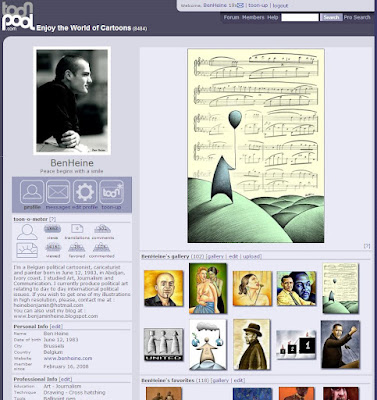
Selected Cartoon :
"Democrats Hunting Democrats"
 © 2008 - Ben Heine
.
"Democrats Hunting Democrats"
© 2008 - Ben Heine.
Agit-Blog
.
Ben Heine is a provocateur! His cartoons recall John Heartfield's agitprop images, but created with a blogger's tools: political protest and activism as streaming poetic diary entries on the Web. Heine is a master of his craft. He draws on a variety of expressionist and surrealist role models, including George Grosz and René Magritte, and combines images, poems and essays with great virtuosity. This "hunting" scene in Iowa, which was commissioned as a book illustration, is given an unreal, nearly ghostly depth by the expressionless faces of the Christian hunters, the vanishing point of the lettuce fields, just out of view, and the iconographic elements such as weapons and cars. Hannah Arendt's banality of evil, transported to the American heartland.
.
(toonpool.com 02/08)
.
(toonpool.com 02/08)



Interview with the Poetryman

“The idea of blogging to the powers that be
is terrifying and they’d love to control it”
Known as the “Poetryman”, Mark Prime is a prolific North American poet and Peace activist. He runs several blogs: "A Poetic Justice" (updated everyday, mainly with political poetry and illustrated with his own photomontages). He is also the head of other sites, such as "The Peace Tree" and "Poets for Peace". Sometimes he even writes plays, you can read his texts there: The Origin Theatre. You can reach him at prime63@cox.net.
BH: You are a prolific American poet and Peace activist. You are also a blog expert and own several ones, including A Poetic Justice, The Origin Theatre, Poetic Justice Pictures, The Peace Tree, Poets for Peace…
.
BH: You are a prolific American poet and Peace activist. You are also a blog expert and own several ones, including A Poetic Justice, The Origin Theatre, Poetic Justice Pictures, The Peace Tree, Poets for Peace…
.
MP: Prolific, perhaps in the since that I always have writers cramp. As for my myriad of blogs? I had to compartmentalize my various forms of expression for my own sanity and they each needed their own pages.
BH: When and why did you start to open your first blogs?
MP: I first began blogging, as a commenter, when I happened upon a blog called Crooks and Liars during a search for crooks and liars and politicians. But I repeat myself…
I suppose I was a bit out of the loop since C&L had been around for some time before I found it, but once I began to comment, there and around the web, I was quickly caught up in the liberation of personal expression and exchange of ideas. It wasn’t long after that that someone recommended I begin writing my own blog. I’m not sure if it was someone concerned about the bandwidth I was using at C&L (knowing the best way to remedy this was for me to begin my own blog), or if one of the many blogging friends I had on the web recommended I do so, either way it worked out well for me.
I soon began to summon my muse, or perhaps she summoned me, three or four times a day and the rest, as they say, is… I suppose the fact that I was so upset by my government’s occupation of
BH: Which audience does your site(s) target?
MP: Certainly it (they) targets and receives a more liberal audience, but I have had right, left, center, Christian right, Christian left, communist, socialist, atheist, agnostic, and a myriad of readers, that don’t seem to fit any political mold, pay my site(s) a visit or two. I like a diverse readership; it is, after all, the liberal way.
BH: Is it manageable, in terms of time and finances?
MP: The Blogger platform, there are many others out there, is free which is the only way I could manage to do this at this particular juncture in my life. As far as time is concerned; it is only manageable because I don’t get much sleep.
BH: Some of your blogs are collective sites (The Peace Tree, Poets for Peace); how do you recruit members?
MP: I ask them via email to start, and always put it out there that I am open to contributions from any and all, as long as they match the sites intent of course. If they don’t, you may find me starting another blog so that they might have a home to express themselves.
I’ve stumbled upon some great talent by not closing myself off to a certain stripe or style. Just because I’m anti-occupation and a peace activist doesn’t mean that I should stop listening to any and all angles. It’s what an open-mind is supposed to do, right?
BH: Blogging about politics is a good way of taking part in the world’s affairs, which other advantages do you find in running a blog?
.
MP: The biggest benefit for me is the honing and use of my artistic expressions. It is a great release. Keeping these sorts of things bottled up inside might prove to be dangerous to one’s health. I also find that there are people out there, blogging or surfing the net, who will ask me questions and offer me stories that I might not hear were it not for my blog(s). I’ve heard and read so many points of view on any number of topics that I cannot help realize that this benefits me greatly. It gives me the chance to filter through emotions and points of view and allows me to see things more clearly by hearing the many voices around the globe. It’s not like talking to mere friends on any given day, with blogging I can converse and freely exchange ideas with people from any and every country on earth that is able to connect to the web… and freedom of expression and the exchange of ideas is never a bad thing, right?
BH: Have you been able to meet new people, poets, artists and peace activists through your blog activity?
MP: I’ve been introduced to artists of every stripe and variety. Blogging is a wonderful hodgepodge of people; idealists and realists, artists and non-artists, all coming together to express their ideas!
BH: Now a few questions on the digital divide: Although some analysts say they are mainly places for entertainment, do you think that the cybercafés (and the other public centers where a low cost Internet connection is available) are a good weapon against the digital divide in poorer countries?
MP: Without question. The mere fact that one has need to ask this indicates to me the enormous power within the question. Who gains from the free exchange of ideas? The people, everywhere. Who has the most to lose? Those who try to control the switches, be it in DC or
BH: Don’t you think that the Western political rhetoric about the digital divide is a kind of political slogan which purpose is to force the countries of the Global South to conform their economic system to the Western one, for example, by inciting them to buy the same Western software and hardware?
MP: Absolutely. The game is money (control) whether it be called “oil”, “software”, “automobile”, “hardware”, “class”, “race”, “sex”, “age”, “the flag”, “god”, etc. The dynamics of competition are always at play, and in many respects that is very unfortunate.
BH: We have recently heard about very cheap « generic » laptops being sold in Africa and in
MP: Another absolutely! I think if one has to be “herded” into a group setting to access what many carry with them every day that this may constitute oppression.
This idea, from Apple I believe, is one that offers a great many the opportunity to be heard. I mean it is a human, fundamental right, in my opinion, to be heard, to express yourself, to call out for help, to offer your ideas. What on earth could be more fundamental in this electronic age than the world coming together on the web? Might we then be less inclined to want to go to war and kill them or they us, and might they be more able to see that not all Americans, etc, think like Blair and Bush or Sharon or Ahmadinejad or Bin Laden, or “fill in the ruler”...?
BH: My last question: How would you define the ideal digital society in a few words?
MP: Free.
.

By Judy Aita
.
.
United Nations -- The Internet is a key component of press freedom in the 21st century, yet Internet journalists and bloggers increasingly are coming under attack by repressive regimes trying to block the free flow of information and expression, say journalists and activists.
"Free thought, particularly expressed on the Internet is becoming more and more dangerous," says Bridget Johnson, Los Angeles Daily News columnist and blogger. "The Committee to Protect Journalists has been tracking the detention of Internet writers since 1997 and the 2006 figure is the highest the group has ever recorded. Now, one in three jailed journalists is a blogger, online editor, or Web-based reporter." According to CPJ, 134 journalists were jailed in 2006; of that number, 49 worked on the Internet.
U.S. efforts to promote the free flow of information range from monitoring Internet access in countries around the world and including the data in the annual State Department Country Reports on Human Rights to financing Internet projects in developing countries. Since 2004, the United States has given $250 million to projects that include assisting with Web site design, providing computers and training technicians to keep systems operating.
Johnson and other bloggers and activists discussed the growing challenges to free speech on the Internet at a World Press Freedom Day panel May 3 entitled "The Citizen Journalist: The Internet as a Tool for Freedom of Speech." The panel was hosted by the U.S. Mission to the United Nations and included bloggers from countries with press restrictions and representatives of nongovernmental organizations ( NGOs ). The press fosters debate, provides a forum for expressing different points of view and keeps governments accountable for the decisions they make, said Jeffrey Krilla, U.S. deputy assistant secretary of state for democracy, human rights and labor. "The increasing challenges the press face around the world are challenges to democracy and freedom."
One of the great opportunities for spreading freedom of expression is the Internet, Krilla said. "The Internet holds enormous promise particularly for the developing world and efforts to blunt the Internet's transformational power need to be countered by governments, NGOs, and by citizens worldwide."
Tala Dowlatshahi, New York director of the Paris-based Reporters Without Borders, said that the ongoing debate among some media representatives and lawmakers over whether bloggers are journalists and to what freedoms bloggers are entitled "is a waste of time." "It is high time we set aside the blogger-versus-journalist polemic and acknowledge that they are there fighting side-by-side in many countries to defend freedom of expression," she said.
"In legal terms, a media professional is not entitled to better protection than a blogger," Dowlatshahi said. "Freedom of expression, at least in theory, is something everyone is entitled to regardless of their status. Article 19 of the Universal Declaration of Human Rights underscores this basic principle."
INTERNET FREEDOM AND REPRESSIVE REGIMES
The Internet has caused major upheavals in countries that do not permit freedom of expression, Dowlatshahi said. Bloggers can be pivotal in repressive environments where the media live in constant fear of the political leadership. In Egypt, she pointed out, it was a blogger who revealed that torture was being carried out in detention centers.
China is the worst place for cyberdissidents, but other countries --including Vietnam, Syria, Tunisia, Libya and Iran -- are not far behind, Dowlatshahi said. Watson Meng, founder of Boxun News, and Drexel University marketing professor Frank Xie, a blogger on Boxun News, talked about the problems facing Chinese bloggers. In China, citizen journalists are important, said Meng. Official information is not reliable and people are looking for good Web sites with reliable information. Since Boxun was founded in 2000, it has been the Number 1 online Chinese news service.
Governments ( including that of China ), NGOs, journalists and ordinary citizens make up the audience for the Boxun Web site, which contains news and 1,400 blogs. But, Meng said, his big problem is "the great firewall" the Chinese government uses to block his site. Xie added that China uses the best technology for its firewall and is exporting it free to Cuba, North Korea and Sudan.
There are about 137 million Internet users in China ( 10.5 percent of the population ), according to Xie. One of the problems is the cost of Internet access, he said. Xie predicted that if the cost of access were reduced, the number of Internet users in China would surpass the 210 million people in the United States who now use the Internet.
Bloggers "need international support at this moment, on International Press Freedom Day," said Nora Younis, an Egyptian blogger and activist. "We need the international support of other bloggers, scholars, journalists, intellectuals and civil society."
With an estimated 8 million Internet users in Egypt, blogging has become an increasingly important means of expression for a country with a young population. Nevertheless, Younis said, new government restrictions are forcing young bloggers to censor their own writings -- which they never had to do before -- or quit altogether.
Echoing the sentiments of the other panelists, Younis said, "We as young people do not want to go to prison. We want to write, we want to engage."
-------------------
.
--> This article originally appeared on media-newswire.com
.
"Free thought, particularly expressed on the Internet is becoming more and more dangerous," says Bridget Johnson, Los Angeles Daily News columnist and blogger. "The Committee to Protect Journalists has been tracking the detention of Internet writers since 1997 and the 2006 figure is the highest the group has ever recorded. Now, one in three jailed journalists is a blogger, online editor, or Web-based reporter." According to CPJ, 134 journalists were jailed in 2006; of that number, 49 worked on the Internet.
U.S. efforts to promote the free flow of information range from monitoring Internet access in countries around the world and including the data in the annual State Department Country Reports on Human Rights to financing Internet projects in developing countries. Since 2004, the United States has given $250 million to projects that include assisting with Web site design, providing computers and training technicians to keep systems operating.
Johnson and other bloggers and activists discussed the growing challenges to free speech on the Internet at a World Press Freedom Day panel May 3 entitled "The Citizen Journalist: The Internet as a Tool for Freedom of Speech." The panel was hosted by the U.S. Mission to the United Nations and included bloggers from countries with press restrictions and representatives of nongovernmental organizations ( NGOs ). The press fosters debate, provides a forum for expressing different points of view and keeps governments accountable for the decisions they make, said Jeffrey Krilla, U.S. deputy assistant secretary of state for democracy, human rights and labor. "The increasing challenges the press face around the world are challenges to democracy and freedom."
One of the great opportunities for spreading freedom of expression is the Internet, Krilla said. "The Internet holds enormous promise particularly for the developing world and efforts to blunt the Internet's transformational power need to be countered by governments, NGOs, and by citizens worldwide."
Tala Dowlatshahi, New York director of the Paris-based Reporters Without Borders, said that the ongoing debate among some media representatives and lawmakers over whether bloggers are journalists and to what freedoms bloggers are entitled "is a waste of time." "It is high time we set aside the blogger-versus-journalist polemic and acknowledge that they are there fighting side-by-side in many countries to defend freedom of expression," she said.
"In legal terms, a media professional is not entitled to better protection than a blogger," Dowlatshahi said. "Freedom of expression, at least in theory, is something everyone is entitled to regardless of their status. Article 19 of the Universal Declaration of Human Rights underscores this basic principle."
INTERNET FREEDOM AND REPRESSIVE REGIMES
The Internet has caused major upheavals in countries that do not permit freedom of expression, Dowlatshahi said. Bloggers can be pivotal in repressive environments where the media live in constant fear of the political leadership. In Egypt, she pointed out, it was a blogger who revealed that torture was being carried out in detention centers.
China is the worst place for cyberdissidents, but other countries --including Vietnam, Syria, Tunisia, Libya and Iran -- are not far behind, Dowlatshahi said. Watson Meng, founder of Boxun News, and Drexel University marketing professor Frank Xie, a blogger on Boxun News, talked about the problems facing Chinese bloggers. In China, citizen journalists are important, said Meng. Official information is not reliable and people are looking for good Web sites with reliable information. Since Boxun was founded in 2000, it has been the Number 1 online Chinese news service.
Governments ( including that of China ), NGOs, journalists and ordinary citizens make up the audience for the Boxun Web site, which contains news and 1,400 blogs. But, Meng said, his big problem is "the great firewall" the Chinese government uses to block his site. Xie added that China uses the best technology for its firewall and is exporting it free to Cuba, North Korea and Sudan.
There are about 137 million Internet users in China ( 10.5 percent of the population ), according to Xie. One of the problems is the cost of Internet access, he said. Xie predicted that if the cost of access were reduced, the number of Internet users in China would surpass the 210 million people in the United States who now use the Internet.
Bloggers "need international support at this moment, on International Press Freedom Day," said Nora Younis, an Egyptian blogger and activist. "We need the international support of other bloggers, scholars, journalists, intellectuals and civil society."
With an estimated 8 million Internet users in Egypt, blogging has become an increasingly important means of expression for a country with a young population. Nevertheless, Younis said, new government restrictions are forcing young bloggers to censor their own writings -- which they never had to do before -- or quit altogether.
Echoing the sentiments of the other panelists, Younis said, "We as young people do not want to go to prison. We want to write, we want to engage."
-------------------
.
--> This article originally appeared on media-newswire.com
.
Subscribe to:
Posts (Atom)