
Showing posts with label Political Art. Show all posts
Showing posts with label Political Art. Show all posts

Slideshow of the week
.
.
This is a selection of my older traditional drawings made with ballpoint pens (not pencils) on large paper. I just scanned the final drawings and colored them digitally... I used this simple cross hatching technique several years back, it gives some interesting effects, the only thing is that it's harder to make corrections when you make mistakes... I have now switched to 100% digital. I still make full drawings and paintings on paper/canvas from time to time but I rather prefer to work with real brushes then. :)

Printed Publication in
"Imagine Demain le Monde"
"Imagine Demain le Monde"
.

Two of my recent political cartoons appear in the new number of the sensational Belgian magazine "Imagine Demain le Monde": www.imagine-magazine.com (January/February - Number 77).
.
Karl Marx
.
 .
.Just a quick painting...
Merry Christmas :D
Merry Christmas :D
.


I Am a Freegan
.
 .
.
Freeganism is an anti-consumerist lifestyle whereby people employ alternative living strategies based on "limited participation in the conventional economy and minimal consumption of resources". Freegans "embrace community, generosity, social concern, freedom, cooperation, and sharing in opposition to a society based on materialism, moral apathy, competition, conformity, and greed." The lifestyle involves salvaging discarded, unspoiled food from supermarket dumpsters, known as dumpster diving. Freegans salvage the food for political reasons, rather than out of need.
The word "freegan" is a portmanteau of "free" and "vegan". Freeganism started in the mid 1990s, out of the antiglobalization and environmentalist movements. The movement also has elements of Diggers, an anarchist street theater group based in Haight-Ashbury in San Francisco in the 1960s, that gave away rescued food. (Text's source: Wikipedia)
.
 .
.The word "freegan" is a portmanteau of "free" and "vegan". Freeganism started in the mid 1990s, out of the antiglobalization and environmentalist movements. The movement also has elements of Diggers, an anarchist street theater group based in Haight-Ashbury in San Francisco in the 1960s, that gave away rescued food. (Text's source: Wikipedia)
A/H1N1 Pandemic
.
 © 2009 - Ben Heine
.
The A/H1N1 influenza pandemic has been spreading at an unprecedented speed, much faster than other pandemics in history, the World Health Organization (WHO) recently said.
"In past pandemics, influenza viruses have needed more than six months to spread as widely as the new H1N1 virus has spread in less than six weeks," the UN agency said in a briefing posted on its website.
The agency will no longer issue the global tables showing the numbers of confirmed cases for all countries, because the number of infections is increasing so fast in many countries that it has become almost impossible for them to follow through laboratory tests, said the WHO briefing.
.
>>> read the whole report
>>> See an older illustration I made on the A/H1N1 virus
.
.
 © 2009 - Ben Heine
 .
A/H1N1 Pandemic Spreads at
Unprecedented Speed, Says WHO
Unprecedented Speed, Says WHO
The A/H1N1 influenza pandemic has been spreading at an unprecedented speed, much faster than other pandemics in history, the World Health Organization (WHO) recently said.
"In past pandemics, influenza viruses have needed more than six months to spread as widely as the new H1N1 virus has spread in less than six weeks," the UN agency said in a briefing posted on its website.
The agency will no longer issue the global tables showing the numbers of confirmed cases for all countries, because the number of infections is increasing so fast in many countries that it has become almost impossible for them to follow through laboratory tests, said the WHO briefing.
.
>>> read the whole report
>>> See an older illustration I made on the A/H1N1 virus
.


Mute
.

Silences, Alone
By Peter S. Quinn
A silence comes within us all,
When we with darkness again fall;
A shadow creeping softly stays,
And show its vision many ways.
Everything my brain still knows,
Step by step into silences goes;
Dreams and feelings down it break’s,
Away my visions all it takes.
When I am alone and streets I walk,
Silences to me softly talk;
About the heart that was here before,
But is now gone for ever more.
A lonesome soul just only knows,
The restless silence that never goes;
Sharp and shining like a razor blade,
A forgotten love song now too late.
That echoed once from heart to heart,
With promises to never depart;
But now lies resting on its own,
Like silences that are still alone.
.
By Peter S. Quinn
A silence comes within us all,
When we with darkness again fall;
A shadow creeping softly stays,
And show its vision many ways.
Everything my brain still knows,
Step by step into silences goes;
Dreams and feelings down it break’s,
Away my visions all it takes.
When I am alone and streets I walk,
Silences to me softly talk;
About the heart that was here before,
But is now gone for ever more.
A lonesome soul just only knows,
The restless silence that never goes;
Sharp and shining like a razor blade,
A forgotten love song now too late.
That echoed once from heart to heart,
With promises to never depart;
But now lies resting on its own,
Like silences that are still alone.
.
Barack Obama's
Toughest Opponent
.
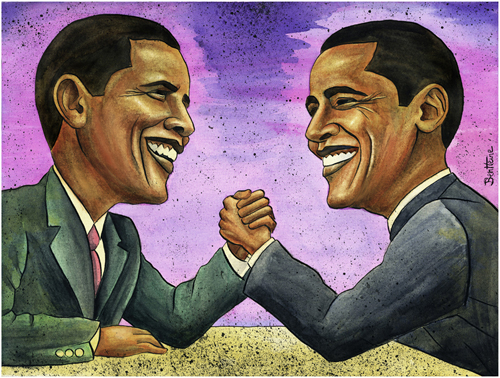
© 2009 - Ben Heine
.
Watercolor on paper...
.
Obama Works to Repair America's Image in the
World. Smiles and handshakes are a start, but
Obama's real challenge will be to show results
By Thomas Omestad
Toughest Opponent
.
© 2009 - Ben Heine
.
Watercolor on paper...
.
Obama Works to Repair America's Image in the
World. Smiles and handshakes are a start, but
Obama's real challenge will be to show results
By Thomas Omestad
The few "Yankee Go Home" signs that greet him abroad seem almost an afterthought, and when he enters a room of world leaders, he is the most sought-after man for a photo op and a handshake. Such is the star power that has swirled around Barack Obama on his initial foreign travels as the U.S. president.
This comes as little surprise, yet it will present a challenge of sorts for the president. Obama's relative youth and vigor, his calls for reaching out to adversaries and friends overseas, his breaks from past policy, and his triumphant personal story as the nation's first African-American president all seem to make the 47-year-old leader the best single antidote to anti-Americanism in years, maybe decades. White House officials say Obama's appeal extends beyond just the leaders of the world. "What has happened is that anti-Americanism isn't cool anymore," says top Obama adviser David Axelrod.
But this initial repositioning of the American leadership brand onto more popular terrain internationally will be the easier part of Obama's task. For all the sense of fresh starts and of goodwill, the seeds of perhaps inevitable disappointments are present as well. Visiting the Czech Republic in April, Obama got a friendly warning from Vaclav Havel, the once dissident playwright and former president who led his country's Velvet Revolution. Havel cautioned that the accumulation of exaggerated expectations could turn against the new American leader. "People may end up thinking that he has betrayed them, that he has raised their hopes too far," Havel said. A smiling Obama is said to have replied that he is aware of the danger.
Still, Obama has deftly gone about trying to reset the global image of America. The guiding impulse seems to be to start reviving U.S. standing in the world quickly in the hope that policy gains will accrue later. He has ordered the future closure of the U.S. prison at Guantánamo Bay, Cuba, barred torture of terrorist suspects, and made public the Bush administration's internal memos authorizing harsh interrogation methods.
This comes as little surprise, yet it will present a challenge of sorts for the president. Obama's relative youth and vigor, his calls for reaching out to adversaries and friends overseas, his breaks from past policy, and his triumphant personal story as the nation's first African-American president all seem to make the 47-year-old leader the best single antidote to anti-Americanism in years, maybe decades. White House officials say Obama's appeal extends beyond just the leaders of the world. "What has happened is that anti-Americanism isn't cool anymore," says top Obama adviser David Axelrod.
But this initial repositioning of the American leadership brand onto more popular terrain internationally will be the easier part of Obama's task. For all the sense of fresh starts and of goodwill, the seeds of perhaps inevitable disappointments are present as well. Visiting the Czech Republic in April, Obama got a friendly warning from Vaclav Havel, the once dissident playwright and former president who led his country's Velvet Revolution. Havel cautioned that the accumulation of exaggerated expectations could turn against the new American leader. "People may end up thinking that he has betrayed them, that he has raised their hopes too far," Havel said. A smiling Obama is said to have replied that he is aware of the danger.
Still, Obama has deftly gone about trying to reset the global image of America. The guiding impulse seems to be to start reviving U.S. standing in the world quickly in the hope that policy gains will accrue later. He has ordered the future closure of the U.S. prison at Guantánamo Bay, Cuba, barred torture of terrorist suspects, and made public the Bush administration's internal memos authorizing harsh interrogation methods.
New Works to be
Published Here Soon!
Published Here Soon!
.
 Rough UNFINISHED sketch of
 Richie Hawtin's portrait,
soon to be published in
colour and full quality
.
Hello everyone,
I've been working hard these past weeks and I just wanted to share with you the subjects of the illustrations and portraits I'm going to publish on my blog in the coming days...
There will be portraits of the Cocorosie Sisters, Richie Hawtin (Canadian DJ also known as Plastikman), Nina Simone, the controversial boxer Mike Tyson and 3 new caricatures of Barack Obama.
There will also be 1 new political drawing on Swine Flu, 2 illustrations on Censorship, one painting on the Information and Communication Technologies (ICT), 2 paintings on Africa, 2 illustrations on Love/Sex and 2 abstract works.
Most of that is already finished and everything will soon be available in highres here (Just need to scan each work and fix a few things).
As always, thanks to all for your much appreciated support!
Cheers
.
Hello everyone,
I've been working hard these past weeks and I just wanted to share with you the subjects of the illustrations and portraits I'm going to publish on my blog in the coming days...
There will be portraits of the Cocorosie Sisters, Richie Hawtin (Canadian DJ also known as Plastikman), Nina Simone, the controversial boxer Mike Tyson and 3 new caricatures of Barack Obama.
There will also be 1 new political drawing on Swine Flu, 2 illustrations on Censorship, one painting on the Information and Communication Technologies (ICT), 2 paintings on Africa, 2 illustrations on Love/Sex and 2 abstract works.
Most of that is already finished and everything will soon be available in highres here (Just need to scan each work and fix a few things).
As always, thanks to all for your much appreciated support!
Cheers
Interview with Ben Heine
for 'The New American Dream'
.

Mike Palecek: Where do you think your passion came from? What are your personal experiences of oppression, militarism, imperialism?
Ben Heine: My passion started a long time ago when I was a little boy. I didn’t live in an oppressed country, I read about it in books and news articles. And I do my best to denounce all kinds of social injustices, crimes against humanity, human rights infringements, racism and oppression with my pencils and brushes.
M P: How long have you been making a living as an artist? You don't have a day job, do you? Did you use to?
Ben Heine: Are you joking? Do you really think I make a living as a political artist? Ha ha, no, I don’t. I do have a full time day job. I teach French, English and History in a Belgian high school. This is very challenging and time consuming. A few months ago, I was working in a communication agency. I didn’t really like it. I think we, artists, must accept making jobs that have nothing related to our passion. That’s stupid, I know, but that’s what society obliges us to do. A good friend of mine and a very talented Spanish artist, Juan Kalvellido, used to work many years at Burger King and make his revolutionary political creations beside!
Mike Palecek: Would you like to choose one of these to answer, elaborate on? I don't ask this to make fun. I ask because I really seek the answers.
Are UFOs real? - Did we land on the moon in 1968? - Did Bush knock down the towers? - Was Paul Wellstone's death an accident? - The Oklahoma City bombing? Wasn't that just another U.S. government terrorist exercise? Or not. - Waco. We burned kids, right? You can see flames shooting out of the tanks. Or not. - Is Bigfoot real? - Is there a God? ... What makes you think that?
Ben Heine: Ok, I go for "Is there a God?". Yes, I think so. God is to be found in as many entities as there are human beings. This is just a personal opinion. (Mike, I’m not a crazy philosopher, you are. ☺)
Mike Palecek: Let me see, how do I want to put this... Do Europeans give a shit about America? Do we really affect your lives? How about our wars, our government? Our movies, entertainers? Or, do you have your own culture, exclusive of us. I have never been to Europe, you understand.
Ben Heine: Very good question you ask here. Yes, in my opinion, all European countries and people are very concerned about America’s decisions. Many European countries are involved in the same wars (sad to say, but for instance, the Belgian government sent some troops in Afghanistan too…) Many Americans used to be Europeans in the past. American culture affects us in a strong way too. We have all your big Hollywood movies in our cinemas. I’m not sure that this is positive because this is somehow a “brain colonization”. And we actually don’t have much choice. And yes, we have our own culture. We have our own movies too, ha ha! Each country in Europe has rich traditions. Belgium is in the middle of Europe. From Brussels, I can travel to Amsterdam, Paris, London or Berlin in just a few hours. We all have different languages. Although we all have different customs and standards of living, we still feel Europeans.
Mike Palecek: Do you have hope in Obama? Why? Why not? Do you spend time thinking about Obama? Bush?
Ben Heine: Yes, I have many hopes. Barack Obama has won the presidential elections and I believe an important change is happening in America. There is a new positive hope for Americans and for the citizens of other foreign nations. I foresee a better future for America hence for the world. There are a lot of expectations. And Obama might disappoint us in many ways. But he will act differently than his predecessors and if he follows only 50% of his promises this will have positive consequences. This election changed in many ways my views about America. America is able to renew itself as no other country can do.
Mike Palecek: Does your favorite coffee cup have words on it? What are they? What did you absolutely have to get done by noon today?
Ben Heine: My favourite coffee cup has a big heart on it. I’m a lover and I drink litters of coffee everyday. I must prepare the lessons I’ll give to my students tomorrow and answer to a bunch of emails.
Mike Palecek: What else would you like to add? What else should I have asked?
Ben Heine: I would like to put here some questions that were recently asked to me by Joe Szabo (Joe Szabo is an American cartoonist, author, editor, public speaker and founder of WittyWorld International Cartoon Magazine. He is currently making a worldwide survey for his upcoming book on “The Image of America”.
-----------
Joe Szabo: If you could think of one word that could describe the United States best, what would that be?
Ben Heine: The US, as everybody knows, is a multicultural country. It is the fruit of the old European colonization. The practice of intense slavery gave the US African people. Now, people from all around the world (especially from South American coutries)are coming to live in the US, because they consider it as an "El Dorado". The US is a mix of nationalities, of origins and roots, that's, according to me, an explanation of it's cultural wealth, but also of the growing xenophobia, and the fear of the foreigner…
Joe Szabo: In its relation to other countries, do you see the U.S. as a partner, leader, or dictator?
Ben Heine: The US is definitely a worldwide leader. It is a strong democracy, thus not a dictatorship. Since the "Monroe Statement", the US has decided to lead and not to be lead. The US is a partner for some countries (mostly European) but also has many enemies (mostly in the Middle East and in South America).
Joe Szabo: Many countries took the model for their own constitution, legislative system as well as economic and cultural development from the United States. Do you see this as an equalizer, a threat to national and cultural independence or do you view this as a common sense, forward-propelling factor for the rest of the world hoping to catch up?
Ben Heine: I see this as "a common sense, forward-propelling factor for the rest of the world hoping to catch up." I am from Belgium. Belgium got its independence from the bigger nations surrounding it (Germany, France, Nederland...) in 1831. It got its own Constitution, which was inspired from the US Constitution. We can criticize the use of this Constitution by the Bush administration, but I think that the US Constitution in itself is a true and beautiful example of real democracy.
Joe Szabo: Is there still such a thing as "the American dream?" And if so what is it for you?
Ben Heine: The American dream is the search of material possessions as a way of finding happyness. The American dream is different for each American, though I think it's always related to material wealth and financial success. The famous "American dream" has evolved throughout American history. It has become a symbol and an ideal.
The American dream is different nowadays and is more related to egoism, making money and pure consumerism. I find it a bad choice. In some ways and for some people, it has become the "American nightmare".
Mike Palecek (an American writer living in Iowa for whom I made several illustrations in his recent book "Iowa Terror") has just launched a new website called "The New American Dream" where he gives a new definition of it, affirming that one of the obstacles Americans need to overcome is the lack of curiosity about the rest of the world... I can't agree more with him.
Joe Szabo: Why do people hate America?
Ben Heine: May be because of it's arrogance though its a young democratic State in mankind history, because of it's violent way of solving conflicts abroad (Iraq, Afghanistan...), because many Americans just ignore what's happenning outside the borders of their country, because big US multinationals (Coca Cola, Nike, Mc Donalds...)invade and destroy the economy of several other nations.
In the Middle East, many Arab countries hate America because it backs Israel by giving money to the Israeli government and weapons to Tsahal (the Israeli army).
Europeans usually criticize specifically the Bush administration (not the US in general). They usually dislike Bush because they believe he is stupid and doesn't understand the consequences of his acts.
But the US and European countries still have a lot in common (same judeo-christian roots, similar culture, same way of living, similar political systems...)
I think the question is wrong. It shouldn't be "Why people...", but "Why some people...". Americans are sometimes "paranoiac" and believe all the world hates them, which is of course wrong. People know North America is able to change fast.
Joe Szabo: About 59 million immigrants, including 11 million illegal aliens, live in the U.S. today. Why do so many people - some even risking their lives - keep migrating to the U.S.?
Ben Heine: As I said in a previous answer, I think the main reason to that is the "El Dorado" ideal. We have roughly the same situation in Europe (many Africans try to migrate to European industrialized countries, most of them die on their way. It's a terrible situation.)
The immigrants (Mexicans...) coming in the US dream to earn more money, to have a great job, to live in a nice house, and to enjoy social/financial help. Some immigrants also seek asylum and consider the US as a better democracy, they are political refugees.
This is a totally wrong conception. What they get instead is social exclusion, ghettos... America is considered as the richest and most powerful, technologically advanced country but many Americans do not earn a lot and live as "poor people". All the world saw the growing poverty some American citizens after the Katrina disaster last summer.
Joe Szabo: Tell a story you heard about or experienced in the United States and of which you could say it can happen "only in America."
Ben Heine: Well, a few years ago I visited all the Western coast of the US (and only Washington in the East). The landscapes, towns (Canyons, Yosemite village, salt desert, amazing hotels in Las Vegas, business in Holywood, Indians in Arizona...) hotels, food and people were great. I can't quote all the great things I saw.
But I was struck by the Indian tribes reserves in Arizona. This was quite shocking. Most of the Indians have no social help and live in total poverty. They become depressed and alcoholic and they die very young. They are treated like animals in a zoo by the "modern Americans" (because the Indians only shoud be called "Americans", as it's their land originally...). That can only happen in America. I liked a lot visiting the US, but I was deeply shocked by this.
I was also amazed by the "big dimension" of everything. Las Vegas is a particularly good example: Huge hotels with so many casinos... In one of the hotels, there is even a reconstitution of Paris! Along the streets, there are lakes with shows and spectacles to attract the tourists and visitors in the casinos... All the advertising lights, the smart limousines, the famous people. Actually Las Vegas is an artificial town in the middle of the desert! This was beautiful to see. That can only happen in North America.
Joe Szabo: Why did 9/11 (the terror attack against the World Trade Center and the Pentagon) happen?
Ben Heine: That's very complicated. The September 11 attacks were a tragic event in American history. It was also tragic for the world. The so called "War on terrorism" launched by the Bush administration generated more dramatic tensions between leading countries. Instead of appeasing the world, it increased terrorist attacks worldwide. I think it happened because Al-Qaeda wanted to show the world that American supremacist behaviour had come to an end. America was vulnerable as any other country. I believe it was also a revenge by the attackers and all their supporters against American imperialism.
Joe Szabo: How would you describe the American culture?
Ben Heine: I would say the American culture is rich and fertile. The only problem is that it’s too “self-centered”
Joe Szabo: What is America's greatest shortcoming?
Ben Heine: It's too "self-centered", blind to all the disasters that are happening outside its borders...
Joe Szabo: How is America different from your country?
Ben Heine: My country is really tiny :) The USA is huge. We, as Belgians do not really consider that being Belgian is a “top quality” in itself. At least that's my belief. I consider myself more as a “citizen of the world” or a “European”. I was born and lived 7 years in another country (Ivory Coast, Africa). So I might be somehow an "exception". I have the feeling that some Americans are so proud of their nationality that they don’t pay attention to what’s happening “outside”. This is an important difference.
Joe Szabo: Would the world be a better or worse place without America? Why?
Ben Heine: I don't know. What I know is that any other huge nation could make the same mistakes.
Joe Szabo: Describe your feelings, and emotion when you see an American flag.
Ben Heine: I see a lot of colored and complex symbols…
Now the fact that it is so frequently displayed in public and private places (more I think than in other European nations) proves a certain fear of the American people to lose what they have had with great difficulty: independence, unity, freedom, democracy and power.
Although American people do certainly not interpret it this way, I think many foreign observers see this as a hostile and arrogant demonstration of authority, control, supremacy…
A flag should have a rational meaning, but the American flag brings a lot, may be too much emotion, pride and passion.
Joe Szabo: In your view what are the main goals of U.S. foreign policy?
Ben Heine: I think the main goal of the U.S. foreign policy is to preserve national interests. This is rather logical. But I’m convinced that this shouldn’t be the purpose of a leading nation worldwide. A good leader normally helps as much as they can the weakest the poorest and the oppressed ones and do not fight only for their own interests. A good leader promotes Peace and defends democracy and justice in its land but also in other lands. But it’s always easier to play with people’s fear.
Joe Szabo: How do you see the foreseeable future of America?
Ben Heine: Barack Obama has won the presidential elections and an important change is happening in America. There is a new positive hope for Americans and for the citizens of other foreign nations. I foresee something good for America.
Joe Szabo: What are America's greatest contributions to the world? You may give more examples starting with the most important.
Ben Heine: There have been many contributions. Here are a few ones that I have in mind:
1) The progress and spreading of new technologies and applied sciences.
2) The proof that a country can have citizens of all origins, of all races, of all colours living in an apparent peaceful harmony.
3) The demonstration of the importance and effectiveness of the Constitutional democracy and the safe development of universal suffrage.
4) Freedom of the will for the individual.
5) Universal access to education and information
But all these positive contributions have been achieved with tremendous difficulties and after centuries. And I could evoke a negative aspect for each one of them. 1) weapons’ business, 2) Xenophobia, racism, 3) 8 years of almost “dictatorship” under the Bush administration…
.Ben Heine: My passion started a long time ago when I was a little boy. I didn’t live in an oppressed country, I read about it in books and news articles. And I do my best to denounce all kinds of social injustices, crimes against humanity, human rights infringements, racism and oppression with my pencils and brushes.
M P: How long have you been making a living as an artist? You don't have a day job, do you? Did you use to?
Ben Heine: Are you joking? Do you really think I make a living as a political artist? Ha ha, no, I don’t. I do have a full time day job. I teach French, English and History in a Belgian high school. This is very challenging and time consuming. A few months ago, I was working in a communication agency. I didn’t really like it. I think we, artists, must accept making jobs that have nothing related to our passion. That’s stupid, I know, but that’s what society obliges us to do. A good friend of mine and a very talented Spanish artist, Juan Kalvellido, used to work many years at Burger King and make his revolutionary political creations beside!
Mike Palecek: Would you like to choose one of these to answer, elaborate on? I don't ask this to make fun. I ask because I really seek the answers.
Are UFOs real? - Did we land on the moon in 1968? - Did Bush knock down the towers? - Was Paul Wellstone's death an accident? - The Oklahoma City bombing? Wasn't that just another U.S. government terrorist exercise? Or not. - Waco. We burned kids, right? You can see flames shooting out of the tanks. Or not. - Is Bigfoot real? - Is there a God? ... What makes you think that?
Ben Heine: Ok, I go for "Is there a God?". Yes, I think so. God is to be found in as many entities as there are human beings. This is just a personal opinion. (Mike, I’m not a crazy philosopher, you are. ☺)
Mike Palecek: Let me see, how do I want to put this... Do Europeans give a shit about America? Do we really affect your lives? How about our wars, our government? Our movies, entertainers? Or, do you have your own culture, exclusive of us. I have never been to Europe, you understand.
Ben Heine: Very good question you ask here. Yes, in my opinion, all European countries and people are very concerned about America’s decisions. Many European countries are involved in the same wars (sad to say, but for instance, the Belgian government sent some troops in Afghanistan too…) Many Americans used to be Europeans in the past. American culture affects us in a strong way too. We have all your big Hollywood movies in our cinemas. I’m not sure that this is positive because this is somehow a “brain colonization”. And we actually don’t have much choice. And yes, we have our own culture. We have our own movies too, ha ha! Each country in Europe has rich traditions. Belgium is in the middle of Europe. From Brussels, I can travel to Amsterdam, Paris, London or Berlin in just a few hours. We all have different languages. Although we all have different customs and standards of living, we still feel Europeans.
Mike Palecek: Do you have hope in Obama? Why? Why not? Do you spend time thinking about Obama? Bush?
Ben Heine: Yes, I have many hopes. Barack Obama has won the presidential elections and I believe an important change is happening in America. There is a new positive hope for Americans and for the citizens of other foreign nations. I foresee a better future for America hence for the world. There are a lot of expectations. And Obama might disappoint us in many ways. But he will act differently than his predecessors and if he follows only 50% of his promises this will have positive consequences. This election changed in many ways my views about America. America is able to renew itself as no other country can do.
Mike Palecek: Does your favorite coffee cup have words on it? What are they? What did you absolutely have to get done by noon today?
Ben Heine: My favourite coffee cup has a big heart on it. I’m a lover and I drink litters of coffee everyday. I must prepare the lessons I’ll give to my students tomorrow and answer to a bunch of emails.
Mike Palecek: What else would you like to add? What else should I have asked?
Ben Heine: I would like to put here some questions that were recently asked to me by Joe Szabo (Joe Szabo is an American cartoonist, author, editor, public speaker and founder of WittyWorld International Cartoon Magazine. He is currently making a worldwide survey for his upcoming book on “The Image of America”.
-----------
Joe Szabo: If you could think of one word that could describe the United States best, what would that be?
Ben Heine: The US, as everybody knows, is a multicultural country. It is the fruit of the old European colonization. The practice of intense slavery gave the US African people. Now, people from all around the world (especially from South American coutries)are coming to live in the US, because they consider it as an "El Dorado". The US is a mix of nationalities, of origins and roots, that's, according to me, an explanation of it's cultural wealth, but also of the growing xenophobia, and the fear of the foreigner…
Joe Szabo: In its relation to other countries, do you see the U.S. as a partner, leader, or dictator?
Ben Heine: The US is definitely a worldwide leader. It is a strong democracy, thus not a dictatorship. Since the "Monroe Statement", the US has decided to lead and not to be lead. The US is a partner for some countries (mostly European) but also has many enemies (mostly in the Middle East and in South America).
Joe Szabo: Many countries took the model for their own constitution, legislative system as well as economic and cultural development from the United States. Do you see this as an equalizer, a threat to national and cultural independence or do you view this as a common sense, forward-propelling factor for the rest of the world hoping to catch up?
Ben Heine: I see this as "a common sense, forward-propelling factor for the rest of the world hoping to catch up." I am from Belgium. Belgium got its independence from the bigger nations surrounding it (Germany, France, Nederland...) in 1831. It got its own Constitution, which was inspired from the US Constitution. We can criticize the use of this Constitution by the Bush administration, but I think that the US Constitution in itself is a true and beautiful example of real democracy.
Joe Szabo: Is there still such a thing as "the American dream?" And if so what is it for you?
Ben Heine: The American dream is the search of material possessions as a way of finding happyness. The American dream is different for each American, though I think it's always related to material wealth and financial success. The famous "American dream" has evolved throughout American history. It has become a symbol and an ideal.
The American dream is different nowadays and is more related to egoism, making money and pure consumerism. I find it a bad choice. In some ways and for some people, it has become the "American nightmare".
Mike Palecek (an American writer living in Iowa for whom I made several illustrations in his recent book "Iowa Terror") has just launched a new website called "The New American Dream" where he gives a new definition of it, affirming that one of the obstacles Americans need to overcome is the lack of curiosity about the rest of the world... I can't agree more with him.
Joe Szabo: Why do people hate America?
Ben Heine: May be because of it's arrogance though its a young democratic State in mankind history, because of it's violent way of solving conflicts abroad (Iraq, Afghanistan...), because many Americans just ignore what's happenning outside the borders of their country, because big US multinationals (Coca Cola, Nike, Mc Donalds...)invade and destroy the economy of several other nations.
In the Middle East, many Arab countries hate America because it backs Israel by giving money to the Israeli government and weapons to Tsahal (the Israeli army).
Europeans usually criticize specifically the Bush administration (not the US in general). They usually dislike Bush because they believe he is stupid and doesn't understand the consequences of his acts.
But the US and European countries still have a lot in common (same judeo-christian roots, similar culture, same way of living, similar political systems...)
I think the question is wrong. It shouldn't be "Why people...", but "Why some people...". Americans are sometimes "paranoiac" and believe all the world hates them, which is of course wrong. People know North America is able to change fast.
Joe Szabo: About 59 million immigrants, including 11 million illegal aliens, live in the U.S. today. Why do so many people - some even risking their lives - keep migrating to the U.S.?
Ben Heine: As I said in a previous answer, I think the main reason to that is the "El Dorado" ideal. We have roughly the same situation in Europe (many Africans try to migrate to European industrialized countries, most of them die on their way. It's a terrible situation.)
The immigrants (Mexicans...) coming in the US dream to earn more money, to have a great job, to live in a nice house, and to enjoy social/financial help. Some immigrants also seek asylum and consider the US as a better democracy, they are political refugees.
This is a totally wrong conception. What they get instead is social exclusion, ghettos... America is considered as the richest and most powerful, technologically advanced country but many Americans do not earn a lot and live as "poor people". All the world saw the growing poverty some American citizens after the Katrina disaster last summer.
Joe Szabo: Tell a story you heard about or experienced in the United States and of which you could say it can happen "only in America."
Ben Heine: Well, a few years ago I visited all the Western coast of the US (and only Washington in the East). The landscapes, towns (Canyons, Yosemite village, salt desert, amazing hotels in Las Vegas, business in Holywood, Indians in Arizona...) hotels, food and people were great. I can't quote all the great things I saw.
But I was struck by the Indian tribes reserves in Arizona. This was quite shocking. Most of the Indians have no social help and live in total poverty. They become depressed and alcoholic and they die very young. They are treated like animals in a zoo by the "modern Americans" (because the Indians only shoud be called "Americans", as it's their land originally...). That can only happen in America. I liked a lot visiting the US, but I was deeply shocked by this.
I was also amazed by the "big dimension" of everything. Las Vegas is a particularly good example: Huge hotels with so many casinos... In one of the hotels, there is even a reconstitution of Paris! Along the streets, there are lakes with shows and spectacles to attract the tourists and visitors in the casinos... All the advertising lights, the smart limousines, the famous people. Actually Las Vegas is an artificial town in the middle of the desert! This was beautiful to see. That can only happen in North America.
Joe Szabo: Why did 9/11 (the terror attack against the World Trade Center and the Pentagon) happen?
Ben Heine: That's very complicated. The September 11 attacks were a tragic event in American history. It was also tragic for the world. The so called "War on terrorism" launched by the Bush administration generated more dramatic tensions between leading countries. Instead of appeasing the world, it increased terrorist attacks worldwide. I think it happened because Al-Qaeda wanted to show the world that American supremacist behaviour had come to an end. America was vulnerable as any other country. I believe it was also a revenge by the attackers and all their supporters against American imperialism.
Joe Szabo: How would you describe the American culture?
Ben Heine: I would say the American culture is rich and fertile. The only problem is that it’s too “self-centered”
Joe Szabo: What is America's greatest shortcoming?
Ben Heine: It's too "self-centered", blind to all the disasters that are happening outside its borders...
Joe Szabo: How is America different from your country?
Ben Heine: My country is really tiny :) The USA is huge. We, as Belgians do not really consider that being Belgian is a “top quality” in itself. At least that's my belief. I consider myself more as a “citizen of the world” or a “European”. I was born and lived 7 years in another country (Ivory Coast, Africa). So I might be somehow an "exception". I have the feeling that some Americans are so proud of their nationality that they don’t pay attention to what’s happening “outside”. This is an important difference.
Joe Szabo: Would the world be a better or worse place without America? Why?
Ben Heine: I don't know. What I know is that any other huge nation could make the same mistakes.
Joe Szabo: Describe your feelings, and emotion when you see an American flag.
Ben Heine: I see a lot of colored and complex symbols…
Now the fact that it is so frequently displayed in public and private places (more I think than in other European nations) proves a certain fear of the American people to lose what they have had with great difficulty: independence, unity, freedom, democracy and power.
Although American people do certainly not interpret it this way, I think many foreign observers see this as a hostile and arrogant demonstration of authority, control, supremacy…
A flag should have a rational meaning, but the American flag brings a lot, may be too much emotion, pride and passion.
Joe Szabo: In your view what are the main goals of U.S. foreign policy?
Ben Heine: I think the main goal of the U.S. foreign policy is to preserve national interests. This is rather logical. But I’m convinced that this shouldn’t be the purpose of a leading nation worldwide. A good leader normally helps as much as they can the weakest the poorest and the oppressed ones and do not fight only for their own interests. A good leader promotes Peace and defends democracy and justice in its land but also in other lands. But it’s always easier to play with people’s fear.
Joe Szabo: How do you see the foreseeable future of America?
Ben Heine: Barack Obama has won the presidential elections and an important change is happening in America. There is a new positive hope for Americans and for the citizens of other foreign nations. I foresee something good for America.
Joe Szabo: What are America's greatest contributions to the world? You may give more examples starting with the most important.
Ben Heine: There have been many contributions. Here are a few ones that I have in mind:
1) The progress and spreading of new technologies and applied sciences.
2) The proof that a country can have citizens of all origins, of all races, of all colours living in an apparent peaceful harmony.
3) The demonstration of the importance and effectiveness of the Constitutional democracy and the safe development of universal suffrage.
4) Freedom of the will for the individual.
5) Universal access to education and information
But all these positive contributions have been achieved with tremendous difficulties and after centuries. And I could evoke a negative aspect for each one of them. 1) weapons’ business, 2) Xenophobia, racism, 3) 8 years of almost “dictatorship” under the Bush administration…
![Reblog this post [with Zemanta]](http://img.zemanta.com/reblog_e.png?x-id=80224b7c-0239-4c27-ae6d-5f1f9c044911)
Obama's Magic
.
.

.
Ink on paper (digital colors)
Ink on paper (digital colors)
.
He Is a Real
Magical Man
By Peter S. Quinn
He is a real magical man
Walking down the magical span
Making so much magical for everyone’s treat
Not everything needs to be true
Though it’s going to be like it seems too
In its way on every walking street
Magical man, please have a try
There is deep and there's blue sky
Magical man, make your own magical plan
He’s exited for what he is
Reaching the earth in watery bliss
Magical man, never reaching your own feet
Magical man keeps on flying
Go all the way in your trying
Bringing it all up into reality
In magic’s for all to see
Not everything needs to be true
Though it’s going to be like it seems too
In its way on every walking street
Magical man please has a try
There is deep and there's blue sky
Magical man, make your own magical plan
He is a real magical man
Walking down a magical span
Making so much magical for everyone’s treat
Magical Man
By Peter S. Quinn
He is a real magical man
Walking down the magical span
Making so much magical for everyone’s treat
Not everything needs to be true
Though it’s going to be like it seems too
In its way on every walking street
Magical man, please have a try
There is deep and there's blue sky
Magical man, make your own magical plan
He’s exited for what he is
Reaching the earth in watery bliss
Magical man, never reaching your own feet
Magical man keeps on flying
Go all the way in your trying
Bringing it all up into reality
In magic’s for all to see
Not everything needs to be true
Though it’s going to be like it seems too
In its way on every walking street
Magical man please has a try
There is deep and there's blue sky
Magical man, make your own magical plan
He is a real magical man
Walking down a magical span
Making so much magical for everyone’s treat
.
VISAS, What a Pain !

An illustration I made for "Gavroche" (a French magazine based in Thailand) and that illustrates the difficulties to get a Visa for French people who live in Thailand' (work permit, tourist Visa to extend...) or for Thai people to go to France.

Publication in
the Fucid Mag
.
the Fucid Mag
.
 .
.My painting "Mother Africa" was recently published in the Fucid magazine. See the online edition.
The FUCID is a non-governmental organization located in the University campus of Namur, Belgium. It intends to bring lasting social, political and environmental changes and promotes solidarity and citizenship.
Many thanks to the editors and to Benjamin Moriamé in particular. (Benjamin Moriamé is a Belgian journalist working for the FUCID and as a freelance for La Libre Belgique, Le Soir, Vers l'Avenir and several other magazines.)
.
The FUCID is a non-governmental organization located in the University campus of Namur, Belgium. It intends to bring lasting social, political and environmental changes and promotes solidarity and citizenship.
Many thanks to the editors and to Benjamin Moriamé in particular. (Benjamin Moriamé is a Belgian journalist working for the FUCID and as a freelance for La Libre Belgique, Le Soir, Vers l'Avenir and several other magazines.)
.
Subscribe to:
Posts (Atom)