
Showing posts with label contest. Show all posts
Barack Obama's
Toughest Opponent

.
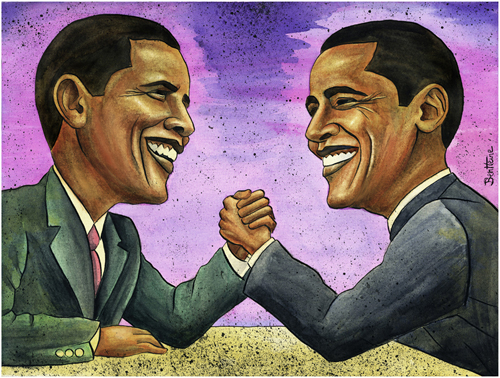
© 2009 - Ben Heine
.
Watercolor on paper...
.
Obama Works to Repair America's Image in the
World. Smiles and handshakes are a start, but
Obama's real challenge will be to show results


By Thomas Omestad

The few "Yankee Go Home" signs that greet him abroad seem almost an afterthought, and when he enters a room of world leaders, he is the most sought-after man for a photo op and a handshake. Such is the star power that has swirled around Barack Obama on his initial foreign travels as the U.S. president.

This comes as little surprise, yet it will present a challenge of sorts for the president. Obama's relative youth and vigor, his calls for reaching out to adversaries and friends overseas, his breaks from past policy, and his triumphant personal story as the nation's first African-American president all seem to make the 47-year-old leader the best single antidote to anti-Americanism in years, maybe decades. White House officials say Obama's appeal extends beyond just the leaders of the world. "What has happened is that anti-Americanism isn't cool anymore," says top Obama adviser David Axelrod.

But this initial repositioning of the American leadership brand onto more popular terrain internationally will be the easier part of Obama's task. For all the sense of fresh starts and of goodwill, the seeds of perhaps inevitable disappointments are present as well. Visiting the Czech Republic in April, Obama got a friendly warning from Vaclav Havel, the once dissident playwright and former president who led his country's Velvet Revolution. Havel cautioned that the accumulation of exaggerated expectations could turn against the new American leader. "People may end up thinking that he has betrayed them, that he has raised their hopes too far," Havel said. A smiling Obama is said to have replied that he is aware of the danger.

Still, Obama has deftly gone about trying to reset the global image of America. The guiding impulse seems to be to start reviving U.S. standing in the world quickly in the hope that policy gains will accrue later. He has ordered the future closure of the U.S. prison at Guantánamo Bay, Cuba, barred torture of terrorist suspects, and made public the Bush administration's internal memos authorizing harsh interrogation methods.

From Babel to Esperanto
.
.

Esperanto is a language introduced in 1887 by Dr. L.L. Zamenhof after years of development. He proposed Esperanto as a second language that would allow people who speak different native languages to communicate, yet at the same time retain their own languages and cultural identities. Esperanto doesn't replace anyone's language but simply serves as a common second language. Esperanto can be learned in much less time than any other language. (Some say that it is four times easier). Esperanto is politically unbiased.

Although there aren't a lot of people who speak Esperanto in any one place, there are some almost everywhere. There are over a hundred periodicals regularly published in Esperanto. There are thousands of books in Esperanto, both translated and original works. There are millions of webpages.

People who speak Esperanto are internationally minded, concerned about social justice and peace, and are helping to preserve linguistic diversity. Meetings and conventions in America, Europe, and Asia provide a fun opportunity to travel and meet new people from around the world. (Source: esperanto-usa.org)

.

Let’s Erect a New
Tower of Babel

Essay by an Information Scientist
(November 6, 1974)

.
The Tower of Babel has come to mean exactly the opposite of what it was. Babel was probably Babylon, a great metropolis where everyone spoke the same language. And at Babylon, man built the huge and towering ziggurats so beautifully pictured by Peter Breughel and others. To the writer of Genesis the technology of that great metropolis and its single language must have seemed like marvels indeed. The writer could imagine its destruction only as the result of divine wrath. How else could mankind have declined from such a lofty state?

The abandonment of the Tower of Babel and of the common language of its builders is attributed in Genesis to the wrath of an angry God. At Babel God observed that “the whole earth was of one language and one speech… and now nothing will be restrained from them which they have imagined to do... Confound their language that they may not understand one another’s speech.”

Thus, the Tower of Babel was a great technological achievement whose construction was unhampered by linguistic difficulties. There was no translation problem for those early scientists and engineers. God’s curse has left us essentially incommunicado. 1would like to suggest that mankind has suffered enough since then. We should now complete a modern Tower of Babel through the universal adoption of English as the mandatory language of science. Considering how far we have progressed in molecular biology, this suggestion may seem superfluous. But surely the potential danger to all mankind in this new technology makes English as necessary as the metric system.

Communication by speech was a ‘divine’ gift to mankind alone. The ancients knew well the irony implicit in divine gifts. It is the theme of much classic Greek drama, where the audience knows what the hero and his fellows in the play do not know--that the divine gift, whatever it happens to be in the particular play, brings with it the seed and the moment of destruction. We are accustomed to say that science knows no boundaries and no lesser allegiances than knowledge and the search for truth. But of course we should know, from reading sociologists from Marx to Merton, that the notion of science unbounded is mostly utopian foolishness. Perhaps science ideally should know no boundaries, no restrictions, but in fact it knows many. National aspiration, cultural milieu, social philosophy, economic power, political wrangling, and language are but a few.

Language may be a divine gift, but the diversity of language must surely be the tragic irony implicit in this particular divine gift. Is it overly simplistic or even stupid to suggest --like the author of Genesis-- that we would be better off as human beings, and as scientists, if we did “understand one another’s speech, ” if we could more nearly approach one another’s thought ?

Linguistic diversity is the tip of a great mental iceberg. We have been blessed and cursed not only to speak differently but to think differently because of it. Is there any doubt that thought not only shapes speech but, as Whorf suggested that language shapes thought? What is easily expressed in one language may be beyond conceptualization in another. Whether this applies to molecular biology or any other branch of modern science is easily enough appreciated if one were to imagine an attempt to translate The Double Helix into Eskimo.

I don’t believe that English is the language most suited to science because it is the best language. It is simply the language that scientists as a whole now best understand. We must goon from that fact. English is by no means a simple language. It does not have that to recommend it. Even though it can claim the grandeur of Shakespeare and the glory of the King James Bible, it also carries the stigma of having been the oral and administrative instrument of unparalleled colonial exploitation. It may not be as lucid as French, as vigorous as German, as musical as Italian, as subtle as Russian, or as tender as Spanish. I am told it is not as deceptively concrete as Chinese, nor as heart-easing as Gaelic, but it is the language now best understood by scientists. The overwhelming superiority and recommendation of its being best understood should not be underestimated. The government of India seems to agree, whatever the compromises to which the national consciousness has forced it to pay lip service.

The chauvinists of particular languages would perhaps prefer French because it was the language of Racine. Others might prefer the German of Schnitzler, or the Italian of Dante, or the Russian of Pushkin, or the Spanish of Garcia Lmca. But I do not recommend English as the lingua fianca of science because it was the language of Shakespeare. Most of the world cannot read even in their own languages works of men that have enriched their cultures.

The urge to be once again’ ‘of one language and one speech,” in and outside of science, should not be dismissed as anti-cultural. It is a powerful urge that expresses itself in many forms, such as our delight in a “silent” movie by Charlie Chaplin, or the universal embracement of the modern television broadcast. The urge has also been powerful enough to spawn numerous “artificial” languages like Volapuk, Esperanto, lnterlingua, Novial, etc. In retrospect, it may seem remarkable that people of so many nations grasped so eagerly at the ‘linguistic’ monstrosities frankensteined by idealist inventors.

Looking today, for example, at a page of Volapuk, a once popular and now ‘dead’ artificial language, one finds it hard to believe that anyone could ever have taken such a WorldSpeak (the name Volapiik meant that) seriously. But in the l9th century a great many people did. On the other hand, artificial languages have not been solely the product of amateur utopians or entrepreneurial egotists, as was often the case. Distinguished linguistic scientists like Otto Jespersen tried their hand at it as well. Some rate Jespersen’s Novial the best of the lot. The time may come when English will be universally understood. I join with Professor Steiner (1) in expressing the hope that the universality of English will be accompanied by an increasing bilingualism or trilingualism. A world of bilingual nations will be better off for its ability to share the benefits of different linguistic cultures, as well as those of technology.

(1) Steiner, G. What is an educated man now? (JZOmion) ZYmes Higher Education Supplement 11 October, 1974, p. 13

-------------------------

>>> The essay appeared on garfield.library.upenn.edu

.
Envious Rivalry

.
By Samuel Nze

I told them they would destroy my world
They would make it a hell;
They cannot say I did not tell them,
As I looked upon them from celestial heights

The country is full of mediocre ill
Of a lack of understanding;
The land is full of hate,
No one cares at all.

This old man is barking at his daughter
Saying this and that;
He is refusing to reason,
No gentlemanliness about him.

They struggle with one another
Increase the need to strive;
They complain about everything,
There is no respite.

Bickering the livelong day
These ones do not care for the truth;
They love delusion,
They give it heated chase.

It is envious rivalry they prefer
Envious rivalry they choose;
It is envious rivalry that will,
As it were satisfy them.

(The poem appeared on Poetryagainstpoverty.vox.com)

Creative Commons License
