Visite du studio de l'artiste Ben Heine qui nous parle de ses passions pour l'art graphique, le piano et la production musicale. Il réalise également une rapide démonstration de son concept "Pencil Vs Camera" pour MaTele (l'interview a été réalisée par Antoine Peret pour MaTele).
Showing posts with label discussion. Show all posts
Showing posts with label discussion. Show all posts
Rencontre avec l'artiste Ben Heine dans son studio
Visite du studio de l'artiste Ben Heine qui nous parle de ses passions pour l'art graphique, le piano et la production musicale. Il réalise également une rapide démonstration de son concept "Pencil Vs Camera" pour MaTele (l'interview a été réalisée par Antoine Peret pour MaTele).

Interview de l'Artiste Ben Heine pour Babel Cafe
L'artiste pluri-disciplinaire Ben Heine nous parle de son évolution, de ces projets créatifs, de ces expositions en cours et de sa nouvelle passion pour la musique. Interview réalisée par Nicolas Debatty pour MaTele.
Interview For Der Bildbearbeiter
 |
| Working on "Walking Lion" animation |
What education do you have? Did you study?
I have a degree in Communication/Information. I also briefly studied Painting and Sculpture in an Art School in UK. You can view a short version of my CV on LinkedIn.
I have a degree in Communication/Information. I also briefly studied Painting and Sculpture in an Art School in UK. You can view a short version of my CV on LinkedIn.
Did you learn your illustrating techniques by yourself?
Yes indeed, I learned most of the techniques I’m using on my own. I’m a self taught person in drawing and in Digital Photography (although I learned the basics of analog photography in my Journalism studies).
Yes indeed, I learned most of the techniques I’m using on my own. I’m a self taught person in drawing and in Digital Photography (although I learned the basics of analog photography in my Journalism studies).
 |
| Working on "Walking Lion" |
I use Adobe Photoshop mainly in my digital photography work and for some graphic projects. For my music projects, I use Ableton Live.
Do you still remember your very first commissioned artwork? If you do, what was it?
It was a large traditional acrylic painting featuring Buddha for an Asian restaurant in Hastings, UK. I was 18 y/o.
How would you describe your style? How did it develop through the years?
Many people tell me that my photos look like paintings. It’s because I paint and draw on them. Also, I’m mainly known for “Pencil Vs Camera”, a series mixing drawing and photography. So "mixed media" is what I'm the best at. This could be my style.
 |
| Working on "Walking Lion" |
Where do you find your themes and subjects? Where does your inspiration come from?
I find inspiration mainly by observing people around me and by living intense experiences and emotions but strangely, inspiration comes from small and insignificant events most of the time.
What would you advise our readers to do to become an illustrator like you?
I would tell them to keep working hard and try developing a concept that has never been done before. Also, I'd suggest them to think about other jobs too, haha.
When you get a request for a new illustration, how do you start? (Do you make a lot of research? Do you travel to a particular place?)
I usually receive requests by email and then I choose the collaborations I find the most interesting. In some cases, I travel to meet the clients. It helps getting better results sometimes.
I usually receive requests by email and then I choose the collaborations I find the most interesting. In some cases, I travel to meet the clients. It helps getting better results sometimes.
 |
| At Culinaria festival |
Exactly, it’s often difficult for both parties to be totally happy with the final work, so it’s important to establish the terms of collaboration from the beginning and to anticipate such conflicts.
Do you have a favorite image, which you have made yourself?
I would say this image is currently one of my favorite ones.
I would say this image is currently one of my favorite ones.
Who are your role models?
I admire people who managed to change the world in a positive way and who succeeded in bringing a bit of happiness and enjoyment in people’s life.
I admire people who managed to change the world in a positive way and who succeeded in bringing a bit of happiness and enjoyment in people’s life.
What do you do to relax?
I spend time with my family and I also like playing video games just to relax my brain between the projects I’m involved in.
(*) Der Bildbearbeiter is a magazine about art and design for professionals. It's based in Germany.
I spend time with my family and I also like playing video games just to relax my brain between the projects I’m involved in.
.jpg) |
| Printed publication and interview in Der Bildbearbeiter, 2013 |
(*) Der Bildbearbeiter is a magazine about art and design for professionals. It's based in Germany.

Please tell us how you got started and how long you have been in the business.
I started drawing and painting in the early nineties. I took my first photos during my studies in Journalism. I started sharing my works online in 2006 (first on my blog, then on Flickr, then on deviantArt and finally on 500px and some social networks). I began to make a living out of my creative works only recently through exhibitions in art galleries and art fairs, in Europe mainly.
What has been the career defining moment in your life?
Professional opportunities became serious and interesting just after I launched my Pencil Vs Camera series in 2010. This is certainly the highest creative peak in my career so far.
While most of the photographers capture the world in their images, you are much more than an image creator. How do you conceptualize such themes?
As most of the photographers do, I also “capture the world” in my normal photos, but there is another dimension in Pencil Vs Camera, which is very powerful: imagination. This series belongs to mixed media, the images in this collection mix drawing and photography, imagination and reality. I do not really spend time to “conceptualize” any of my pictures. I simply express my ideas and feelings with the mediums I have used the most these past years: photography and drawing. The idea came very naturally.
Your photographs have a strong message in them against injustice. What else do you portray through your photographs and how important is it to retain the sense of humor in your photographs?
Humor is important but it’s not my priority. I like to generate a dramatic mood in my photos. Let’s say it’s more about irony, derision and sarcasm.
How important is it for a photograph to tell a story and how do you relate to your audience?
There is a story behind each photo. Some stories are more significant than other ones. When there is a very special and unusual anecdote behind a picture, I always mention it because it’s not always obvious to the viewers. I think sharing the circumstances in which the photo was taken makes sense and gives more value to the photo itself. Definitely a photo becomes really successful when it talks by itself and when no comment or legend is needed at all.
You have made paintings, sculptures, cartoons, illustrations, portraits, caricatures, collages, photos, calligraphy, and poems. Which form of representation is the closest to you?
I think the real me is more of a painter/drawer. Some people tend to say that many of my pictures look like painting. Because this is what I like the most.
Are you a dreamer?
Yes, I totally am. I’m not sure what exactly are my dreams, my hopes or expectations, but I always try to achieve things that seem completely impossible to accomplish. I’m not afraid to take a wrong direction or to do mistakes. We all do... It’s important to keep going and give the best all the time. I wake up every morning believing I’ll manage to achieve new goals. May be I won’t, but in the end, the path counts more than the final results.
Who are some of your favourite artists and how have they influenced your work?
In my creative projects, I try not to be influenced by other artists. I definitely agree we are a "big community" of creative persons who influence each other, but I really do my best to stay away from the standards, just by following my own direction as much as I can.
Marketing and self-promotion is critical to any business and even more so for photographers. What is your take on this?
I have tried working with an agent some time ago. It didn’t work very well. I prefer to manage myself even if it is harder and even if it looks strange. It’s difficult for artists to promote themselves and to handle the different commercial and administrative aspects of their work but it's possible.
The egg or the hen question, do you take a photo first and then make your drawings or do you sketch first and then capture an image?
Most of the time I do the sketches first and then take the picture. I often need to add some small corrections to the final photo in post-production to make sure the sketch on the paper matches perfectly with the photo.
Do you have a a person reviewing and examining your photographs before you share them with the world?
No, I don’t have any person to judge or evaluate my work before I post it online. As soon as I’m finished with the production and the editing of an image, I share it online. I’m the only one to blame if I share bad stuff. But I always pay attention to the comments and feedbacks I receive from the people viewing my images.
When you move from being behind the lens, what do you enjoy most?
I love to spend time with my wife and my family. I like to walk in parks, forests or any other green environment, do sports, go out with friends and get completely wasted (this happens only a few times a year, lol)…
What do you have in store next and how different is it to your previous projects?
Right now, I’m working on something very different and maybe unexpected for people following my work. It might take a lot of time and be a total fiasco in the end but I need to give it a try. I also have a new graphic project in mind which I might start this Summer, I plan to make giant portraits with organic elements, I can’t say more so far.
What equipment and software do you make use of in your workflow?
Here is the material I currently use:
Canon EOS Mark II. Canon lens EF 70-200mm f/4L IS USM. Canon lens EF 24-105mm f/4L IS USM. Samsung NX11. Samsung lens 50-200mm f 4.0-5.6 ois. Samsung ifunction lens 20-50mm f 3.5-5.6. I work on an iMac computer, I use an Intuos Wacom tablet and my main images editing softwares are Adobe PS CS4 and Illustrator. For my traditional works, I use paper, pencils, canvas, acrylic painting, ballpoint pens…
Quick 10: (In very few words):
(*) FotoFlock is a photography magazine featuring portfolios and interviews of professional photographers, tutorials, how-to articles and product reviews. It is based in india.
I started drawing and painting in the early nineties. I took my first photos during my studies in Journalism. I started sharing my works online in 2006 (first on my blog, then on Flickr, then on deviantArt and finally on 500px and some social networks). I began to make a living out of my creative works only recently through exhibitions in art galleries and art fairs, in Europe mainly.
What has been the career defining moment in your life?
Professional opportunities became serious and interesting just after I launched my Pencil Vs Camera series in 2010. This is certainly the highest creative peak in my career so far.
While most of the photographers capture the world in their images, you are much more than an image creator. How do you conceptualize such themes?
As most of the photographers do, I also “capture the world” in my normal photos, but there is another dimension in Pencil Vs Camera, which is very powerful: imagination. This series belongs to mixed media, the images in this collection mix drawing and photography, imagination and reality. I do not really spend time to “conceptualize” any of my pictures. I simply express my ideas and feelings with the mediums I have used the most these past years: photography and drawing. The idea came very naturally.
Your photographs have a strong message in them against injustice. What else do you portray through your photographs and how important is it to retain the sense of humor in your photographs?
Humor is important but it’s not my priority. I like to generate a dramatic mood in my photos. Let’s say it’s more about irony, derision and sarcasm.
How important is it for a photograph to tell a story and how do you relate to your audience?
There is a story behind each photo. Some stories are more significant than other ones. When there is a very special and unusual anecdote behind a picture, I always mention it because it’s not always obvious to the viewers. I think sharing the circumstances in which the photo was taken makes sense and gives more value to the photo itself. Definitely a photo becomes really successful when it talks by itself and when no comment or legend is needed at all.
You have made paintings, sculptures, cartoons, illustrations, portraits, caricatures, collages, photos, calligraphy, and poems. Which form of representation is the closest to you?
I think the real me is more of a painter/drawer. Some people tend to say that many of my pictures look like painting. Because this is what I like the most.
Are you a dreamer?
Yes, I totally am. I’m not sure what exactly are my dreams, my hopes or expectations, but I always try to achieve things that seem completely impossible to accomplish. I’m not afraid to take a wrong direction or to do mistakes. We all do... It’s important to keep going and give the best all the time. I wake up every morning believing I’ll manage to achieve new goals. May be I won’t, but in the end, the path counts more than the final results.
Who are some of your favourite artists and how have they influenced your work?
In my creative projects, I try not to be influenced by other artists. I definitely agree we are a "big community" of creative persons who influence each other, but I really do my best to stay away from the standards, just by following my own direction as much as I can.
Marketing and self-promotion is critical to any business and even more so for photographers. What is your take on this?
I have tried working with an agent some time ago. It didn’t work very well. I prefer to manage myself even if it is harder and even if it looks strange. It’s difficult for artists to promote themselves and to handle the different commercial and administrative aspects of their work but it's possible.
The egg or the hen question, do you take a photo first and then make your drawings or do you sketch first and then capture an image?
Most of the time I do the sketches first and then take the picture. I often need to add some small corrections to the final photo in post-production to make sure the sketch on the paper matches perfectly with the photo.
Do you have a a person reviewing and examining your photographs before you share them with the world?
No, I don’t have any person to judge or evaluate my work before I post it online. As soon as I’m finished with the production and the editing of an image, I share it online. I’m the only one to blame if I share bad stuff. But I always pay attention to the comments and feedbacks I receive from the people viewing my images.
When you move from being behind the lens, what do you enjoy most?
I love to spend time with my wife and my family. I like to walk in parks, forests or any other green environment, do sports, go out with friends and get completely wasted (this happens only a few times a year, lol)…
What do you have in store next and how different is it to your previous projects?
Right now, I’m working on something very different and maybe unexpected for people following my work. It might take a lot of time and be a total fiasco in the end but I need to give it a try. I also have a new graphic project in mind which I might start this Summer, I plan to make giant portraits with organic elements, I can’t say more so far.
What equipment and software do you make use of in your workflow?
Here is the material I currently use:
Canon EOS Mark II. Canon lens EF 70-200mm f/4L IS USM. Canon lens EF 24-105mm f/4L IS USM. Samsung NX11. Samsung lens 50-200mm f 4.0-5.6 ois. Samsung ifunction lens 20-50mm f 3.5-5.6. I work on an iMac computer, I use an Intuos Wacom tablet and my main images editing softwares are Adobe PS CS4 and Illustrator. For my traditional works, I use paper, pencils, canvas, acrylic painting, ballpoint pens…
Quick 10: (In very few words):
• Something you’re still learning: Electronic music
• Five adjectives that describe you well: Determined, hopeful, positive,
hard worker, unpredictable
• Favourite printer: ZPrinter 650 (3D printer)
• Favourite shoot: Recent shooting for “Tour the France Photo”
• Favourite cartoon: Dragon Ball Z
• Favourite photographer: Christophe Gilbert
• Current photographers you like: Gilad Benary, Anne Geddes…
• Most memorable story: My Flesh and Acrylic shootings
• Pencil or camera? : Pencil ☺
• Toughest day at work: Everyday
• Five adjectives that describe you well: Determined, hopeful, positive,
hard worker, unpredictable
• Favourite printer: ZPrinter 650 (3D printer)
• Favourite shoot: Recent shooting for “Tour the France Photo”
• Favourite cartoon: Dragon Ball Z
• Favourite photographer: Christophe Gilbert
• Current photographers you like: Gilad Benary, Anne Geddes…
• Most memorable story: My Flesh and Acrylic shootings
• Pencil or camera? : Pencil ☺
• Toughest day at work: Everyday
(*) FotoFlock is a photography magazine featuring portfolios and interviews of professional photographers, tutorials, how-to articles and product reviews. It is based in india.

Tell us about your childhood, family and friends.
I was born in Ivory Coast in 1983, I lived there 7 years along with my parents and 3 sisters. We all moved to Brussels, Belgium in 1990. My father was a commercial engineer; my mother is a Modern jazz dance teacher. My little sister became a lawyer, one of my older sisters became a psychologist and the other one a political scientist.
Can you share with us some moments of your life that you can’t forget?
All my travels abroad and some specific shootings such as my “Flesh and Acrylic” projects which are very particular and spectacular.
When did you start taking photographs?
During my studies in Journalism (around 2005). I first started taking press photos and then I became more interested in conceptual and artistic pictures.
What was the first photo you took?
The first artistic shooting I made was the portrait of a bodybuilder near the place where I lived at that time. I made several collages based on the photos of this man. These works are part of my early experimental sketchbooks. I should share them online soon but it’s not yet time to show them.
What was your very first camera?
It was one of these old Canon analog cameras. They look like dinosaurs now.
Do you remember your first love story?
My first love… woaw, I remember very well. It was a platonic and spiritual relationship with a girl when I was a teenager. I was really a romantic and diplomatic guy, I should have been more explicit about my feelings. Things have changed now; I’m not the same.
Who are the people that influenced you in your life?
Many professors, my parents, some extraordinary persons who took part in important events in History. Also, more simply, the people following my work. Each time I get a message or an email from one of them, it always stimulates me and gives me fresh ideas.
What is the kind of photography and art you like?
I like surrealism and I also like simplicity. I like clean pictures, possibly with no dust, bugs or strange elements.
Does the Internet have an impact on your work?
Social networks and online artists platforms such as deviantART and Flickr have helped me a lot to "spread" my creative works. I use them for this purpose mainly and also to meet amazing people. Our generation of artists (and younger ones even more) uses a lot the Internet to get recognition. That’s how it works nowadays if you’re not the son of a super famous person.
Are you happy?
I’m happy to be alive. Each morning when I wake up, I’m realizing that I’m lucky to be healthy and that I’m able to do what I like.
What is the best place in the world for you?
I would say an isolated house in the middle of a forest in a warm country.
What is the most important principle of life for you?
Respect for others.
What are your current dreams?
I am always hopeful that tomorrow will be a better day for all of us. I hope that there will be less injustice and discrimination in the world. I’m too small and don’t have enough power to change things but I do what I can in my own field to bring joy and surprise for the people who follow my work.
What about your future?
I have many projects in stock. Too many may be. I’m not sure I will be able to manage everything in a lifetime. I have to fix my priorities and make sure to know where are my real goals.
What tips can you share for young photographers from a famous photographer?
If you don’t have enough ideas or inspiration, go visit exhibitions, talk with interesting people, keep shooting as much as you can. It’s not the software, the computer or even the camera you use that will make your photos look good, it’s only your point of view, your originality and the quantity of work spent behind each image that will give some value to your work.
What is your favorite quote?
“Give a man a mask and he will tell you the truth” (Oscar Wilde)
(*) iFamous is an online interactive magazine talking about cultural news and lifestyle. iFamous headquarters are based in Russia.
I was born in Ivory Coast in 1983, I lived there 7 years along with my parents and 3 sisters. We all moved to Brussels, Belgium in 1990. My father was a commercial engineer; my mother is a Modern jazz dance teacher. My little sister became a lawyer, one of my older sisters became a psychologist and the other one a political scientist.
Can you share with us some moments of your life that you can’t forget?
All my travels abroad and some specific shootings such as my “Flesh and Acrylic” projects which are very particular and spectacular.
When did you start taking photographs?
During my studies in Journalism (around 2005). I first started taking press photos and then I became more interested in conceptual and artistic pictures.
What was the first photo you took?
The first artistic shooting I made was the portrait of a bodybuilder near the place where I lived at that time. I made several collages based on the photos of this man. These works are part of my early experimental sketchbooks. I should share them online soon but it’s not yet time to show them.
What was your very first camera?
It was one of these old Canon analog cameras. They look like dinosaurs now.
Do you remember your first love story?
My first love… woaw, I remember very well. It was a platonic and spiritual relationship with a girl when I was a teenager. I was really a romantic and diplomatic guy, I should have been more explicit about my feelings. Things have changed now; I’m not the same.
Who are the people that influenced you in your life?
Many professors, my parents, some extraordinary persons who took part in important events in History. Also, more simply, the people following my work. Each time I get a message or an email from one of them, it always stimulates me and gives me fresh ideas.
What is the kind of photography and art you like?
I like surrealism and I also like simplicity. I like clean pictures, possibly with no dust, bugs or strange elements.
Does the Internet have an impact on your work?
Social networks and online artists platforms such as deviantART and Flickr have helped me a lot to "spread" my creative works. I use them for this purpose mainly and also to meet amazing people. Our generation of artists (and younger ones even more) uses a lot the Internet to get recognition. That’s how it works nowadays if you’re not the son of a super famous person.
Are you happy?
I’m happy to be alive. Each morning when I wake up, I’m realizing that I’m lucky to be healthy and that I’m able to do what I like.
What is the best place in the world for you?
I would say an isolated house in the middle of a forest in a warm country.
What is the most important principle of life for you?
Respect for others.
What are your current dreams?
I am always hopeful that tomorrow will be a better day for all of us. I hope that there will be less injustice and discrimination in the world. I’m too small and don’t have enough power to change things but I do what I can in my own field to bring joy and surprise for the people who follow my work.
What about your future?
I have many projects in stock. Too many may be. I’m not sure I will be able to manage everything in a lifetime. I have to fix my priorities and make sure to know where are my real goals.
What tips can you share for young photographers from a famous photographer?
If you don’t have enough ideas or inspiration, go visit exhibitions, talk with interesting people, keep shooting as much as you can. It’s not the software, the computer or even the camera you use that will make your photos look good, it’s only your point of view, your originality and the quantity of work spent behind each image that will give some value to your work.
What is your favorite quote?
“Give a man a mask and he will tell you the truth” (Oscar Wilde)
(*) iFamous is an online interactive magazine talking about cultural news and lifestyle. iFamous headquarters are based in Russia.
.
 Shooting of a Pencil Vs Camera image (more pics below)
Votre Art: How long have you been an artist?
Ben Heine: When I was 11 year old or so, there was a shift in my personality and habits. I started spending all my free time on my projects. I was somehow learning on my own and trying different graphic experimentations. This new passion somehow damaged my social life at that time but I don’t regret anything, I wouldn’t be where I am if I hadn’t decided to do this.
 Is being an artist a full-time career for you?
Yes, it is. I’m working on my artistic projects from very early in the morning till late in the evening. It is a full time investment. Since 2 years, I’m finally able to make a living out of my artistic work. It is nice to be able to do what I like but it’s hard everyday and it involves many sacrifices, which is may be the downside.
 Tell me about your work? What are you currently working on? How is this different from past projects?
I’m currently working on some new “Pencil Vs Camera” works with colored drawings instead of black and white sketches. It’s a richer and more complex approach. I’m collaborating since a few weeks only with an advertising agency in Bucharest, Romania. I’m also working on some electronic musical compositions, but that’s more as a hobby.
 What was your inspiration?
Many teachers have inspired me in a great way when I was a student. Nowadays, I find inspiration in my daily life, in every new person I meet, in nature, in cities I travel to, in music I listen to, in movies I watch... All this gives me good insight and stimulates my imagination.
"What is Art?" is certainly too big of a question to ask here, but what do you hope your audience takes away from your art? What statement do you hope to make?
I think Art should surprise and inspire people. It should be the reflection of the society we live in or a reflection of how society will be in the future.
 What was the best advice given to you as an artist?
Everybody can be part of History.
Tell me about your workspace and your creative process.
Wow, my workspace... There are 2 workspaces actually; my desk and computers place where I do my digital stuff (and from where I’m writing right now) and my studio in the countryside where I do all my traditional works. Both are quite messy and completely crazy to look at. I’d never show them in detail I guess.
My creative process... I need to experience intense, emotional and powerful events in my life first to find inspiration and creative stimulations. When I have some nice ideas in mind, I need to know how exactly I’m going to express them, which medium I’m going to use etc. When this is chosen, I spend days or weeks developing them. And then there is the final part, may be the most important one: share and spread the final projects with the public and the press to receive criticisms and reviews.
What has been the biggest challenge in the work you create?
Every new project is a big challenge, but I would say Pencil Vs Camera is becoming more and more complex graphically speaking, so this is more challenging and time consuming for me. I noticed that the more time spent on a project the best it becomes. It’s easy to understand why.
 Where do you go online for good art resources, whether to find a new artist, or to see what is going on in the art world?
DeviantArt and Flickr mainly. There are thousands of good people there already.
Do you have any exhibits to promote?
There might be a new solo exhibition with my limited edition prints at “The Avenue” in London via The Art Movement, early May. It’s not confirmed yet.
 (*) Votre Art is social platform for artists, art lovers, collectors & galleries interested in Painting, Graphic Design, Illustration, Digital Art, Photography, Sculpture and Drawing. I was interviewed by Fiman Prayudi Utama and this interview was published on Votre Art blog in March 2012.
Ben Heine: When I was 11 year old or so, there was a shift in my personality and habits. I started spending all my free time on my projects. I was somehow learning on my own and trying different graphic experimentations. This new passion somehow damaged my social life at that time but I don’t regret anything, I wouldn’t be where I am if I hadn’t decided to do this.
 Is being an artist a full-time career for you?
Yes, it is. I’m working on my artistic projects from very early in the morning till late in the evening. It is a full time investment. Since 2 years, I’m finally able to make a living out of my artistic work. It is nice to be able to do what I like but it’s hard everyday and it involves many sacrifices, which is may be the downside.
 Tell me about your work? What are you currently working on? How is this different from past projects?
I’m currently working on some new “Pencil Vs Camera” works with colored drawings instead of black and white sketches. It’s a richer and more complex approach. I’m collaborating since a few weeks only with an advertising agency in Bucharest, Romania. I’m also working on some electronic musical compositions, but that’s more as a hobby.
 What was your inspiration?
Many teachers have inspired me in a great way when I was a student. Nowadays, I find inspiration in my daily life, in every new person I meet, in nature, in cities I travel to, in music I listen to, in movies I watch... All this gives me good insight and stimulates my imagination.
"What is Art?" is certainly too big of a question to ask here, but what do you hope your audience takes away from your art? What statement do you hope to make?
I think Art should surprise and inspire people. It should be the reflection of the society we live in or a reflection of how society will be in the future.
 What was the best advice given to you as an artist?
 Everybody can be part of History.
Tell me about your workspace and your creative process.
Wow, my workspace... There are 2 workspaces actually; my desk and computers place where I do my digital stuff (and from where I’m writing right now) and my studio in the countryside where I do all my traditional works. Both are quite messy and completely crazy to look at. I’d never show them in detail I guess.
My creative process... I need to experience intense, emotional and powerful events in my life first to find inspiration and creative stimulations. When I have some nice ideas in mind, I need to know how exactly I’m going to express them, which medium I’m going to use etc. When this is chosen, I spend days or weeks developing them. And then there is the final part, may be the most important one: share and spread the final projects with the public and the press to receive criticisms and reviews.

What has been the biggest challenge in the work you create?
Every new project is a big challenge, but I would say Pencil Vs Camera is becoming more and more complex graphically speaking, so this is more challenging and time consuming for me. I noticed that the more time spent on a project the best it becomes. It’s easy to understand why.
 Where do you go online for good art resources, whether to find a new artist, or to see what is going on in the art world?
DeviantArt and Flickr mainly. There are thousands of good people there already.
Do you have any exhibits to promote?
There might be a new solo exhibition with my limited edition prints at “The Avenue” in London via The Art Movement, early May. It’s not confirmed yet.
 (*) Votre Art is social platform for artists, art lovers, collectors & galleries interested in Painting, Graphic Design, Illustration, Digital Art, Photography, Sculpture and Drawing. I was interviewed by Fiman Prayudi Utama and this interview was published on Votre Art blog in March 2012.
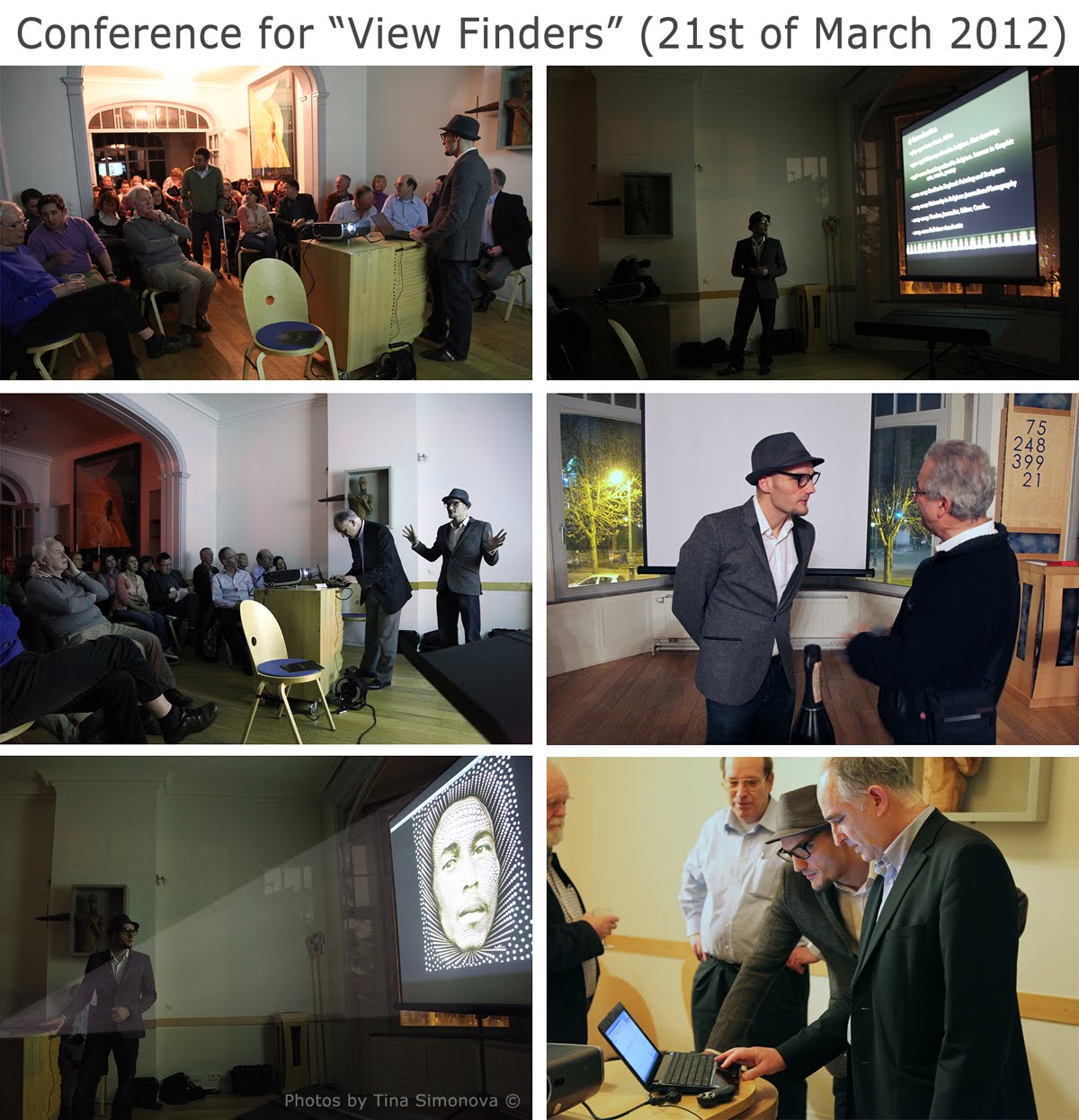
 At the Sagrada Família, Barcelona, Spain, Feb 2012
K. M. Rehan Salahuddin: Everybody around the world knows who is Benjamin Heine, but would you please introduce yourself to your fans and readers of our website?
Ben Heine: Thank you. I’ll try to be short for the introduction. I’m a Belgian visual artist, I’ve started drawing when I was a child, I went on with traditional and digital painting when I was a teenager and I started photography a couple of years after. I never stopped producing graphic art. I have a degree in Journalism and I briefly studied History of Art, Painting and Sculpture as well but I’m mainly a self-taught person in Drawing and Photography.
I’ve launched a creative series in 2010 called “Pencil Vs Camera”, it’s somehow a new and powerful form of expression that mixes drawing and photography, imagination and reality. I’m also known for 2 other creative series started in 2010 and 2011: “Digital Circlism” and “Flesh and Acrylic”.
My photos have been published in newspapers, magazines and websites all over the world and I started exhibiting limited edition prints (Diasec finishing) of my creations in well-known galleries and art fairs in different European countries since 2010.
I’m not sure what I’m going to do next, I’m still searching and working hard everyday to do more innovative and powerful art, I’m in a constant evolution and development in my new artistic projects, I’m never satisfied and I try to take fresh directions most of the time. Although my series may look different, there is always a connection between all the images I share.
Why have you chosen this profession? In this world nowadays people are all running behind glory and money, but you have made yourself very unique, would you please tell us the story of your early days?
I would say “the profession chose me”. But you’re so right, we live in a very competitive world. There are so many corrupted people in our current system. But is it really their fault? From a very early age, we’re told to be merciless and ready for action and good results. This is not easy for many artists to be different and unique and to find their place in such an aggressive global structure.
But I think everybody can do it with hard work and determination. We need to be aware of the system’s failures and we need to do our best to improve every angle of the world, as much as we can. We need more solidarity and more love. Finally, there is also a bit of chance and unexpected events happening in someone’s life. It is fortunately or unfortunately impossible to plan everything in advance.
You have a degree in Journalism, how do you connect journalism with drawing and cartoons?
I really liked Journalism, I know how important it is for artists to have their works published and promoted in newspapers. Creators need journalists to talk about their work and journalists also need creative minds to have something funny and original to talk about in their paper. Although I barely worked as a journalist after my degree, my journalistic academic background helped me a lot to get in touch more easily with the media, because my brain works like a journalist’s brain, I’m one of them somehow. In some cases, I’m the journalist and the artist at the same time, which is strange. I’m trying now to focus on my visual projects exclusively. I feel more confident and I prefer it this way.
Would you please tell us about "The Limits of Freedom of Speech in Political Cartoons", the final thesis paper that you have written at the end of your studies?
I see you are well informed. This is a sensitive subject. For your information, I’m no longer doing political work since 2009, I’m no longer doing "cartoons" neither.
I think every artist needs some freedom and space to express their ideas and thoughts. Provocation can be useful to shake people’s mind, but we are not allowed to offend anybody’s feelings or personal convictions. A clever image shouldn’t harm, accuse or take anybody’s side, it should rather make everybody think in an objective and neutral way. This doesn’t mean we can’t have an opinion, it just means that we need to be careful and think twice before doing or saying something. My freedom ends where your freedom begins.
How do you react when you see a lot of terrorism and corruption around the world? Do you have any plan to do any set/series of creative artworks on this topic?
No, I really don’t want to get involved in this. Terrorism belongs to the political sphere, not to the artistic one. All I can say is that I condemn any kind of terrorism. I just really hope all the innocent victims of terrorism won’t have died in vain and that they will be remembered forever.
"Pencil Vs Camera" how did you come up with this idea? Do you want to restrict other artists from doing similar things by owning the creative copyrights of this concept?
Good question... This concept is the fusion of two disciplines I’ve practiced since many years. It came very naturally and legitimately. I’m honored and happy to notice it’s becoming a new form of expression for many artists. I just don’t want people to “steal” this powerful and eye-catching “invention” I initiated and popularized without being credited. To be honest, I’m a bit mad when big companies use “Pencil Vs Camera” images for commercial purposes without even telling me. This is not fair. I understand Pencil Vs Camera has become universal and popular. It’s hard to keep control over it. But I wish I could be part of every new turn this concept is taking. People need to remember every image of this series is copyrighted and the name “Pencil Vs Camera” is trademarked.
Ben Heine is a cartoonist, an artist, a photographer and a lot more. In your heart, who are you? Who do you want to be?
I don’t see myself as a cartoonist anymore, I’m more of an “illustrator”; I try to illustrate every step of my life in a surreal and timeless way, with simple tools (camera, pencils, brushes…). To be honest I might do something a bit different soon. I’ll be a "creative and productive" person all my life, but I’ll never hesitate to take atypical and unexpected directions when I’ll need it. Surprise is always nice.
(*) Interview by K M Rehan Salahuddin. It was first published on sortoflife.com in February 2012. Sort of Life™ is a website about art, design and lifestyle.
Ben Heine: Thank you. I’ll try to be short for the introduction. I’m a Belgian visual artist, I’ve started drawing when I was a child, I went on with traditional and digital painting when I was a teenager and I started photography a couple of years after. I never stopped producing graphic art. I have a degree in Journalism and I briefly studied History of Art, Painting and Sculpture as well but I’m mainly a self-taught person in Drawing and Photography.
I’ve launched a creative series in 2010 called “Pencil Vs Camera”, it’s somehow a new and powerful form of expression that mixes drawing and photography, imagination and reality. I’m also known for 2 other creative series started in 2010 and 2011: “Digital Circlism” and “Flesh and Acrylic”.
My photos have been published in newspapers, magazines and websites all over the world and I started exhibiting limited edition prints (Diasec finishing) of my creations in well-known galleries and art fairs in different European countries since 2010.
I’m not sure what I’m going to do next, I’m still searching and working hard everyday to do more innovative and powerful art, I’m in a constant evolution and development in my new artistic projects, I’m never satisfied and I try to take fresh directions most of the time. Although my series may look different, there is always a connection between all the images I share.
Why have you chosen this profession? In this world nowadays people are all running behind glory and money, but you have made yourself very unique, would you please tell us the story of your early days?
I would say “the profession chose me”. But you’re so right, we live in a very competitive world. There are so many corrupted people in our current system. But is it really their fault? From a very early age, we’re told to be merciless and ready for action and good results. This is not easy for many artists to be different and unique and to find their place in such an aggressive global structure.
But I think everybody can do it with hard work and determination. We need to be aware of the system’s failures and we need to do our best to improve every angle of the world, as much as we can. We need more solidarity and more love. Finally, there is also a bit of chance and unexpected events happening in someone’s life. It is fortunately or unfortunately impossible to plan everything in advance.
You have a degree in Journalism, how do you connect journalism with drawing and cartoons?
I really liked Journalism, I know how important it is for artists to have their works published and promoted in newspapers. Creators need journalists to talk about their work and journalists also need creative minds to have something funny and original to talk about in their paper. Although I barely worked as a journalist after my degree, my journalistic academic background helped me a lot to get in touch more easily with the media, because my brain works like a journalist’s brain, I’m one of them somehow. In some cases, I’m the journalist and the artist at the same time, which is strange. I’m trying now to focus on my visual projects exclusively. I feel more confident and I prefer it this way.
Would you please tell us about "The Limits of Freedom of Speech in Political Cartoons", the final thesis paper that you have written at the end of your studies?
I see you are well informed. This is a sensitive subject. For your information, I’m no longer doing political work since 2009, I’m no longer doing "cartoons" neither.
I think every artist needs some freedom and space to express their ideas and thoughts. Provocation can be useful to shake people’s mind, but we are not allowed to offend anybody’s feelings or personal convictions. A clever image shouldn’t harm, accuse or take anybody’s side, it should rather make everybody think in an objective and neutral way. This doesn’t mean we can’t have an opinion, it just means that we need to be careful and think twice before doing or saying something. My freedom ends where your freedom begins.
How do you react when you see a lot of terrorism and corruption around the world? Do you have any plan to do any set/series of creative artworks on this topic?
No, I really don’t want to get involved in this. Terrorism belongs to the political sphere, not to the artistic one. All I can say is that I condemn any kind of terrorism. I just really hope all the innocent victims of terrorism won’t have died in vain and that they will be remembered forever.
"Pencil Vs Camera" how did you come up with this idea? Do you want to restrict other artists from doing similar things by owning the creative copyrights of this concept?
Good question... This concept is the fusion of two disciplines I’ve practiced since many years. It came very naturally and legitimately. I’m honored and happy to notice it’s becoming a new form of expression for many artists. I just don’t want people to “steal” this powerful and eye-catching “invention” I initiated and popularized without being credited. To be honest, I’m a bit mad when big companies use “Pencil Vs Camera” images for commercial purposes without even telling me. This is not fair. I understand Pencil Vs Camera has become universal and popular. It’s hard to keep control over it. But I wish I could be part of every new turn this concept is taking. People need to remember every image of this series is copyrighted and the name “Pencil Vs Camera” is trademarked.
Ben Heine is a cartoonist, an artist, a photographer and a lot more. In your heart, who are you? Who do you want to be?
I don’t see myself as a cartoonist anymore, I’m more of an “illustrator”; I try to illustrate every step of my life in a surreal and timeless way, with simple tools (camera, pencils, brushes…). To be honest I might do something a bit different soon. I’ll be a "creative and productive" person all my life, but I’ll never hesitate to take atypical and unexpected directions when I’ll need it. Surprise is always nice.
(*) Interview by K M Rehan Salahuddin. It was first published on sortoflife.com in February 2012. Sort of Life™ is a website about art, design and lifestyle.
.

An interview I gave for Embrosyst (a visual communications e-magazine based in Indonesia). The interview was published in the issue 9 (October 2011)
 Ben by Glenn Ferguson
.
Artists Inspire Artists is all about inspiration, so tell us what inspires you?
Everything around me is a source of creativity. Every smallest event in my life is a big inspiration. For instance random people I meet in the street or the tiniest details I see on a wall… I often spend hours observing things, like unknown people next to me when I’m in a restaurant, trying to foresee what they will say or do. Traveling abroad, going to a museum, watching a movie, reading a book, talking with a beautiful lady, discovering new ways of thinking or new cultures are also sources of inspiration.
Something I've been trying to figure out for a while now, is how exactly do you do your Pencil Vs Camera drawings?
There are several methods. The concept is fairly simple: mix a photo and a drawing, reality and imagination. I sometimes use traditional tools to achieve this and in other cases, I use digital tools. The result is always the same and the drawing is always handmade. The most important is to find nice and original ideas. Traveling inside your own imagination is something really exciting.
Your drawings are very unique, and I haven't seen anyone who does similar work, so how did you come up with this concept?
I’ve been drawing and taking photos since many years, I’ve been struggling to combine these 2 disciplines in single images. When I found how I would do this, Pencil Vs Camera was born.
How long have you been drawing? And were you self-taught or did you take classes?
Yes, I’m mainly a self-taught person in drawing. I started making interesting drawings at 11 yo. I have a degree in Journalism and studied some bits of painting and sculpture in England.
Like most creative people, would you say you "live in your own little world" and you’re constantly thinking about drawing/ design, etc?
Oh, yes, almost everything I do in my life is based on my creative projects. It’s more than a passion, it’s a way of living. I spend the rest of my time with the persons I love.
Have you ever used your amazing drawing skills to pick up the ladies? Like Shia LaBeouf in Eagle Eye. Do a sketch of her on the subway so you have an excuse to talk, haha.
It happened a few times :)
How about I give you three words, lets say, Spiderman, Yoga Instructor, and Bob Barker, could you come up with a drawing?
Crazy combination, I would maybe make a drawing showing the old Bob Barker having yoga class with his personal instructor at a top of a skyscraper, enjoying a beautiful panorama while doing some well needed stretching, Spiderman would suddenly fall from the sky and start to show them what yoga really means…
Is there any advice you would give to a young aspiring artist?
Never give it up! Some people will always be criticizing your work, take their criticisms as lessons to improve yourself. Don't escape from problems, many other people will be there to encourage and support you. Find them. Life is love, energy and inspiration. Believe in what you do. Good luck and I wish you all the best.
Everything around me is a source of creativity. Every smallest event in my life is a big inspiration. For instance random people I meet in the street or the tiniest details I see on a wall… I often spend hours observing things, like unknown people next to me when I’m in a restaurant, trying to foresee what they will say or do. Traveling abroad, going to a museum, watching a movie, reading a book, talking with a beautiful lady, discovering new ways of thinking or new cultures are also sources of inspiration.
Something I've been trying to figure out for a while now, is how exactly do you do your Pencil Vs Camera drawings?
There are several methods. The concept is fairly simple: mix a photo and a drawing, reality and imagination. I sometimes use traditional tools to achieve this and in other cases, I use digital tools. The result is always the same and the drawing is always handmade. The most important is to find nice and original ideas. Traveling inside your own imagination is something really exciting.
Your drawings are very unique, and I haven't seen anyone who does similar work, so how did you come up with this concept?
I’ve been drawing and taking photos since many years, I’ve been struggling to combine these 2 disciplines in single images. When I found how I would do this, Pencil Vs Camera was born.
How long have you been drawing? And were you self-taught or did you take classes?
Yes, I’m mainly a self-taught person in drawing. I started making interesting drawings at 11 yo. I have a degree in Journalism and studied some bits of painting and sculpture in England.
Like most creative people, would you say you "live in your own little world" and you’re constantly thinking about drawing/ design, etc?
Oh, yes, almost everything I do in my life is based on my creative projects. It’s more than a passion, it’s a way of living. I spend the rest of my time with the persons I love.
Have you ever used your amazing drawing skills to pick up the ladies? Like Shia LaBeouf in Eagle Eye. Do a sketch of her on the subway so you have an excuse to talk, haha.
It happened a few times :)
How about I give you three words, lets say, Spiderman, Yoga Instructor, and Bob Barker, could you come up with a drawing?
Crazy combination, I would maybe make a drawing showing the old Bob Barker having yoga class with his personal instructor at a top of a skyscraper, enjoying a beautiful panorama while doing some well needed stretching, Spiderman would suddenly fall from the sky and start to show them what yoga really means…
Is there any advice you would give to a young aspiring artist?
Never give it up! Some people will always be criticizing your work, take their criticisms as lessons to improve yourself. Don't escape from problems, many other people will be there to encourage and support you. Find them. Life is love, energy and inspiration. Believe in what you do. Good luck and I wish you all the best.
(*) Artists Inspire Artists is a blog owned by Mackenzie Child intending to share articles about art and design.
.
 Ben by Mosen
.
 Ben by Mosen
.
You were born in Ivory Coast but live in Belgium. Tell us more about your family and career. How did you start to work in Brussels?
My family is originally from Brussels, Belgium. My parents traveled to Ivory Coast from 1980 to 1990, mainly for professional reasons. I lived there 7 years as a child. We all came back to Brussels in 1990. I’ve been living, studying and working in Belgium since then. I briefly studied painting and sculpture in Hastings, England and I also studied Journalism in Brussels and in Utrecht (The Netherlands). I made all kinds of jobs as an employee before managing to make a living out of my art projects. I intend to move abroad permanently as soon as there will be an interesting opportunity. Who knows what will come next.
You are both a photographer and a cartoonist and your project Pencil Vs Camera became very popular. How did you come up with the idea to combine both arts in it?
The original idea came quite naturally. I’ve been drawing and taking photos since a long time. I aimed to mix 2 of my passions in a very crazy and new way. Pencil Vs Camera was born.
If you have to choose between a camera or a pencil – what would be your choice?
I think I would opt for the pencil. I really like traditional art especially drawing on paper, you don’t need anything else than a pencil and a piece of paper, which are some of the most simple, accessible and creative tools, and you can express everything you want with them.
Are there different ways to make such an image?
Yes, several methods can be used to make “Pencil Vs Camera” images. There are traditional and digital techniques. But the result is always the same. The concept is really easy to understand: mix drawing and photography. The most important is to find nice and original ideas. Traveling inside your own imagination is something really exciting.
Do you have a favorite image among all of them?
My latest project is always my favorite one. When I’m finished with a new work, I usually forget it very quickly, I’m only thinking about the next one…
You are also a Samsung imageloger. We saw an interesting 360 degrees panorama of Cologne. How did you start working with the brand and what are your projects with it?
Samsung Imaging sent me an email one year ago; they wanted to start a partnership and sponsorship. The material they sent me is very nice and powerful. It’s some very amazing gear. I try to make the best use of it. If all goes well, we will expand our collaboration and build sponsored events and exhibitions around the world.
Your project Digital Circlism portraits different persons - from Marilyn Monroe and Elvis Presley to Lady Gaga and Eminem. How do you choose the persons to portray?
I usually make portraits of persons I really admire and find exceptional not especially for their work but mostly for their personality and unique vision of the world.
Tell us more about your digital circlist technique. Do you know exactly how many circles there are in the images you create?
That’s a very good question. I usually don’t count the circles... They are too many of them in every portrait, may be several thousands for each image, but that’s only an approximation, it might be even more for some works.
How long does it take you to create one image? Which one was the most difficult?
Digital Circlism is a very time consuming, challenging and technical way of making portraits; it can take between 100 and 180 hours of work for one single picture. The first steps of the creation process are very important and require application and concentration: find references, create a montage, make a digital painting and finally apply flat circles one by one. In the final steps, I often work like a robot, listening to music and radio podcasts, so that my eyes can stay focused on the image. I always try to put a lot of work and energy in each project.
Why did you choose to work with circles (not with squares for example)?
The circle is a simple, magic and very aesthetically pleasing shape.
What do you know about Bulgaria? Have you ever been here?
Although I’ve never been to Bulgaria yet, I know it’s one of the rising European countries with a huge cultural heritage. Bulgarian way of life was influenced by various nations but it has managed to preserve its national character (a bit like here in Belgium). I hope I’ll have the opportunity to exhibit my creations there soon and to discover Bulgarian traditions!
What would you wish to our readers?
Happiness, success, health and luck!
My family is originally from Brussels, Belgium. My parents traveled to Ivory Coast from 1980 to 1990, mainly for professional reasons. I lived there 7 years as a child. We all came back to Brussels in 1990. I’ve been living, studying and working in Belgium since then. I briefly studied painting and sculpture in Hastings, England and I also studied Journalism in Brussels and in Utrecht (The Netherlands). I made all kinds of jobs as an employee before managing to make a living out of my art projects. I intend to move abroad permanently as soon as there will be an interesting opportunity. Who knows what will come next.
You are both a photographer and a cartoonist and your project Pencil Vs Camera became very popular. How did you come up with the idea to combine both arts in it?
The original idea came quite naturally. I’ve been drawing and taking photos since a long time. I aimed to mix 2 of my passions in a very crazy and new way. Pencil Vs Camera was born.
If you have to choose between a camera or a pencil – what would be your choice?
I think I would opt for the pencil. I really like traditional art especially drawing on paper, you don’t need anything else than a pencil and a piece of paper, which are some of the most simple, accessible and creative tools, and you can express everything you want with them.
Are there different ways to make such an image?
Yes, several methods can be used to make “Pencil Vs Camera” images. There are traditional and digital techniques. But the result is always the same. The concept is really easy to understand: mix drawing and photography. The most important is to find nice and original ideas. Traveling inside your own imagination is something really exciting.
Do you have a favorite image among all of them?
My latest project is always my favorite one. When I’m finished with a new work, I usually forget it very quickly, I’m only thinking about the next one…
You are also a Samsung imageloger. We saw an interesting 360 degrees panorama of Cologne. How did you start working with the brand and what are your projects with it?
Samsung Imaging sent me an email one year ago; they wanted to start a partnership and sponsorship. The material they sent me is very nice and powerful. It’s some very amazing gear. I try to make the best use of it. If all goes well, we will expand our collaboration and build sponsored events and exhibitions around the world.
Your project Digital Circlism portraits different persons - from Marilyn Monroe and Elvis Presley to Lady Gaga and Eminem. How do you choose the persons to portray?
I usually make portraits of persons I really admire and find exceptional not especially for their work but mostly for their personality and unique vision of the world.
Tell us more about your digital circlist technique. Do you know exactly how many circles there are in the images you create?
That’s a very good question. I usually don’t count the circles... They are too many of them in every portrait, may be several thousands for each image, but that’s only an approximation, it might be even more for some works.
How long does it take you to create one image? Which one was the most difficult?
Digital Circlism is a very time consuming, challenging and technical way of making portraits; it can take between 100 and 180 hours of work for one single picture. The first steps of the creation process are very important and require application and concentration: find references, create a montage, make a digital painting and finally apply flat circles one by one. In the final steps, I often work like a robot, listening to music and radio podcasts, so that my eyes can stay focused on the image. I always try to put a lot of work and energy in each project.
Why did you choose to work with circles (not with squares for example)?
The circle is a simple, magic and very aesthetically pleasing shape.
What do you know about Bulgaria? Have you ever been here?
Although I’ve never been to Bulgaria yet, I know it’s one of the rising European countries with a huge cultural heritage. Bulgarian way of life was influenced by various nations but it has managed to preserve its national character (a bit like here in Belgium). I hope I’ll have the opportunity to exhibit my creations there soon and to discover Bulgarian traditions!
What would you wish to our readers?
Happiness, success, health and luck!
(*) Rouge is a monthly fashion and lifestyle magazine based in Bulgaria.
.
Rouge Magazine - Bulgaria (2011)


Since you appear to be a one million-talent man, we have to ask: do you cook; do you play an instrument and can you knit? Just for our female audience. J
Haha, unfortunately I don't knit, I cook from time to time. I love music, I used to play many instruments when I was a teenager: piano, guitar and drums. I would have become a musician for sure if I weren’t a visual artist.
To set the right mood, what kind of music do you listen to? Favorites?
I like all sorts of music: rock, reggae, electro… I must say I have been listening to loads of modern electronic sounds recently, it really helps me being focused on my projects and keeping a good rhythm and energy while working.
How does a potential journalist mutate into a digital artist, combining design, photography and illustration? Bad pedagogical approach and counseling or just creative stumbles upon the way?
I would say it was a wrong direction I took when I was younger. I candidly believed I would be able to manage 2 full time activities, one as a journalist during the day and the other as an artist during the night. After trying a few jobs as a journalist, I realized it would be impossible to live like that, my interest for visual arts was always there and I couldn’t get rid of it. I was going to fail everything. So I had to start over again and find opportunities in the art industry. Which wasn’t very easy because I’m mainly a self taught person as a graphic artist and don’t have prestigious diplomas in that field. I mainly have a degree in Journalism and that’s it, academically speaking. It didn’t really help me to be exhibited in art galleries. Anyway, I don’t regret anything; I’ve had the chance to meet several extraordinary persons during this strange progression.
More than ever, knowledge is web accessible and for almost everyone. Do you believe that institutional and college knowledge has made you a better professional? Or, in a nutshell, do you believe that colleges and universities have good creative and artistic teachers in design and photography?
The fact that knowledge is being shared online is something really good. But many learners will always need some real professors, real humans to grasp important things. I think it’s possible to find online almost all the information that’s being taught in art schools. Motivation and determination is the most important element. As far as I’m concerned, I mainly learned what I’m doing by "trial and error”, it takes a bit more time than reading ready-made tutorials, but it’s achievable.
Designers are frequently seen and work well as photographers, as we see across the web. It seems that the opposite isn’t so plausible. Do you think it’s a genetic issue? What’s your angle on this?
Haha, I really don’t think there is anything genetic in this observation. I guess it’s a bit easier to use a camera than to make a design or a drawing. That’s my only explanation.
Who are your creative top influencers? And how about the creative process? Do you have one method to think? Do you believe alternative substances spice up the brain?
Oh, yes, I tried all kinds of substances, lol. It’s always nice to be in a secondary state when starting a new creative task so that I can work in a more “intuitive” way, especially when doing abstract stuff. When I’m on a project that requires many details, my concentration is always at it’s best. The persons I admire a lot are some well-established artists like Damien Hirst, Takashi Murakami, Wim Delvoye, Banksi, Panamarenko and many others…
Speaking of brilliant ideas: do you have your shiny moments outdoors, indoors, or in the bathroom?
Cool ideas often come when I’m alone in a quiet place, it might be indoor, or outdoor… this isn’t the important fact. My inspiration works better when I’m in peace, when I feel good.
Someone (we don’t know who) said: “copying is the best compliment you can give to an author”. Do you feel everything is a remix or are you copyright oriented?
I think the community of artists is similar to the community of scientists; both have a few individuals working more than others and doing completely amazing things. Both evolve at a certain rhythm, making some new discoveries and innovations all the time. But in the end, everything affects everything and everybody influences everybody, I totally agree with that.
What’s your favorite photographer? And designer?
Henri Cartier Bresson is one of my favorite photographers. And Shepard Fairey is a great designer.
What’s the best photo ever taken?
I don’t have a very objective point of view on my own work. So I’d pick a photo by someone else. I think the famous portrait of Che Guevara “Guerrillero Heroico” taken by Alberto Korda is an extremely powerful photo. Everybody has seen it.
If some of the creative genes in your DNA failed, and you had to choose between disciplines in your work, what would you prefer?
o Photography
o Graphic Design
o Illustration/Painting => I’d choose that option
o Would you run away for a distant island?
Modern days are a “visual overdose”. How do you see the unique success of pieces such as “Hope”, from Shepard Fairey? Do you believe it’s all about agenda setting and politics? Probably, we won’t have brilliant propaganda posters that will stamps us, from the future generation’s point of view, such as the Cold War graphic approaches, that still remain as communication icons.
As I said above, I really like Shepard Fairey… Well, I think the success of this poster is due to different reasons. No doubt the publicity given by the Obama campaign was a huge booster. But even without this, I think it still remains an excellent and influential poster, simple, aesthetic and right to the point.
3 tips for newbies and beginners in design…
- Confidence
- Originality
- Perseverance
“Computers are to design what microwaves are to cooking”... Is there – or not – an overwhelming dependence on technological tools to create design?
Technology and computers often help doing better stuff than traditional tools. So why not using them?
The design and creation process – all around the world – is frequently influenced and owned by clients and not by the artists or agencies. The sentence “A camel is a horse designed by a committee” is an expression that reveals the usual client interference. What’s your angle and how do you manage the client participation?
That’s the problem with commissions for client. As soon as there is an order with money involved, there will be” clients’ interference”. Artists and designers have to accept it. It’s part of the job.
Portugal … ever been there? What was your feeling to be contacted by a Portuguese blog?
I’ve been there 2 times. I visited Lisbon, Porto, Coimbra, Faro, Obidos and some other well-known cities. It’s a beautiful and warm country, the perfect place to enjoy life! I was happy to receive an interview request from Zoomzine because it helps me to remember all the good moments I had in Portugal.
(*) Zoomzine is a blog based in Portugal focusing on Art and Design
Haha, unfortunately I don't knit, I cook from time to time. I love music, I used to play many instruments when I was a teenager: piano, guitar and drums. I would have become a musician for sure if I weren’t a visual artist.
To set the right mood, what kind of music do you listen to? Favorites?
I like all sorts of music: rock, reggae, electro… I must say I have been listening to loads of modern electronic sounds recently, it really helps me being focused on my projects and keeping a good rhythm and energy while working.
How does a potential journalist mutate into a digital artist, combining design, photography and illustration? Bad pedagogical approach and counseling or just creative stumbles upon the way?
I would say it was a wrong direction I took when I was younger. I candidly believed I would be able to manage 2 full time activities, one as a journalist during the day and the other as an artist during the night. After trying a few jobs as a journalist, I realized it would be impossible to live like that, my interest for visual arts was always there and I couldn’t get rid of it. I was going to fail everything. So I had to start over again and find opportunities in the art industry. Which wasn’t very easy because I’m mainly a self taught person as a graphic artist and don’t have prestigious diplomas in that field. I mainly have a degree in Journalism and that’s it, academically speaking. It didn’t really help me to be exhibited in art galleries. Anyway, I don’t regret anything; I’ve had the chance to meet several extraordinary persons during this strange progression.
More than ever, knowledge is web accessible and for almost everyone. Do you believe that institutional and college knowledge has made you a better professional? Or, in a nutshell, do you believe that colleges and universities have good creative and artistic teachers in design and photography?
The fact that knowledge is being shared online is something really good. But many learners will always need some real professors, real humans to grasp important things. I think it’s possible to find online almost all the information that’s being taught in art schools. Motivation and determination is the most important element. As far as I’m concerned, I mainly learned what I’m doing by "trial and error”, it takes a bit more time than reading ready-made tutorials, but it’s achievable.
Designers are frequently seen and work well as photographers, as we see across the web. It seems that the opposite isn’t so plausible. Do you think it’s a genetic issue? What’s your angle on this?
Haha, I really don’t think there is anything genetic in this observation. I guess it’s a bit easier to use a camera than to make a design or a drawing. That’s my only explanation.
Who are your creative top influencers? And how about the creative process? Do you have one method to think? Do you believe alternative substances spice up the brain?
Oh, yes, I tried all kinds of substances, lol. It’s always nice to be in a secondary state when starting a new creative task so that I can work in a more “intuitive” way, especially when doing abstract stuff. When I’m on a project that requires many details, my concentration is always at it’s best. The persons I admire a lot are some well-established artists like Damien Hirst, Takashi Murakami, Wim Delvoye, Banksi, Panamarenko and many others…
Speaking of brilliant ideas: do you have your shiny moments outdoors, indoors, or in the bathroom?
Cool ideas often come when I’m alone in a quiet place, it might be indoor, or outdoor… this isn’t the important fact. My inspiration works better when I’m in peace, when I feel good.
Someone (we don’t know who) said: “copying is the best compliment you can give to an author”. Do you feel everything is a remix or are you copyright oriented?
I think the community of artists is similar to the community of scientists; both have a few individuals working more than others and doing completely amazing things. Both evolve at a certain rhythm, making some new discoveries and innovations all the time. But in the end, everything affects everything and everybody influences everybody, I totally agree with that.
What’s your favorite photographer? And designer?
Henri Cartier Bresson is one of my favorite photographers. And Shepard Fairey is a great designer.
What’s the best photo ever taken?
I don’t have a very objective point of view on my own work. So I’d pick a photo by someone else. I think the famous portrait of Che Guevara “Guerrillero Heroico” taken by Alberto Korda is an extremely powerful photo. Everybody has seen it.
If some of the creative genes in your DNA failed, and you had to choose between disciplines in your work, what would you prefer?
o Photography
o Graphic Design
o Illustration/Painting => I’d choose that option
o Would you run away for a distant island?
Modern days are a “visual overdose”. How do you see the unique success of pieces such as “Hope”, from Shepard Fairey? Do you believe it’s all about agenda setting and politics? Probably, we won’t have brilliant propaganda posters that will stamps us, from the future generation’s point of view, such as the Cold War graphic approaches, that still remain as communication icons.
As I said above, I really like Shepard Fairey… Well, I think the success of this poster is due to different reasons. No doubt the publicity given by the Obama campaign was a huge booster. But even without this, I think it still remains an excellent and influential poster, simple, aesthetic and right to the point.
3 tips for newbies and beginners in design…
- Confidence
- Originality
- Perseverance
“Computers are to design what microwaves are to cooking”... Is there – or not – an overwhelming dependence on technological tools to create design?
Technology and computers often help doing better stuff than traditional tools. So why not using them?
The design and creation process – all around the world – is frequently influenced and owned by clients and not by the artists or agencies. The sentence “A camel is a horse designed by a committee” is an expression that reveals the usual client interference. What’s your angle and how do you manage the client participation?
That’s the problem with commissions for client. As soon as there is an order with money involved, there will be” clients’ interference”. Artists and designers have to accept it. It’s part of the job.
Portugal … ever been there? What was your feeling to be contacted by a Portuguese blog?
I’ve been there 2 times. I visited Lisbon, Porto, Coimbra, Faro, Obidos and some other well-known cities. It’s a beautiful and warm country, the perfect place to enjoy life! I was happy to receive an interview request from Zoomzine because it helps me to remember all the good moments I had in Portugal.
(*) Zoomzine is a blog based in Portugal focusing on Art and Design
.

KANIKA GUPTA: Please introduce yourself to our readers. Tell us a bit about your background as an artist and a photographer.
BEN HEINE: I’m 27-year-old, born in Africa, living and working in Brussels, the Capital of Europe. I paint, I draw, I take photos… visual art is my major interest in life. My creations got noticed mainly thanks to a new series called "Pencil Vs Camera". I graduated in Journalism several years ago. I’ve done different jobs so far, but graphic art was always the strongest passion and I’m now making a living out of it. I’m exhibiting my photos/paintings in several countries.
What motivates you to create such masterpieces? Who/what is your inspiration?
"Masterpiece" is a big word... I just make art for people. I want them to dream and forget their daily troubles. I used to write poems many years ago, I want to convey a poetic meaning into my pictures, each new creation should tell a story and generate an intense emotion, like a poem, like a melody. I also want to discover new universes and use new tools or mix them together in an unusual way. Everything around me is a source of inspiration.
There is always a story behind becoming a successful person. We would love to learn your story as well.
Well, I’m not sure I have something spectacular to say about that. My life is rather normal. Luckily, I made some artworks that had an impact on people recently, and that’s it. In the past, I used to make some political illustrations (mainly during my studies in Journalism). I was an artist before being an activist. I’m no longer an activist; I remain an artist, forever. I’ve also had the chance to meet some amazing persons so far. They give me strength and hopes.
When I first viewed your "Pencil Vs Camera" images, the first word in my mind was "awesome" and the second thought was "how are these made". Well, I am still wondering. Tell us briefly how these images are created? How did this idea occur to you?
Thanks for the compliment. Concerning the making, there are several methods but the concept is quite easy to understand: I usually make a drawing on a small piece of paper and take a photo of my hand holding it in an interesting place. May I suggest you to see this recent video report intending to quickly show the way I’m making a Pencil Vs Camera image. The original idea came almost one year ago (in April 2010) quite by coincidence but I’m sure it was the result of a slow evolution and the outcome of my personal graphic exploration. For instance, I made this drawing more than 2 years before I started the Pencil Vs Camera project. It is only a rough drawing but the concept is very similar. Later on, I thought it would be nice to mix my 2 creative passions: Photography and drawing, reality and imagination. I just had to find the best way to do it. In this series, I like to focus on architecture, portraits, and animals. Among many others, the main themes approached in "Pencil Vs Camera" are love and friendship. My hand is always clearly visible. That was a difficult choice but it emphasizes the intimate connection between the viewer and the action happening on the piece of paper. The concept will certainly evolve in time.
On your blog, I came across a project of yours called "The Dancer". It is so impactful! What do you have to say about it?
That piece is very personal. It is dedicated to my mother who is a fervent and talented choreographer and dance teacher. It is made with hundreds of hand-written words. It is a combination of calligraphy and typography. I always love to use small elements that make a whole new image when placed together.
Another of your image got my attention: "Maybe", a contradiction made in a creative way. I read its caption, which really moved me. What are your views on it?
It's just a very rough idea quickly realized. The group says "no" but the individual says "yes"... This is a contradiction I have often noticed in human societies, especially in Belgium, where we have some serious political troubles right now. The people of Belgium (the group) want to stay united and say "yes" to a peaceful nation but a few politicians say "no" and want the division of this (already small) country.
You have made an awesome portrait of Julian Assange using '@'. The good news is you're going to make a portrait of the 20,000th person subscribing to your Facebook Page. Do you already know what you'll do for that lucky 20,000th person?
Haha, I see you’re aware of my latest notes on Facebook… I don’t know yet what exactly I’ll do for this 20,000th person. But I’ll do my best to give him/her something original and that suits his/her goals and personality. The "At sign" typographic characters were perfect for Julian Assange as he is quite a powerful cyber activist.
You possess so many creations! Which one is closest to your heart and why?
Usually, my favorite image is the latest I’ve been working on. So right now, the closest to my heart is "Pencil Vs Camera – 49". But my next pictures will be even more exciting to do!
What was the turning point in your career or is it yet to come?
Pencil Vs Camera was certainly a major stage in my artistic life. I don’t know how the public will react to my next projects. We’ll see. I’ll do my best.
What are the challenges that a struggling artist has to face to create a space for himself in this competitive web world?
Competition is sadly very present in our society. We learn it at school from a very young age: If you don’t get better marks than your fellows, you’re seen as a very silly, incompetent and uninteresting person. It’s the same for adults… You’ve got to be the best or you’ll be treated like trash. Of course, I despise this. I find it awful and terrible. But it’s difficult to change the core values and the culture of a whole system in our society. There isn’t a single intelligence. There are many sorts of aptitudes for sure. Everybody is good at something! I think an artist should stand out from the crowd simply by being himself/herself. Creativity, quality, hard work and innovation should be the leitmotivs.
How and where do you promote your work? As an experienced and successful artist, what do you think is more important to promote your work: online or offline? Which brings more recognition to an artist's artwork?
Online or offline… That’s the question. I would say it depends from one person to another. There are many options to get more exposure. For instance, if you have a huge network offline and get opportunities to exhibit your work in art galleries and fairs and that you can make a living out of it, that’s great and I guess you won’t even need to promote your art online. But if you start from scratch, and if you believe you’ve got something interesting to show to others, then, online platforms can definitely help you to get noticed. They are easy to use and not expensive. If your art really brings something new, it will be noticed. Keep hoping. Keep working. As far as I’m concerned, I started sharing my works mainly on 3 sites since 2006: my blog, Flickr and DeviantArt (also my official website, but it’s less frequently updated so I don’t count it in). Online or offline… Both are important in the end. I would say, try having a consistent presence on the web and also in the real world. This is the most interesting choice in my views.
How would you rate "Social Networking Sites" as a tool to promote your work online on a scale of 10?
I would say 7/10. Social Neworking Sites are awesome and very helpful. I mainly use them to stay in touch with people that find interest in my creations and to build a network. But in my opinion, art sites like Flickr and DeviantArt are even more powerful to get known in your field.
Any project on the cards? Is there any dream project of yours?
To be honest, there are a lot of new projects I would like to start. Too many. I will not explain in details, but my current dream project would be to go in a foreign country and make something creative with a local community. I’m currently working on finding some real opportunities for this goal. I’m also going to focus on other projects in Belgium, including some big size creations mixing sculpture and traditional painting.
(*) E-Junkie is a blog focusing on E-Commerce and Technology
.

VERONICA PETRELLI: First, tell me a little bit about your trajectory in life. You were born in Ivory Coast. How long have you been living there? Why did you decide to go to Brussels? Are your relatives from Belgium?
BEN HEINE: Yes, my family is originally from Belgium. My parents traveled to Ivory Coast in 1980 for professional reasons (my father worked as a commercial engineer in Abidjan). I was born there in 1983 and we all came back to Brussels in 1990. I lived one year in UK and 6 months in The Netherlands during my studies. I lived the rest of my life in Brussels. I’m willing to move abroad permanently as soon as possible.
What are the differences between life in Ivory Coast and life in Belgium?
I was just a little child but I still have lots of good memories from the life we had in this beautiful country. Everything was more colorful, there was more light, lots of smiles and happiness on people’s face. Belgium is much colder and less colorful but it’s a nice little country, full of surrealism.
You have a degree in Journalism. Where did you graduate? Beside this, are you graduated in any other course, such as Photography, Digital Arts or Design? Or you are a self-taught man?
I graduated in Brussels, Belgium. I also studied Sculpture and Painting during one year in Hastings, England. One year is not enough, so I’m mainly a self-taught person in arts, especially in drawing, photography and digital arts. And I think it’s better this way, as I prefer to not have any academic influence on my work.
When did you realize that drawing was your passion? Were you a young boy?
Oh, yes, I was quite young when I realize that! Every child loves to draw. This interest never disappeared in my case.
Talking about your job: how did the Internet contribute to the propagation of your work?
The Internet has always been very useful for me. I think it is a gorgeous tool for anybody willing to get noticed worldwide and to build a network.
How did the idea of “Pencil Vs Camera” appear? Are you enjoying doing it?
The idea came at a very random moment. It’s always a huge pleasure to start a new Pencil Vs Camera image. I’ve been focusing on this series since almost one year. I can’t believe time went that fast!
Why do you think “Pencil vs. Camera” had a really good reception in the public?
I’m not sure about the answer. What I’m sure of is that the majority of the people appreciates this series, no matter their language, their culture or their nationality, which is really unbelievable. I think it speaks to the child that’s still in every one of us. It’s very simple and accessible to everybody. There is something universal about that and imagination has no boundary!
And “Digital Circlism”? How did it all start?
I’ve been doing portraits since several years now. I always love to use small elements that make a whole new structure when viewed together. I like to add texture and little details to the images I’m working on. So I tried with different shapes (triangles, squares…), when I tried with circles, I thought it looked really cool and special. I think this series is a bit less creative than my other projects. I see it more as a delight for the eyes and a technical challenge because it is always time consuming and sometimes tricky to do.
How does your experience in Journalism modify the way you make art?
Journalism has had a huge influence on my perception of the world. During my studies, I started making pictures having strong political connotations (I stopped making political illustrations a few years after my studies). So I guess this period of my life really had a direct effect on my sources of inspiration. As I often said, I was an artist before being an activist/journalist. I’m no longer an activist but I remain an artist, forever. More positively, Journalism also helped me be curious about everything, be willing to read the worldwide news, have a critical eye about what’s happening in general and verify twice everything I say or do…
Inspiration, creativity… For you, where do they come from?
There is something magic and divine about it. I guess they come from events happening around us. I think artists are used to find these little creative universes hidden around us. As far as I’m concerned, they are the results of past events in my life and expectations for the future. They are also the fruits of a long and slow evolution. Inspiration and creativity are everywhere! Each thing I see around me could be the subject of a creative project.
Do you have a personal style at your pieces of art? I noticed that some of your drawings are surrealistic… Do you like surrealism?
Certainly true I love surrealism! But I don’t think I have a particular style. Uniformity and sameness are not my priority at all. In my opinion, they diminish the potential of a creator. The mediums and instruments I use define the style and I use many. Creativity, quality, hard work and innovation are my leitmotivs.
There is a huge conflict between the traditional ways of making art (with paints and brushes) and the technological ways (with computer programs). What do you think about this? Which one do you prefer? Is this confrontation worth?
Yes, there is a big difference between digital and traditional, especially in the making of an image. But the results are often very similar in the end. I don’t see it as a conflict or a problem, I think both traditional and digital tools can be mixed with harmony. I use them in my daily work. Pencil Vs Camera is a good example… I think artists should live with their time. There will be other tools available in 20 years. Softwares and hardwares are now being employed by creators to express their feelings in an even more powerful way.
Tell me a little bit about your blog “Ben Heine in Colleague’s Eyes”. How is the sensation of being portrayed by other artists?
It’s a nice feeling! We do that quite frequently between artists. =)
I noticed that, in some of your “Pencil vs. Camera” pictures, you use some Walt Disney’s characters, such as Mickey and Tinker Bell. Why do you have this preference? Are you a big fan of Walt Disney?
Walt Disney and his contribution to our western culture is amazing. So I used these 2 famous characters (Mickey and Tinker Bell) as a tribute to his enormous legacy and vision.
To end up: what is art for you?
For me, Art is a door to imagination, freedom, hopes, meditation and happiness.
(*) Grappa is an advertising company based in São Paulo, Brazil.
BEN HEINE: Yes, my family is originally from Belgium. My parents traveled to Ivory Coast in 1980 for professional reasons (my father worked as a commercial engineer in Abidjan). I was born there in 1983 and we all came back to Brussels in 1990. I lived one year in UK and 6 months in The Netherlands during my studies. I lived the rest of my life in Brussels. I’m willing to move abroad permanently as soon as possible.
What are the differences between life in Ivory Coast and life in Belgium?
I was just a little child but I still have lots of good memories from the life we had in this beautiful country. Everything was more colorful, there was more light, lots of smiles and happiness on people’s face. Belgium is much colder and less colorful but it’s a nice little country, full of surrealism.
You have a degree in Journalism. Where did you graduate? Beside this, are you graduated in any other course, such as Photography, Digital Arts or Design? Or you are a self-taught man?
I graduated in Brussels, Belgium. I also studied Sculpture and Painting during one year in Hastings, England. One year is not enough, so I’m mainly a self-taught person in arts, especially in drawing, photography and digital arts. And I think it’s better this way, as I prefer to not have any academic influence on my work.
When did you realize that drawing was your passion? Were you a young boy?
Oh, yes, I was quite young when I realize that! Every child loves to draw. This interest never disappeared in my case.
Talking about your job: how did the Internet contribute to the propagation of your work?
The Internet has always been very useful for me. I think it is a gorgeous tool for anybody willing to get noticed worldwide and to build a network.
How did the idea of “Pencil Vs Camera” appear? Are you enjoying doing it?
The idea came at a very random moment. It’s always a huge pleasure to start a new Pencil Vs Camera image. I’ve been focusing on this series since almost one year. I can’t believe time went that fast!
Why do you think “Pencil vs. Camera” had a really good reception in the public?
I’m not sure about the answer. What I’m sure of is that the majority of the people appreciates this series, no matter their language, their culture or their nationality, which is really unbelievable. I think it speaks to the child that’s still in every one of us. It’s very simple and accessible to everybody. There is something universal about that and imagination has no boundary!
And “Digital Circlism”? How did it all start?
I’ve been doing portraits since several years now. I always love to use small elements that make a whole new structure when viewed together. I like to add texture and little details to the images I’m working on. So I tried with different shapes (triangles, squares…), when I tried with circles, I thought it looked really cool and special. I think this series is a bit less creative than my other projects. I see it more as a delight for the eyes and a technical challenge because it is always time consuming and sometimes tricky to do.
How does your experience in Journalism modify the way you make art?
Journalism has had a huge influence on my perception of the world. During my studies, I started making pictures having strong political connotations (I stopped making political illustrations a few years after my studies). So I guess this period of my life really had a direct effect on my sources of inspiration. As I often said, I was an artist before being an activist/journalist. I’m no longer an activist but I remain an artist, forever. More positively, Journalism also helped me be curious about everything, be willing to read the worldwide news, have a critical eye about what’s happening in general and verify twice everything I say or do…
Inspiration, creativity… For you, where do they come from?
There is something magic and divine about it. I guess they come from events happening around us. I think artists are used to find these little creative universes hidden around us. As far as I’m concerned, they are the results of past events in my life and expectations for the future. They are also the fruits of a long and slow evolution. Inspiration and creativity are everywhere! Each thing I see around me could be the subject of a creative project.
Do you have a personal style at your pieces of art? I noticed that some of your drawings are surrealistic… Do you like surrealism?
Certainly true I love surrealism! But I don’t think I have a particular style. Uniformity and sameness are not my priority at all. In my opinion, they diminish the potential of a creator. The mediums and instruments I use define the style and I use many. Creativity, quality, hard work and innovation are my leitmotivs.
There is a huge conflict between the traditional ways of making art (with paints and brushes) and the technological ways (with computer programs). What do you think about this? Which one do you prefer? Is this confrontation worth?
Yes, there is a big difference between digital and traditional, especially in the making of an image. But the results are often very similar in the end. I don’t see it as a conflict or a problem, I think both traditional and digital tools can be mixed with harmony. I use them in my daily work. Pencil Vs Camera is a good example… I think artists should live with their time. There will be other tools available in 20 years. Softwares and hardwares are now being employed by creators to express their feelings in an even more powerful way.
Tell me a little bit about your blog “Ben Heine in Colleague’s Eyes”. How is the sensation of being portrayed by other artists?
It’s a nice feeling! We do that quite frequently between artists. =)
I noticed that, in some of your “Pencil vs. Camera” pictures, you use some Walt Disney’s characters, such as Mickey and Tinker Bell. Why do you have this preference? Are you a big fan of Walt Disney?
Walt Disney and his contribution to our western culture is amazing. So I used these 2 famous characters (Mickey and Tinker Bell) as a tribute to his enormous legacy and vision.
To end up: what is art for you?
For me, Art is a door to imagination, freedom, hopes, meditation and happiness.
(*) Grappa is an advertising company based in São Paulo, Brazil.
Subscribe to:
Posts (Atom)