Showing posts with label Freedom of expression. Show all posts

Debate about Freedom of Expression

débat ben heine et pierre kroll sur liberté d'expression

I participated in a debate about freedom of expression with cartoonist Pierre Kroll. It was a public event that happened recently via PAC Bruxelles

débat ben heine et pierre kroll - liberté d'expression

Jean-Paul Lenain - debate bruxelles


ben heine - pierre kroll

artistes pierre kroll et ben heine


.
(Click to enlarge)
.
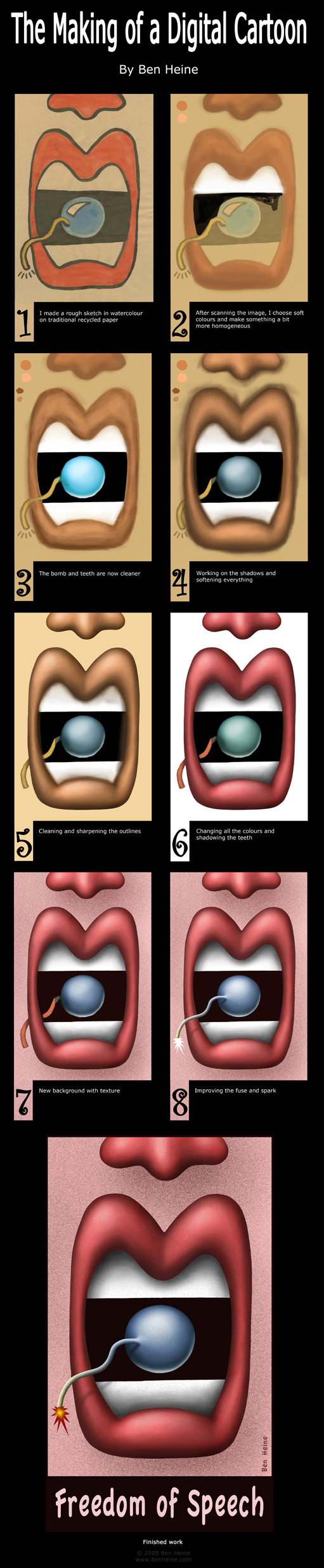
Just a little tutorial... :) ...and one of my first attempts to make a total digital work. This one is very simple in it's form. I will do more complex digital creations in the near future. I'm still learning everyday.

As you know, I tend to think that good concepts are more important than technique anyway.

(see also some more photo editing here)
.
Reblog this post [with Zemanta]

© 2008 - Ben Heine


I was recently invited by Benjamin Moriamé to host a conference on the theme "Art and Militancy" at the FUCID (FUCID, in English: "University Foundation of International Cooperation for Development"). I explained my evolution as a political illustrator, I spoke about the importance of political art nowadays and I also focused on the limits of freedom of expression in political cartooning.

I've illustrated in the past several bulletins published by the FUCID. The FUCID is a non-governmental organization located in the University campus of Namur, Belgium. It intends to bring lasting social, political and environmental changes and promotes solidarity and citizenship.

Warm thanks to Benjamin Moriamé for inviting me and for giving me the chance to use my freedom of speech and have an interesting debate with students. Benjamin Moriamé is a Belgian journalist working for the FUCID and as a freelance for La Libre Belgique, Le Soir, Vers l'Avenir and several other magazines.
.
Breathing Art
.(A Poetic Justice Photomontage)
.
Ceaselessly giving.

Art opens inward
The generous spirit of the heart.

Art widens the eyes,
The soul,
Then seeks you within it.

Rigid and hot,
It needs freedom, faith
To consider where it’s taken you,

Like dipping your mind’s brush
Into the cleansing water,
Thoughts swim, breathing like fish.

Now given to, submerged,
Bathed in the shape of it,
What wrangles your soul?

If you find your breath full...
Think not of the artist’s truth,
Think but of your own;

Spirit and the heart of hope
Weep
And question why…


© 2007 mrp/thepoetryman
.

Mark, thank you, Associate in Peace...
.

Cartoon Liberty
.

Cartoon Liberty ©.Website Project

"Cartoon Liberty" is a website with interviews of cartoonists and with a selection of articles about the cartoonists' freedom of expression. I made this temporary website for my final assignment (about the limits of freedom of expression in cartoons) in the frame of my studies in Journalism.

There are some artworks by the interviewed cartoonists.There are videos (taken on You Tube) about cartoonists freedom of expression and links to several cartoonists' organizations and famous artists worldwide.
It will be first all in French. But it might be all in English in a short time. I will try to put it on the Web as soon as I can.

I attach some screenshots so you can already have an idea.
.


Cartoon Liberty ©

The Pen is Mightier than the Sword

.
The Evolution of Religious Liberty
as a Universal Human Right
By Derek H. Davis (*)

The 20th century witnessed phenomenal growth in the number of democracies around the world. According to Freedom House, a nongovernmental organization that tracks and promotes the spread of democracy, the number of democracies worldwide has more than tripled (to 120) in the last 30 years. While the essence of democracy is rule by the people, most democracies today are “liberal” democracies, which means that fundamental rights or liberties of the citizens are built into the legal structure of the regime. These rights usually include freedom of speech, freedom of the press, freedom of assembly and freedom of religion.

Corresponding to the 20th century trend toward democratization is the evolution of religious liberty as a fundamental human right. Democracies are structured to accommodate difference and most countries today are populated by people with a range of religious commitments; thus religious liberty now is considered a basic human right, and indeed we can say that democracy over the last century or so has contributed to what could be termed the internationalization of religious human rights.

The Four Pillars of International Religious Freedom

Of the four major international documents that universalized the principle of religious liberty in recent decades, by far the most central is the Universal Declaration of Human Rights, adopted by the United Nations in 1948. This landmark document recognizes several important religious rights. Article 18 is the key text:

Everyone has the right to freedom of thought, conscience and religion; this right includes freedom to change his religion or belief, and freedom, either alone or in community with others and in public or private, to manifest his religion or belief in teaching, practice, worship and observance.

The declaration vigorously asserts that individual religious differences must be respected. It embraces the political principle that a key role of government is to protect religious choice, not to mandate religious conformity. It took centuries, even millennia, of religious wars and religious persecution for the majority of modern nation-states to come to this position, but the principle now is accepted widely, especially in the West. The modern principle of religious liberty, by which governments declare their neutrality on religious questions, leaving each individual citizen, on the basis of his/her own human dignity, to adopt his/her own religious beliefs without fear of reprisal, is an outgrowth of the Enlightenment’s emphasis on human freedom, which in turned helped spawn the rise of democracy. It received universal recognition in the 1948 declaration, undoubtedly the major milestone in the evolution of international religious liberty.

The declaration refers to "a common standard of achievement for all peoples and nations." Written in the aftermath of the unspeakable horrors of World War II, it provides a standard by which the peoples of the world may learn to live in peace and cooperation. If the world enjoys a greater measure of peace in the current millennium than in previous ones, it is possible that future historians will look to 1948 as the beginning of the new era of peace, much as we now look, for instance, to the year 313 (Edict of Milan) as the beginning of the Constantinian union of church and state, or 1517 (Martin Luther's posting of the 95 Theses) as the beginning of the Protestant Reformation. There simply is no way to overstate the significance of the Universal Declaration of Human Rights.

Whereas the declaration imposed a moral obligation upon all signatory nations, later documents went further in creating a legal obligation to comply with its broad principles. The International Covenant on Civil and Political Rights (1966), ratified to date by 144 nations, prohibits religious discrimination, as stated in Article 2 (1), "without distinction of any kind, such as race, color, sex, language, political or other opinion, national or social origin, property, birth or other status." Article 18 guarantees the same rights listed in Article 18 of the Universal Declaration, then adds more, including the right of parents to direct the religious education of their children. Article 20 prohibits incitement of hatred against others because of their religion, and Article 27 protects members of ethnic, religious or linguistic minorities from being denied the enjoyment of their own culture. Moreover, the 1966 covenant provides a broad definition of religion that encompasses both theistic and nontheistic religions as well as "rare and virtually unknown faiths."

The United Nations Declaration on the Elimination of All Forms of Intolerance and of Discrimination Based on Religion or Belief, adopted in 1981, is another key document protecting religious rights. Articles 1 and 6 provide a comprehensive list of rights regarding freedom of thought, conscience and religion. These include the right (1) to worship or assemble in connection with a religion or belief, and to establish and maintain places for these purposes; (2) to establish and maintain appropriate charitable or humanitarian institutions; (3) to make, to acquire and to use to an adequate extent the necessary articles and materials related to the rites or customs of a religion or belief; (4) to write, to publish and to disseminate relevant publications in these areas; (5) to teach a religion or belief in places suitable for these purposes; (6) to solicit and receive voluntary financial and other contributions from individuals and institutions; (7) to observe days of rest and to celebrate holy days and ceremonies in accordance with the precepts of one's religion or belief; and (8) to establish and maintain communications with individuals and communities in matters of religion and belief at the national and international levels.

Finally, the 1989 Vienna Concluding Document contains provisions similar to the 1948, 1966 and 1981 documents, urging respect for religious differences, especially among various faith communities. The participating nations specifically agree to ensure "the full and effective implementation of thought, conscience, religion or belief."

These international documents, in reality, are binding only on those nations that take steps to give them legal status. In other words, they are not self-executing. While the religious liberty protections contained in the international documents do not carry the effect of law, they already are shaping human rights law in participating nations, and they are a key feature of a developing and, one hopes, more peaceful world order. Nevertheless, today's world is one in which religion still is a source of great conflict, and fundamental principles of religious liberty are often more abused than respected. Can more be done to further religious liberty, and can the spread of democracy contribute to the advancement of religious liberty?

Transforming International Obligations into Reality


Religious persecution continues to be a serious problem worldwide despite the significant steps taken by the world community, particularly since World War II, to combat it. This is a sobering reminder that declarations, conventions and other documents do not translate easily into reality. Scholars have stressed at least five areas where broad institutional approaches may be effective in helping to make religious liberty not only a worldwide ideal, but also a worldwide reality.

Treaty Implementation
.
Nations must take seriously the provisions of international human rights treaties by integrating them into their own legal systems. It perhaps is tautologous to say that religious liberty in the world would be a given if all the countries of the world complied with the various conventions and other documents that have been adopted since World War II. That it is not, is reflective of the fact that too many governments afford themselves the luxury of basking in the glow of the ideals they signed on to while failing to take the necessary legal and other actions to make them a reality.

Legislation
.
Governments around the world should enact meaningful legislation designed to curb religious persecution. In 1998, the U.S. Congress passed the International Religious Freedom Act. This act mandates an annual report, prepared by the State Department’s Office of International Religious Freedom, that assesses and describes violations of religious liberty in each country. The department also considers the suggestions of a nine-member U.S. Commission on International Religious Freedom (USCIRF). Based on the annual report, the U.S. president may impose a range of penalties and sanctions on countries found to be violators. The legislation is controversial internationally, but the measure thus far has helped the cause of international religious liberty. The law does not attempt to impose "the American way" on other nations. Rather, it draws on the universally accepted belief in the inviolable dignity of all human beings and of the universal rights that flow from that belief, and the United States encourages other nations to adopt similar oversight measures.

Since the legislation was implemented, several countries repeatedly are cited for serious abuses of religious freedom. Among them are China, Cuba, North Korea, Iran, Saudi Arabia, and Uzbekistan. According to the State Department, in most cases the practice of religion in these countries "is often seen as a threat to the state's ideology or power." A number of countries have improved their records on religious freedom in recent years, however, including India, Georgia, Turkmenistan, the United Arab Emirates, and Vietnam. By way of illustration, "in October 2004 the UAE’s Ministry of Justice, Islamic Affairs, and Awqaf hosted an international conference on religion and terrorism that was designed to encourage moderation in preaching and condemn extremism and terrorism." Also, in June 2005, the United Arab Emirates created a law establishing the Zayed Center for Islamic Culture to promote interreligious tolerance and co-existence and to educate better people in the West on the meaning and practice of Islam. The extent to which such improvements were the result of the State Department's criticism in earlier-year reports is difficult to document, but it is arguable that the reports were strong motivating factors in bringing about some countries' improved records.

Education
.
More needs to be done to make the people of the world aware of the staggering level of religious persecution still prevalent in many parts of the world. More conferences and symposia could highlight this theme, and more support (verbal and monetary) could be provided to human rights nongovernmental organizations such as Human Rights Watch and the International Religious Liberty Association that monitor human rights abuses around the world and report them to governments and other concerned groups.

Separation of Church and State
.
There must be renewed efforts to increase respect by all political, religious and social institutions for the modern view that political society's primary interests are in fostering peace, justice, freedom and equality, not in advancing religion. This is the basic meaning of the separation of church and state. The obvious tension here, of course, is that historically, religion has been the basis for every dimension of life, including the political. As the eminent Quaker William Penn noted in 1692, "government seems to be a part of religion itself, a thing sacred in its institution and end." But of course Penn was a budding church-state separationist, and he increasingly moved to the view that religion is fundamentally a personal, individual concern, and government's role should be the protection of all religious outlooks rather than the advocacy of one. Since Penn's day, nation-states increasingly have adopted this perspective, and the 20th century's human rights documents have done the same. As already suggested, this perspective needs to be taught by educational institutions through a range of curricula that confront the interaction of religion and government in the modern world.

Spread of Democracy

Democracy is structured to accommodate difference, pluralism and diversity, thus promoting religious liberty. Totalitarian regimes often attempt to unify their nations around a common religion; the consequence often is religious repression and persecution of minority religions and a fundamental denial of the principle of freedom of thought and conscience. As democracy spreads, the result is likely to be less religious repression and a greater practice of religious liberty worldwide.

In the final analysis, we, as members of the world community, owe it to ourselves and to our progeny to make religious liberty a reality for everyone. There is no more important task in the 21st century. All nations should improve their commitments to making religious freedom a reality; indeed religious liberty can be promoted and practiced even in nondemocratic regimes. But if democracy is one of the tools to spread religious liberty as a universally recognized human right, then let democracy ring around the world.
-----------------------------------
.
>>> This essay originally appeared on US Info website
.
(*) Derek H. Davis, B.A., M.A., J.D., Ph.D., is a graduate of Baylor University and Baylor Law School and holds a Master of Arts in Church-State Studies from Baylor University and a Doctor of Philosophy in Humanities from the University of Texas at Dallas. He is Professor of Political Science and the Director of the J.M. Dawson Institute of Church-State Studies, Baylor University, Waco, Texas, which offers M.A. and Ph.D. degrees in Church-State Studies, conducts research and publishes books on church-state relations and religious liberty in national and international contexts, maintains the largest research library in the world pertaining to religious liberty and church-state relations, and sponsors conferences and lectureships on various church-state themes. He can be reached at Derek_Davis@baylor.edu

Ben Heine Chronological Comprehensive Biography

The following bio was last updated in Oct 2014. Short text HERE

2014: New Artistic Challenges / More Music / Mission to Tenerife 

January 2014: Early January, thanks to his collaboration with the British news agency "Barcroft", Ben’s new 3D artworks were published in many notorious newspapers such as "The Daily Mail" (ref), "The Mirror" (ref), "Het Nieuwsblad" (ref), "The Daily Record" (ref), "The Telegraph" (ref), "Metro" (ref) and many others. On the 16th of January, Ben gave for the second time an online conference for 3 classes of Collingwood School in West Vancouver, British Columbia with teacher Mahasti Mofazali (ref). Later in January, with the help of his new agent Najwa, Ben held a solo exhibition at "DCA Gallery" in Brussels, Belgium from the 24th of January until the 22nd of March, an event titled "Parallel Universe" (ref). A selection of limited edition prints from the "Pencil Vs Camera" series were exhibited, including some of Ben’s newest 3D creations. The show gathered thousand of visitors and also attracted national and international journalists such as "Het Laatste Nieuws" (ref) and "Fans of Flanders" (ref) in Belgium or "Press-TV" (ref) and "Irib tv" (ref) in Iran among others (ref)... Inexplicably, the Flemish press heavily covered the event while the French-speaking journalists of Belgium almost ignored it. 

February 2014: Ben’s first comprehensive Pencil Vs Camera tutorial was published on Tuts+ (ref) along with an interview (ref). Tuts+ is a popular online platform aiming to help people learn creative skills. On the 22nd of February, Ben made a public "Flesh and Acrylic" performance at the Brussels "Natural Sciences Museum" in the frame of the "Museum Night Fever", an event organized by MacSwell (ref). His live performance with model Sandra Rassios was filmed by several television channels including Iedereen Beroemd", a well-known program in Flanders (ref). At the end of the performance, Ben wore an overall covered with acrylic paint with the same patterns used on the model and they both walked around in the respected museum (ref). 

March 2014
:
 Ben started collaborating with other musicians and singers such as pianist Thibault Crols and singer Lory Guerriero (ref). Mid March, several Diasec prints of Ben’s new 3D artworks were exhibited by Ben’s British gallery "The Art Movement" at the "Affordable Art Fair" in London (Battersea). Later in March, Ben’s video interview for “Fans of Flanders” was released in Flanders (ref). 

April 2014: Ben improved his knowledge in music theory. He also created several new ballpoint pen sketches (ref). End of April, Ben became ambassador of his new town Rochefort in the frame of "Wallonie Bienvenue" and he opened the doors of his studio to all visitors (ref). 

May 2014: End of May, Ben shared several new musical electronic compositions including "Plucky Ducky", "Rainbow Memories", "You Don't Wanna Play" (ref). Ben started adding vocals to his melodies and collaborated with Belgian singer Lory Guerriero for his track "You Don't Wanna Play" and he also used his own voice. 

June 2014: Mid June, Ben collaborated for the second time with Chinese model Zhuzhu to make another artwork with black stickers (ref). Later in June, an interview with Ben was released in "Cult of Mac" and on many other Apple related websites (ref). On the 23rd of June, a group of 21 students from the KCD School (Katholieke Centrumschool Denderleeuw) in Denderleeuw, Belgium) studying Ben's oeuvre visited his studio in Rochefort (with teacher Bart Verhelle). It was the first time Ben welcomed students directly in his studio. Since then, many schools worldwide have used Ben's artistic inventions to teach students to become more creative (ref). 

July 2014: Ben travelled to Tenerife (Canary Islands, Spain) for a creative project titled "#onthedraw" commissioned by the island’s tourism agency "Promotur - Turismo de Canarias" (ref). Visiting the island’s most secret spots, Ben was asked to express his experiences in Tenerife through a number of drawings and an illustrated sketchbook, intending to promote the development of a sustainable tourism, raise awareness on the Canaries as an ideal scenario for film shooting and also to inspire youth from the Canary Islands to use their imagination and creativity to search for new opportunities (ref). The story of this project was published in Yorokobu (ref), El Pais (ref) and many other major Spanish medias. 

September 2014: Ben worked part time as a teacher at the IFAPME school of Dinant, Belgium. End of September, Ben is interviewed by award-winning journalist Jessica Soho for "State of the Nation" for GMA news in The Philippines (ref). 

October 2014: Ben exhibited a selection of prints at the (Brussels Accessible Art Fair) for the 5th time at the prestigious Cercle de Lorraine in the heart of Brussels. During the opening of the show, Ben wore a colorful handmade outfit made with acrylic (ref). The fair gathered thousand of visitors and different medias talked about it such as the Chinese "CNC News" (ref) or the Belgian "Brussels Diplomatic" (ref). On the 28th of October, Ben participated in an important national awareness action for the World Psoriasis Day by swimming with people having psoriasis to prove that it isn't contagious. This event gathered a great number of artists, politicians and journalists. 

2013: International Recognition / First Exhibition in Asia / Animation 

February 2013: Ben collaborated with Chinese model Zhuzhu for the first time (ref). Their shooting happened in Ben’s studio on the 17th of February. Among the photos they made together, "Less is More" showing the model covered with thousands of small squared black stickers is the most famous work (ref). 

March 2013: The 17th of March, Ben’s animation and music "Time Warp" were released online. The 23rd of March, Ben’s circle portrait featuring Jesus was featured on the cover of "W Sieci" Polish weekly magazine. 

April 2013: The 13th of April, Ben shared his animation "Lion Walk" made to illustrate his eponymous electronic music creation released the same day (ref). Ben travelled to France the 14th of April to co-organize (ref) and participate in "Tour de France Photo" along with founderThomas Ueberschlag and photographer Stephan Deneuvelaere (ref). The 18th of April 2013, during the Tour, Ben exhibited some of his conceptual photos in a collective street exhibition in Marseille, France (ref). He also made a public Pencil Vs Camera performance the same day at Pavillon M (ref). Ben took some highly acclaimed pictures during this tour, such as "Time Traveler" or "Old Times", among others (ref). 

May 2013: The 29th of May, Ben participated in the famous Belgian event "Culinaria" at Tour & Taxis (ref). The 2013 theme was "Pure Street" (ref). Ben's mission was to decorate the working space of Michelin Star Chefs Yves Mattagne and Axel Colonna (ref). He created "Taste Buds", a giant 27m2 abstract and colorful mosaic painting (ref). 

June 2013: Early June, Ben opened his first official online stores (via Zazzle and deviantART) to sell reproductions and derivatives of his creations at more affordable prices and also to counter the massive piracy and illegal reproductions of his art in several countries, particularly in India, Asia and South America (ref). The 18th of June, Ben gave a conference to present his work at "Images International Photography Club" in The Hague, the Netherlands (ref). 

July 2013: Ben started creating much larger drawings with more visible 3D effects using anamorphosis tricks. These images have had a huge success instantly (ref). 

August 2013: Mid August, Ben signed a major contract with Kare Design, a decoration and design company based in Germany. Prior to the contract, Kare had sold to Endemol (international television production) several of Ben’s circle portraits, without Ben’s permission, to decorate the house of the French television reality show "Secret Story" that took place earlier in June. Fortunately, a positive solution to this infringement was found (ref). 

September 2013: The 28th of September, Ben participated in an outdoor collective exhibition in his new town Rochefort via the "Centre Culturel des Roches" (ref). Ben’s audio and video interview for Flickr (via "The Weekly Flickr " by Ameya Pendse) was released on Yahoo news pages in different countries on the 30th of September 2013 (ref). 

October 2013: The 11th of October, Ben exhibited some limited edition prints at the "Event Lounge" (ref) for "Exhi-B" in Brussels (ref). He then travelled to Seoul, South Korea between the 18th and 28th of October to organize and hold his first solo exhibition in Asia titled "The Universe of Ben Heine" that took place at "Hyehwa Art Center" from the 24th until the 31st of October with the help of INMD, a Communication Agency in Seoul and Ben’s local partner since 2010 (ref), Samsung and the support and presence of the Belgian Embassy in Seoul with Ambassador François Bontemps and Consul Pierre Steverlynck (ref). During his travel, Ben also created 2 new Pencil Vs Camera images in Seoul featuring Cheonggyecheon streets andGyeongbokgung Palace (ref), he also took hundreds of photos in famous Seoul spots and gave conferences for students of local universities (ref). Different South Korean newspapers talked about the exhibition such as "The Hearld Business" (ref), "Hankyung" (ref), ebuzz (ref) among others. 

November 2013: Early November, Ben officially started collaborating with Najwa Borro, an art lover he met thanks to their mutual business partner Stephanie Manasseh. She became his agent in Brussels and Paris and she helped him to organize exhibitions and find new business opportunities. Mid November, Ben’s interview and cover for "Volkswagen Magazine" was published in French and Dutch in Belgium (ref). End of November, Ben officially joined the popular social platform Instagram

December 2013: The 5th of December, Ben’s music track "Fly With You" was available for sale on Spotify in the collective album "Mesh 1.0" released by DMS in the UK. Mid December,iCanvas, a renowned US company selling museum-quality canvases offered Ben a long-lasting partnership creating a special collection with a selection of Ben’s artworks (ref). The 18th of December Ben co-animated a debate about the "limits of freedom of expression" with popular Belgian cartoonist Pierre Kroll at "PAC Bruxelles" (ref). On the 29th of December, Ben was featured on the trendy website "Optical Spy" along with artists Donald Rust, Escher, Liu Bolin, Guido Daniele, Banksy and others (ref). 

2012 Birth of Theo / Music Creation / Many Exhibitions / Mission with Samsung Note 10.1 

January 2012: Early January, Ben’s promotional brochures (25 pages) sponsored by "Samsung Imaging" were printed in 5000 copies and hundreds of them were sent to Ben’s most faithful fans around the world (ref). The 9th of January, Ben shared on SoundCloud his first experimental musical composition (ref). A few days later, Ben’s interview for deviantART was published on the 12th of January (ref). One day later, he held an exhibition at "Namur Expo" in the context of the "Art Event" fair, gathering several artists and tens of thousands of art lovers (ref). Ben’s self portrait made of circles ("Remembering What I Am") was featured as the official poster design of the whole event (ref). Ben’s gallery in London exhibited several Pencil Vs Camera Diasec prints at the "London Art Fair" between the 18th and 22nd of January (ref). 

February 2012: Early February, Mc Cann Erickson Romania asked Ben to make some Pencil Vs Camera works for several publicity campaigns for a Lithuanian client ("Bite"). Ben travelled to Bucharest several times between 2012 and 2013 to work on these projects with McCann Erickson (ref). Ben's works were exhibited by 2 different galleries at the Affordable Art Fair (AAF) in Brussels from the 9th till the 12th of February 2012 (ref). It was a successful event. Just after the fair, mid February, Ben travelled to Barcelona in Spain for a special photo shooting with model Caroline Madison. He also made there his first "Double Landscape" picture showing 2 different views of the city of Barcelona (ref) and the Pencil Vs Camera artworks showing the funny monkey (ref). He made another "Double Landscape" image featuring London some days after (ref). 

March 2012: Ben brought some major innovations in his Pencil Vs Camera concept: he introduced colors and black paper instead of white (ref). He shared his first colored sketch the 9th of March. On the 21st of March, Ben gave a conference about his work for "View Finders", an English speaking photography club in the heart of Brussels (ref). Later in March, Ben’s creations were published for the 4th time in "The Huffington Post" (ref). 

April 2012: The 6th of April, Ben released his first hand-drawn animation (and a music composition) showing 18 Pencil Vs Camera works in progress (ref). Mid April, Ben visited Lisbon in Portugal and Sevilla in Spain. At his return, Ben participated for the first time in the event "Tour de France Photo" on the 21st of April (ref). During this day, Ben met former "Miss Belgium" Alizée Poulicek (ref) and they took several photos at "Metropole Hotel" (ref). He created the same day a Pencil Vs Camera artwork with Coralie Nelly, another Belgian model participating in the Tour. On the 30th of April and until June 2012, Ben exhibited a wide collection of Pencil Vs Camera Diasec prints at the respected "Avenue" (ref) restaurant on St James Street in London, UK, with his gallery "The Art Movement" (ref). 

May 2012: Ben gave several interviews in particular for "Fotoflock" and "iFamous". Later in May, his creations were published in some of the biggest UK newspapers such as The Sun (ref), The Telegraph (ref), The Daily Mail (ref), The Mirror (ref) and many other online references such as CBS News (ref) or Msn News (ref). 

June 2012: The documentary filmed by Italian director Davide Gentile about Ben’s work was released worldwide in June 2012 (ref). The 14th of June 2012 Ben exhibited at McCann Erickson headquarters in Bucharest, Romania, a selection of Pencil Vs Camera and Digital Circlism prints on canvas in a collective exhibition titled "PAF/Prints Art Festival" (ref). Ben met Belgian model Jessica De Boeck on the 17th of June and they took several photos in Anderlecht including 2 Pencil Vs Camera pictures. A few days later, on the 22nd of June, Ben had another exhibition at the prestigious "Arsenal" space in Brussels, Belgium, via "Exhi-B (ref). 

August 2012: Ben’s son, Theodor Heine, was born on the 12th of August 2012 in Brussels (ref). 

September 2012: Early September, "Samsung Portugal" contacted Ben asking if he would be interested to help launch nationally the new Samsung Note 10.1 tablet and the Galaxy Note II smartphone (ref). Ben accepted and travelled to Lisbon on the 29th of September until the 6th of October. During this experience, Ben made photo-drawings like usual but instead of using pencils, pieces of paper and a reflex camera, he only used the 10.1 tablet as a drawing surface area, the magnetic S-pen as a tool to draw and the powerful integrated camera of the Galaxy phone to capture the final results (full story here). It was a difficult challenge for Ben because it was the first time he was working with these devices and each drawing was a total improvisation. A mini documentary (ref) showing the interaction Ben had with the tablet, the smartphone and the beautiful city of Lisbon was filmed by "Dub Video Connection" via "Desafio Global Ativism" for "Samsung Portugal" (ref). The experience was also reported by "Samsung Toworrow" (ref) and the full story was published in the issue 34 of "Soura Magazine" (ref) and in other news medias as well. 

From the 13th until the 20th of September, Ben exhibited in the "MontBlanc" Brussels luxury boutiques in the frame of the "Louise Nights" (ref). 

Ben’s artworks were presented at the "Photokina" Art Fair in Cologne, Germany in the "Fujufilm Belgium" stand between the 18th and 23rd of September 2012 (ref). 

The same week, Ben participated for the 4th time in the "Brussels Accessible Art Fair" at the Conrad Hotel of Brussels from the 21st till 23rd of September (ref). Ben had prepared a unique outfit with several handmade drawings (ref). It was a very successful fair. 

Ben then had a solo exhibition at "VIP Offices" in Brussels from the 26th of September until the 15th of November 2012, titled "The Best of Both Worlds" (ref). The vernissage gathered hundreds of people. Ben also created an exclusive Pencil Vs Camera artwork depicting the "VIP Offices" façade (ref). 

October 2012: October 2012 was another very busy month for Ben with exhibitions every week. On the 12th of October, Ben had a collective exhibition at "Auto World" via "Exhi-B where he showed some Pencil Vs Camera Diasec limited edition prints (ref). Ben’s artworks were also exhibited in London at the "Affordable Art Fair" by Ben’s gallery "The Art Movement" between the 25th and 28th of October (ref). 

November 2012: Ben’s interview for "Adobe Photoshop" was released on the 15th of November (ref). On the 17th of November, Ben travelled to Rome, Italy, to give a conference about graphic creation in the frame of "Creative Pro Show", a yearly event featuring some of the most prominent international photographers (ref). End of November, a popular application emulating Ben Heine Pencil Vs Camera’s style was launched worlwide, titled "Fantasy" for Camera 360, developed by Pinguo (ref). Since then, many other applications imitated Ben’s famous concept. 

December 2012: After many exhibitions and new creations, Ben decided to move away permanently with his family to the Belgian countryside in Lessive, a small and charmful village in Rochefort, near Dinant. In this house, Ben owned for the first time a professional studio (ref) that allowed him to start musical projects and to work on graphic projects that required bigger space, such as the 3D Pencil Vs Camera works... 

2011: Ben Heine Documentary by Davide Gentile / Exhibitions / Many New Works 

January 2011: Ben met French/Asian model Caroline Madison for the first time in February 2011. They made a first improvised shooting the same day. 

February 2011: End of February, Ben exhibited his creations at the "Affordable Art Fair in Brussels" with the help of his agent Rami. Many exhibitions happened the next months in Belgium and abroad (ref). 

March 2011: Ben and his agent Rami travelled to London to find new business partners. They met Milly Longin who had contacted Ben previously requesting to have a stock of Ben’s limited edition prints for her gallery "The Art Movement". They also met Belgian Embassador and Consul in London who had already shown interest in Ben’s work. It was a fruitful travel which brought several new opportunities to Ben. 

May 2011: Italian director Davide Gentile came to Ben's family house in Braives, Belgium, with his crew to film a one-week documentary showing Ben working on different projects. Ben made his first "Flesh and Acrylic" with model Caroline Madison in his garden in Braives. 

July 2011: Ben and Rami found in the "Begramoff Gallery Garden" a new partner. Ben had a solo exhibition at this gallery from the 1st of July until the 15th of September 2011. Rami and Ben slowly realized they had different professional goals. The agent wanted to own a virtual gallery with a selection of artists while Ben wanted to continue working exclusively with Rami. Nevertheless they decided to continue collaborating as many events and shows were planned. Several exhibitions happened the next months in Belgium and abroad. 

August 2011: Ben travelled to the North of Spain to walk the famous St James’ Path towards Santiago de Compostela where he made several new sketches, gathered ideas and took many photos for his Pencil Vs Camera project (ref). At Ben’s return, Rami had started collaborations with other artists. Ben and Rami stopped working together permanently. A couple of months later, due to worries with other artists and not being able to achieve his goals with his art gallery, Rami moved permanently to Rio de Janeiro, Brazil, with his family. 

September 2011: Exhibition at Berliner Liste in Germany from the 7th till the 11th of September (ref). 

October 2011: Mid October, Ben travelled again to London, alone this time, to exhibit his works at the "Art London" event (ref) and at the "Affordable Art Fairs" in Hampstead and Battersea with Ben’s local partner "The Art Movement" (ref). Every exhibition in London was a success. Back to Belgium, Ben exhibited at the "Brussels Accessible Art Fair" in the Conrad Hotel between the 28th and 30th of October (ref). 

November 2011: Ben travelled to Sousse in Tunisia and came back with hundreds of pictures including several studies and ideas for his Pencil Vs Camera series (ref). 

December 2011: Early December, Ben started using the music sequencer and digital audio workstation "Ableton Live" to create his own experimental electronic music (ref). Later in December, Ben’s creations were published in some of the biggest international and British newspapers including The Sun (ref), El Pais (ref), The Telegraph (ref), Dein Spiegel (ref), Het Nieuwsblad (ref), The Daily Mail (ref) and many other online references such as The Huffington Post (ref), Yahoo (ref) and others... (ref). The critique was massively praising and supporting his graphic inventions. 

2010: Birth of Major Creative Art Series / Samsung Imagelogger / Many New Creations 

February 2010: Early February, Ben created his first circle portraits (ref). The first circle portraits he made were experimental works and Ben refined his technique later on (ref). On the 10th of February, Rami Achcar, an old acquaintance of Ben from high school approached him to request to become his agent. Ben accepted and it was the beginning of a prosperous association. Thanks to the success and worldwide buzz generated by Ben's Pencil Vs Camera series, they received countless professional opportunities and started to organize exhibitions in major European cities (ref). 

April 2010: 2 months after launching his creative concept with circles, Ben tried something completely different. He shot his first Pencil Vs Camera artwork with a modest Nikon D70 (ref) on the 12th of April 2010. Both series instantly had a huge impact on social networks and Ben’s images were quickly featured on influential news and art sites. International press agencies and freelance journalists contacted Ben requesting to publish his fresh artworks in well-known magazines and newspapers (ref). In Pencil Vs Camera, Ben usually portrayed people’s life, nature, animals or architecture. The main themes are love, freedom, life and friendship… (ref). Ben began with simple black and white sketches on white paper. He brought several major innovations later on (ref). 

May 2010: Ben started working part time at "Fondation Shan", a foundation meant to help autistic people (ref). 

June 2010: Ben was one of the first photographers to become an official Samsung Camera Imagelogger (ref). In this context, Ben had the opportunity to experience and shoot with Samsung latest camera devices between 2010 and 2013 such as the Samsung NX10, NX11, NX20, NX200 and Galaxy NX cameras and lenses (ref). Samsung also sponsored his promotional brochures in 2011 (ref), his collective exhibition at Samsung D’light in 2010 (ref), his project with the Samsung Note 10.1 in Lisbon in 2012 (ref) and his solo exhibition at "Hyehwa Art Center" in Seoul later in 2013 (ref). 

July 2010: Samsung Imaging interviewed Ben as a member of the "imagelogger" program and a sponsored photographer. The interview was published on "Samsung Camera" official website on the 12th of July (ref). In July and August, Ben exhibited at “Le Coach” a trendy restaurant near Montgomery in Brussels (ref). 

August 2010: Too busy with his successful artistic projects, Ben stopped working at "(Fondation Shan)". 

December 2010: Throughout 2010 and particularly in December, Ben’s interest for electronic music creation kept growing. 

2009: No more Activism and Political Art 

Ben stopped doing political art. He worked as a teacher (French, English and Dutch) at "Collège Cardinal Mercier" secondary school in Braine L’Alleud, Belgium from November 2008 until March 2009 (ref). To make a living, Ben also worked as a seller at "Colruyt" supermarket (in Schaerbeek) from June 2009 until February 2010 (ref). Next to these brief professional experiences, Ben started making watercolor illustrations and he never stopped working on his creative projects. 

2008: Different Jobs and Professional Experiences 

Due to the heavy economic crisis, it was not easy for Ben to find a job in Journalism directly after his studies. So he had to try different jobs to make a living. He briefly worked as a communication officer at "Txt Ibis" in Kortenberg (Flanders) from September to December 2008 (ref). Ben also worked as a teacher for a private school in Brussels ("Reussit School"). Despite these jobs, Ben's priority always remained in his creative projects and he couldn’t manage to keep these jobs very long. 

2007: Graduated and New Perspectives 

From January till August, Ben travelled to Utrecht in The Netherlands to study Information and Communication Technologies and to improve his knowledge of Dutch. In September 2007, Ben graduated from (IHECS) Journalism school with distinction in communication, information and journalism (ref). 

2006: Political Activism and Journalism / First Solo Exhibition 

During his studies and being highly influenced by the political aspect of Journalism and by professors like Paul Delmotte (ref), Ben made several political illustrations for different national and international newspapers throughout 2006. Strongly manipulated by a network of cartoon associations (including "Iran Cartoon"), Ben was asked to submit some controversial sketches for the provocative and immoral "Holocaust Cartoon Contest" sponsored by the Iranian newspaper Hamshahri, (meant to denounce the "Western hypocrisy on freedom of speech"). Ben’s final assignment at university included an investigation about the "limit of freedom of expression in political art" so this contest was also an opportunity for him to experience and study such situation. Ben later wrote a public letter to apologize for the confusion he had generated (ref) and to beg pardon to the Jewish community (ref). 

In the summer, Ben organized his very first solo exhibition at "Les Coulisses Saint-Jacques", a trendy cabaret near Brussels Grand Place (ref). Many of his early experimental acrylic paintings were exhibited there during several months. He also did work experience as a journalist at La Libre Belgique in August (ref). Ben joined Flickr the 22nd of August (ref). End of October, Ben attended a workshop with German master acrylic painter Sebastian Kruger (ref). Early November, Ben travelled to Kenya for an African safari into the wild with his family (ref). He came back with thousands of wild animals and landscapes photos. Ben joined deviantART the 12th of November (ref). 

2005: Learning Journalism and Photography 

Ben learned analogue photography with teacher Guy Philippart at IHECS. Every evening after high school, he also went to the "Académie Royale des Beaux Arts de Bruxelles" hoping to refine his painting and drawing techniques with teacher Jean Paul de Moor (ref). He learned several languages (English, Dutch, Spanish, Polish and Russian). 

2004: IHECS Journalism School in the Heart of Brussels 

Ben continued his Journalism studies at IHECS, a well-known High School in the heart of Brussels (IHECS). Due to some highly committed teachers there, Ben got involved in different political causes. Ben sold his first acrylic paintings (early works). 

2003: Poland and Slavonic Culture 

Ben met his future wife Marta Konikowska in March 2003. After completing his studies in Hastings with distinction (BTEC in Foundation Studies Art & Design), Ben came back to Belgium in Summer 2003. Because Poland was not yet part of the European Union at that time, Ben and his family had to fight a lot to have his Polish ladyfriend move permanently to Belgium. Ben started studying Journalism and Slavonic languages at the "Université Libre de Bruxelles" (ref). 

2002: Travel to Hastings / Sculpture/painting / First commissions 

Ben completed secondary school with distinction at "Collège St Vincent" (boarding school) in Soignies, Belgium in June 2002 (ref). He travelled to England in September to study sculpture (clay ceramics), painting and history of arts at "Hastings College of Arts & Technology" in Hastings (ref). Ben made his first commissioned painting for a local Asian restaurant (depiction of Buddha) in Hastings in December 2002. 

1996 - 2002: Secondary School in Soignies

In September 1996, Ben started secondary school at "St Vincent College" in Soignies, a well-known Belgian boarding school (ref). His interest for graphic arts, along with music, poetry and sport grew fast at that time. The first year in that boarding school was not easy for Ben. Fortunately, he started a lot of creative and sportive activities (drums, basketball...). In 2000, Ben became a very studious and a rather solitary person. Along with his studies, he spent a lot of time writing poetry. He also improved his drawing techniques on a daily basis. He learned piano and guitar on his own. In 2001, one of his teachers, Anne-Marie Lansmanne, deeply helped him to believe in a possible future as an artist. Ben travelled to Florence, Italy, with his school in the winter, visiting many classic art museums. 

1990 - 1996: Primary School 

In 1990 Ben started primary school at Notre Dame de La Trinité (ref). It was a difficult time as Ben had just left Ivory Coast, his hometown. In 1993, due to some family issues, Ben became a demanding and compulsive child and he started having small behavioral problems at school. In 1994, at 11 year old, Ben made his first drawings. In 1995, Ben’s parents divorced. The same year, Ben failed at primary school but completed his 6th year successfully at Notre Dame des Grâce in June 1996 (ref). 

1983 - 1990: Birth in 1983 and Childhood in Ivory Coast, Africa