Alcoholism in Russia
.
.
Annals of Russian Self-Destruction: In "Wealthy" Putin’s Russia, They’re still Reduced to Drinking Aftershave

MSNBC reports

Drinking alcohol not meant for consumption such as cologne and antiseptics may be responsible for nearly half of all deaths among working-age men in Russia, according to a study published in The Lancet. “It’s an astounding finding,” said Sir Richard Peto, a professor of medical statistics and epidemiology at Oxford University who was not connected to the study. While the scientists limited their research to the Russian city of Izhevsk, experts suspect the community is probably not atypical. “Evidence is emerging from other areas to suggest this is a nationwide problem,” Peto said.

The research suggests that despite Russia’s economic resurgence in the past decade, it still faces staggering social and health problems, especially in provincial areas far from Moscow and St. Petersburg.

Dr. David Leon of the London School of Hygiene and Tropical Medicine and colleagues looked at all the deaths of men aged 25-54 in Izhevsk, a city in the Urals, from 2003 to 2005. They also interviewed the men’s close relatives to determine contributing factors, such as their health status, drinking habits and socio-economic class. Leon and his colleagues concluded that 43 percent of those deaths were caused by hazardous drinking.

‘Surrogate’ alcohols

Price and accessibility are major factors in the popularity of drinking cologne and other so-called “surrogate” alcohols. They cost a fraction of what vodka costs, and are available in the ubiquitous kiosks and pharmacies on Russian streets. The products also typically contain as much as 97 percent ethanol — compared with the 43 percent in Russian vodka.

Smoking and lower levels of education were both associated with markers of problem drinking. But whether men drank hazardous alcohol was the most potent predictor of mortality, said Leon. Men who did so had an approximately six-fold increase in death compared with men who did not.

Alcoholism has long been thought to be linked to mortality in Russia. Death rates dropped sharply in the mid-1980s when former Soviet leader Mikhail Gorbachev introduced anti-alcoholism campaigns. And in a society that has a word for continual drunkenness lasting more than two days — zapoi — experts say the findings underline Russia’s problem with alcohol.

To address the problem, experts recommend higher taxes for alcohol and stricter regulation of how ethanol is used in products not meant for consumption. Though Russia has taken steps to limit the use of alcohol in colognes, they have not addressed the use of ethanol in medicines. Combating rampant alcoholism in Russia also will require a sea change in social mores that will undoubtedly take years, experts say. “Banning surrogate alcohols doesn’t mean you’re suddenly going to get a population who are upright and sober,” Leon said. “But what you’ll get is a population that takes longer to kill themselves.”

-----------------------

--> This study appeared on msnbc.msn.com
.
Creative Commons License
.
www.benheine.com Updated
Benheine.com
.
Please check out my
newly updated website :


The site is divided in 7 sections :

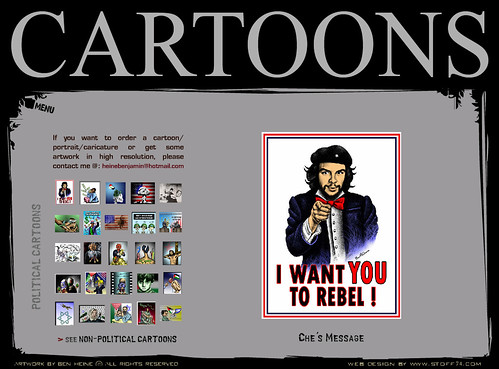
- Cartoons (Selection of "Political Cartoons" and "Non Political Cartoons")
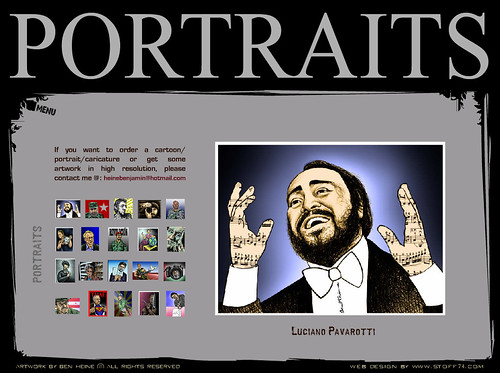
- Portraits (Selection of recent works)
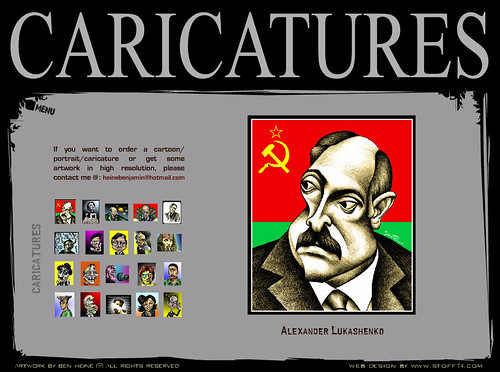
- Caricatures (Selection of recent works)
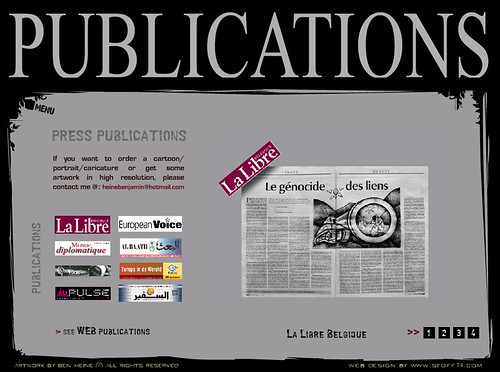
- Publications (Examples of "Printed Publications" and "Publications on the Web")
- Ben by Others (with many thanks to my colleagues)
- Profile
- Contact


Benheine.com2


Benheine.com4


Benheine.com5


Benheine.com6


Benheine.com7


more on benheine
.
* * *

With my sincere thanks to STOFF,
a good friend, a talented artist and
the web designer of benheine.com.

Without him, these updates
and new animations woudn’t
have been possible!

* * *

Stoff
.
Creative Commons License
.
Frida Kahlo
.
.
Frida Kahlo (1907-1954)
Mexican Painter
.
From 1926 until her death, the Mexican painter Frida Kahlo created striking, often shocking, images that reflected her turbulent life. Kahlo was one of four daughters born to a Hungarian-Jewish father and a mother of Spanish and Mexican Indian descent, in the Mexico City suburb of Coyoacán.

She did not originally plan to become an artist. A polio survivor, at 15 Kahlo entered the premedical program at the National Preparatory School in Mexico City. However, this training ended three years later when Kahlo was gravely hurt in a bus accident. She spent over a year in bed, recovering from fractures of her back, collarbone, and ribs, as well as a shattered pelvis and shoulder and foot injuries. Despite more than 30 subsequent operations, Kahlo spent the rest of her life in constant pain, finally succumbing to related complications at age 47.

During her convalescence Kahlo had begun to paint with oils. Her pictures, mostly self-portraits and still lifes, were deliberately naive, filled with the bright colors and flattened forms of the Mexican folk art she loved. At 21, Kahlo fell in love with the Mexican muralist Diego Rivera, whose approach to art and politics suited her own. Although he was 20 years her senior, they were married in 1929; this stormy, passionate relationship survived infidelities, the pressures of Rivera's career, a divorce and remarriage, and Kahlo's poor health. The couple traveled to the United States and France, where Kahlo met luminaries from the worlds of art and politics; she had her first solo exhibition at the Julien Levy Gallery in New York City in 1938. Kahlo enjoyed considerable success during the 1940s, but her reputation soared posthumously, beginning in the 1980s with the publication of numerous books about her work by feminist art historians and others. In the last two decades an explosion of Kahlo-inspired films, plays, calendars, and jewelry has transformed the artist into a veritable cult figure.

- See the official Frida Kahlo Site
- See some of her artworks

------------------

--> This short biography appeared on fridakahlo.com
.
Creative Commons License
.
Chromatic Phenomenon
.
.
A Dystopia of Color Education
in a Utopia of Color Experience

.
By Christopher Willard
.
Possibilities for color explorations in art are probably more ubiquitous now than any other time since mid-century when a brief, but intense, focus on the aesthetic side of color arose with the 1963 publication of Josef Albers' Interaction of Color. The heyday was short. Technology picked up color study on a serious level and because of that we now have the glowing phosphors of television and computer screens, metallic paints, fractals with their repeating color sequences, holograms, and four color process printing. When intertwined with the cesia, or visual signs, of flicker, sparkle, gloss, lustre, iridescence, luminosity, and filmic haze, such color experiences are greatly broadened. Our contemporary conceptions of color are further augmented by that chronic parasite called advertising that links color to desire for everything from the prismatic sparkle of a diamond to the amber glow of a beer.

Yet, beyond such semantic conditioning, associations based solely upon color are apt to suggest odd contradictions such as an adult bashing of a rounded purple dinosaur but an adult affinity for rounded purple cars.

All of these areas have provided grounds for artistic explorations. Students who have grown up familiar with digital media are quick to use such tools for making art. Likewise, the ease in which materials such as interference colors and flourescents can be obtained certainly influences the range of pigments and effects artists can now use. Further the contradictions embedded in color semantics, problems with warm and cool colors or fruitless attempts at categorizing feelings by colors, or the difficulties in naming colors certainly suggest possibilities for exploring relationships between color and language.

In light of such a deluge of color experience one might think academic interest in color would be at an all time high. Yet, indications suggest an appalling lack of regard for color in contemporary art education. I first became aware of such a shift when I witnessed a major school's revamping of the undergraduate foundation wherein a major color figure taught, basically by eliminating color courses. But this was not a lone incident. A number of past conferences at the College Art Association, the annual major conference of the United States and Canada, showed me the ease with which messiahs of departments facing budget crunches chose to eliminate their color courses. Color information was outright dismissed or lumped into general design overviews as though best learned through osmosis. As an analogy, I cannot imagine art schools jettisoning all drawing classes and praying, I guess, that these skills will be picked up in design courses.

A recent study was undertaken to compare secondary education color courses in Japan with those of the United States. Following two months of scrutiny, the researchers found so few discreet color courses in American colleges of art that the project was abandoned.

The continued reliance by artists upon on non-iconic art, by which a work's syntactic qualities such as color are highlighted, would seem to necessitate color education. But lacking this foundation, students allured by color are apt to find themselves in a wasteland where initial studio experiments and forays into books are no assurance of understanding and clarity. Further difficulties arise for art students as the distinctions between art, physics, psychology, psychophysics, chemistry, and philosophy blur when investigating color. Available texts can appear and sometimes are contradictory, misleading, and infrequently downright incorrect, as with a recent best seller that said Seurat would juxtapose yellow and blue dots that would mix optically to a green brighter than any found in a tube of paint -- something completely impossible.

Colors and color diagrams said to be reproducible from three colors are trickily reproduced with four process colors, or in the case of one popular book, 7 carefully chosen process colors to guarantee saturated hues throughout the entire color wheel. Further muddying up the water are camps polarized over the true primary colors: cyan, yellow, magenta for printing processes and transparent painting media; red, yellow, blue for painting and other media that operate with opaque pigments, red, green, and blue relating to our tri-chromatic retinal processing that forms the basis for inventions like color televisions, and yellow, blue, red, green, describing our post retinal coding of colors, called the opponent process which was discovered in part by paying particular attention to perceptual oddities such as afterimages and contrast effects, all of which must appear confusing to art students who lack a foundation in color theory.

In presenting this dichotomy between color experience and academic bias I offer to you a dystopia of color education in a utopia of color experience, and this condition is what I see as off-putting, off-key, and indeed, off-color. In this realm where virtually every seen experience enters us through color channels and is interpreted by us as color information, it seems particularly pertinent to ask why color has apparently lost its meaning in undergraduate and in particular graduate programs.

A questioning of the reasons for the disdain of color study begins by re-examining that manna titled Interaction of Color upon which students were fed more and less frequently up into the 1980's. With a pack of color aid in hand (a set of around 300 silkscreened papers) students would start on page one and diligently work their way through most of the book's exercises. By the end of the semester, each had, like everyone else, little studies that attempted to replicate the effects illustrated in the book. Artists would later stand in front of their own art wondering what relevance simultaneous contrast could possibly have to their messy painting, or digital art. Of course everyone saw that one color appeared to change a bit when surrounded by another color, but so what.

And worse, the method taught many artists that color was limited, apparently, to hard edge and optical configurations and everyone knew those styles were generally unaccepted.

On the other hand it seems simplistic to pin the blame on Albers because his work was ground-breaking, for its breadth as well as its focus. It is true his work did provide the foundation which sparked some artists to further study. But the translation of his ideas into classroom assignments often carried the dangerous scent of the pre-solved answer that turned off many more who couldn't make the connection to their own works. These artists often went on to set departmental policies that reflected their particular biases.

I recognize that I to a certain degree I am recalling the arguments that contrast color and design as debated by the Rubenists, who said color cannot be relegated to simple principles, such as design as argued by the Poussinists, because of the infinitely changeable quality of nature, and by Delacroix who argued for the transforming aspects of color rather than the importance of local colors as championed by Ingres. Such a polarizing of color in art has continued almost unremittently. Examples may be found in the transpositions of deconstruction and semiotics to visual art from text based art. The result was that artists were seduced into believing that all aspects of art must be accountable to text based criteria. So color, a quale so ephemeral and changeable as to be mostly impossible to cram into such an expedient, was quickly dismissed as irrelevant.

Still, I believe the root of the problem is greater than I've so far outlined. In the same way a writer has to find one's voice with words, the artist must find his or her palette with color. An educator, no matter how good, cannot choose the particular array of colors that will prove meaningful to the artist.

The obvious question prods at the necessity of formal color education at all. Grammar doesn't guarantee a Melville nor color mixing a Signac. And for artists, color, like any element of the creative process, can be learned in a variety of ways whether from experience, practice, exercises, texts, or copying.

The artist who never studies color can become a sort of facile and respected artist. Yet it is difficult to articulate the difference between an artist who uses color to create a cohesive color statement and the artist who uses color in a superficial and conventional manner. Succinctly said, the artist lacking in color knowledge lacks possibilities. Color education can demonstrate the remarkable heights some artists have attained using color and can challenge students to aspire to those peaks. Only by the closest of study will young artists begin to understand the wondrous chromatic contrasts of Cezanne, the intensification of edge conditions by Vermeer, the literal depictions of simultaneous contrast by Signac, or the vibratory, floating haze of the Seurat.

If educators can break free of the strangle-hold of the contemporary bias against color, the Alber's post-Bauhausian revival, often viewed as only a brief bright comet, might instead be seen it as a preliminary foundation upon which we can construct methods more appropriate to contemporary experience.

A pedagogical goal then is to create course assignments, combined with a method of teaching, that spark imaginations toward broad and meaningful investigations of color, presented in a way that does not diminish its multifarious and mysterious character.

Note, I am not talking about standards and rules for color usage. I am suggesting a median position incorporating basics and the fact that requirements which color education for art students must meet today have changed. I also stress that any theoretical approach in an artistic program must be grounded in practical exercises, for indeed color is a perceptual event wherein more questions are raised or answers pursued by doing and looking than by reading.

Students who come to my color classes often take for granted much of today's color, for example the bleaching effects of the rapid color presentations on music videos, or the neon colors often found in chainstore clothing. By presenting color from the point of their own world view, the jump to genuine interest in color is facilitated. Yet, although the mode of color presentation has changed due technological advances, and there are those who say color seems to be different today than from what it used to be, these advances remain adequately described by existing theory.

I often ask students to undertake projects by locating an effect of color in which they are particularly interested and to create a form that highlights or a theory that describes their concern. From xerox technicians who want to better understand the overlapping pigments to photographers who wish to predict the characteristics of dyes, to lighting designers who know additive mixture but wish to somehow find their own sense of color order, to visual artists who wish to utilize variations of contrast and assimilation, each describes an urgent need for color education.

In finality it is necessary that students come away from a color course retaining the aesthetic and scientific fundamentals of color, utilizing such knowledge when necessary, filtering out aspects pertinent to their own investigations, and knowing where to find more information should their requirements shift. In this way the artist may begin to master this tool for creating visual structures.

In his book Elementary Color of 1895, Milton Bradley celebrated the observation that:

"A few years ago it might well have been thought necessary to preface a treatise on the subject with arguments to prove that color is a legitimate object for school instruction, but today this is not a question with thoughtful educators whether considered from the practical, industrial or aesthetic standpoint."1

Bradley believed technological inventions would continually invigorate color education. He wrote this at a time when a basis for trichromatic theory was a hundred years old; a theory of the opponent process nearly fifty years old; it came only a few years before the major three-dimensional color order models of Munsell and Ostwald that were to further spark the impetus toward more exacting color quantification. Now a hundred years hence we find Bradley's predictions did not in finality describe a utopia where color understanding and color usage in art find unity.

Reference 1. M. Bradley, Elementary Color, Milton Bradley Co., Springfield MA, 1895, p.8.

Christopher Willard ©

----------------------

--> This study appeared on colormatters.com

--> Christopher Willard can be reached at cwillard@mindspring.com

--> I also recommend this great article by Carlos Cruz-Diez : "Reflections on Color"
.
Creative Commons License
.

Ben by Rohan Voigt
.
.
This is a great gift from Rohan Voigt, a talented Australian artist. Rohan is a Retoucher, Illustrator and Photographer for "Voigtex Creative" (website in construction) and an amazing caricaturist.

I had the chance to meet him last year at Sebastian Kruger Workshop

Thank you dear Rohan. I'm truly speechless!

Below are some recent caricatures by Rohan. Most impressive. (Click to enlarge)
.
Quentin Tarantino
.
.
Tom Cruise
.
.
Bill Murray
.
.
Keanu Reeves
.
.
George Lucas
.
.
Anthony Kiedis
.
.
Sebastian Kruger
.
.
Rohan Voigt by himself
.
.
All above caricatures :
© Copyrights Rohan Voigt
.

Rohan Voigt and his portrait of Richard Wagner
realized at 2006 Kruger Workshop (Photo by Ben Heine)

.
Rohan Voigt and his caricature by Sebastian Kruger
(Photo by Ben Heine)

.

Ben Heine and Rohan Voigt at Sebastian Kruger Workshop
(Photo by Patrick Strogulski)

.
Ben by Murat Yilmaz
.
This is my Caricature by Murat Yilmaz...

Murat Yilmaz is a Turkish illustrator. He works for an information and culture magazine called Semerkand, and he is the founder of Karikaturevi, an interactive Website that gathers the drawings of worldwide cartoonists.

Thank you dear Murat, I love this simplicity...

Below are some artworks by Murat Yilmaz (click to enlarge). You can also read the interview I had with him in February 2007.
.


.
All above cartoons :
© 2007 - Murat Yilmaz
.
Murat Yilmaz by Ben Heine
.
Cigaret Kills
.

.
The War on Cigarettes

.
By Olivia Rose-Innes
.
Alcohol, tooth-rotting fizzy drinks, lardburgers, fast cars – the world is full of fun stuff that isn’t very good for us. So is it fair to single out cigarettes for demonisation?

Patricia Lambert, Director of the Campaign for Tobacco-Free Kids, certainly believes so. At first glance, Lambert appears no more formidable than a nice lady on the PTA, but when she speaks on tobacco control, a steely quality enters her well-modulated voice.

Advertisement

It is because of her considerable resolve, said Yussuf Saloojee, Executive Director of the National Council Against Smoking, introducing Lambert at the recent 38th Union World Conference on Lung Health in Cape Town, that a journalist was once inspired to refer to her as a “neo-Nazi nanny”.

Are stalwarts of the anti-tobacco lobby indeed shrill lifestyle fascists wasting their energies on an irrelevant cause, or are they correct to target smoking as one of the most crucial public health issues of our time? Some of Lambert's highly convincing arguments follow here.

A smokeless planet?

Lambert was at the conference to speak on the World Health Organisation’s Framework Convention on Tobacco Control (FCTC), the first co-ordinated global effort to reduce tobacco use, and the world’s first public health treaty.

And nothing less than a full-scale planetary effort will do, says Lambert, who has been instrumental in developing the FCTC since it was first proposed, “Because the transnational tobacco industries have no use for national borders. They will sell their product to satisfy their shareholders any where they can and any how they can.”

The objective of the FCTC is “to protect present and future generations from the devastating health, social, environmental and economic consequences of tobacco consumption and exposure to tobacco smoke”, and here Lambert likes to draw everyone’s attention to the word “devastating”.

“ People who draft international treaties aren’t given to flowery language; these documents are, as a rule, on the dry side. But we needed expressive language to stress the impact of tobacco on the world.

Devastating: that word was selected to be deliberately strong by the 190 countries who negotiated the convention, because that was how we saw it.”

It’s just not normal

Two oft-repeated arguments by the anti-tobacco lobby as to why tobacco deserves special demon status:

1. A cigarette is the only legally available consumer product that kills through normal use.

2. There is no safe level of exposure to tobacco smoke.

Says Lambert: “Just in case we forget: this isn’t a normal, ordinary consumer product. It kills 50% of the people who use it. With each breath, a smoker takes in 4000 chemicals, 50 of which are known carcinogens.

"When posed the question: ‘If a cigarette were invented today, would any regulatory authority on earth licence it for human consumption?’ I’ve never had any such authority give an answer that wasn’t a flat 'No'.”

Unequivocal health message


The medical community changes its mind frequently – as a result of the nature of scientific research, which, when progressing as it should, constantly checks and modifies itself as new evidence from studies arises.

But there are some areas in medicine where the evidence is so overwhelming that the public health message has remained the same for years now, as in: Eat your Greens, Keep Moving, oh, and – Rather Don’t Smoke.

In the same way that the evidence on the health effects of smoking began to mount mid-20th century and increasingly stilled dissenting voices, the research on the negative impact of passive smoking is now steadily convincing the doubters.

What tobacco costs the world

Lost lives: Currently, close on 5 million people die each year as a result of smoking. By 2030, that figure will have doubled: 10 million deaths. Of these, 70% will occur in developing countries.

“This staggering projected increase in death and disease in developing countries, compared to the relatively small increase in developed countries, is another indication that international control is really the only way to go,” says Lambert.

“There has been a tendency in Africa – and I’m sure in other developing countries – to say that tobacco control is something that rich countries should be doing. But if the burden of disease is coming our way, as developing countries the only prudent and responsible thing we can do is make sure that we initiate and maintain the strongest tobacco control measures possible.”

Poverty:“Tobacco control, rather than being a luxury that only rich nations can afford, is now a necessity that all countries must address.” - WHO report: Tobacco and Poverty: A Vicious Cycle, 2004.

Tobacco consumption is highest among the poor, who spend a larger proportion of their income on tobacco. It further exacerbates poverty due to healthcare costs, illness and premature death.

The costs to government and society are also severe: “The tobacco industry always tells us they bring in huge amounts of tax – they don’t; they only collect it,” says Lambert. “The World Bank estimates that the economic cost of tobacco use is more than 11 times greater than the economic benefits.”

Annual tobacco-attributable health care costs are estimated at between 6% and 15% of total health care costs.

In addition, productivity is greatly decreased by illness and premature death. If current trends persist, about 500 million people alive today will eventually be killed by tobacco, and half will die in their productive middle years. Most smokers lose 20 to 25 years of life.

Environmental damage:Tobacco production causes considerable environmental damage in terms of deforestation and carbon emissions – especially, as Lambert points out, in countries in Africa where tobacco is cured by burning wood.

Towards 100% smoke-free

To date, 151 countries – including South Africa – have acceded to or ratified the FTCT. Its key elements include:

* Raising taxes and prices of tobacco products

* Banning tobacco advertising, promotion and sponsorship

* Changing the packaging and labelling to depict health risks

* Protection from exposure to tobacco smoke

The ultimate aim of these measures is 100% smoke-free, i.e. no smoking in all work and public environments.

----------------------

--> The article appeared on health24.com
.
Creative Commons License
.
Find Your Face
.© 2007 - Ben Heine
.
The Simple Line


By Laura Riding

The secrets of the mind convene splendidly,
Though the mind is meek.
To be aware inwardly
of brain and beauty
Is dark too recognizable.
Thought looking out on thought
Makes one an eye:
Which it shall be, both decide.
One is with the mind alone,
The other is with other thoughts gone
To be seen from afar and not known.

When openly these inmost sights
Flash and speak fully,
Each head at home shakes hopelessly
Of being never ready to see self
And sees a universe too soon.
The immense surmise swims round and round
And heads grow wise
With their own bigness beatified
In cosmos, and the idiot size
Of skulls spells Nature on the ground,
While ears listening the wrong way report
Echoes first and hear words before sounds
Because the mind, being quiet, seems late.
By ears words are copied into books,
By letters minds are taught self-ignorance.
From mouths spring forth vocabularies
To the assemblage of strange objects
Grown foreign to the faithful countryside
Of one king, poverty,
Of one line, humbleness.
Unavowed and false horizons claim pride
For spaces in the head
The native head sees outside.
The flood of wonder rushing from the eyes
Returns lesson by lesson.
The mind, shrunken of time,
Overflows too soon.
The complete vision is the same
As when the world-wideness began
Worlds to describe
The excessiveness of man.

But man's right portion rejects
The surplus in the whole.
This much, made secret first,
Now makes
The knowable, which was
Thought's previous flesh,
And gives instruction of substance to its intelligence
As far as flesh itself,
As bodies upon themselves to where
Understanding is the head
And the identity of breath and breathing are established
And the voice opening to cry: I know,
Closes around the entire declaration
With this evidence of immortality—
The total silence to say:
I am dead.

For death is all ugly, all lovely,
Forbids mysteries to make
Science of splendor, or any separate disclosing
Of beauty to the mind out of body's book
That page by page flutters a world in fragments,
Permits no scribbling in of more
Where spaces are,
Only to look.

Body as Body lies more than still.
The rest seems nothing and nothing is
If nothing need be.
But if need be,
Thought not divided anyway
Answers itself, thinking
All open and everything.
Dead is the mind that parted each head.
But now the secrets of the mind convene
Without pride, without pain
To any onlookers.
What they ordain alone
Cannot be known
The ordinary way of eyes and ears
But only prophesied
If an unnatural mind, refusing to divide,
Dies immediately
Of too plain beauty
Foreseen within too suddenly,
And lips break open of astonishment
Upon the living mouth and rehearse
Death, that seems a simple verse
And, of all ways to know,
Dead or alive, easiest.

(The poem appeared on poets.org)
.
Creative Commons License
.
.
Smile, Please

.
By Amelia Gentleman

It's the most famous painting in the world and a must-see for anyone visiting Paris. But most people fight through the crowds to spend a mere 15 seconds in front of it - just long enough to grab a snapshot. So why do they bother?

Objectively, this is a very bad tourist experience. At least at the Eiffel Tower, the other highlight of travel-brochure Paris, you get the excitement of the lift and an incredible view. Here you get one small, dark picture surrounded by a jostling crowd of hundreds.

It is hard to see how anyone can genuinely enjoy looking at the painting in these circumstances, which probably explains why most people don't. A few seconds, a few photographs and the line moves on. The speed with which the majority of visitors deal with this tourist obligation is astonishing. And yet, unless they have anarchist tendencies, no first-time visitor to Paris would consider skipping it.

The Mona Lisa remains the most famous painting in the world. This year the crowds lining up to see it have grown thicker than ever, with the influx of millions of new Chinese tourists into Europe. A day spent in the room where the picture hangs reveals much about the global tourist industry - illustrating which countries are doing well enough economically to allow their middle classes the chance to visit France. It casts only scant light on why people still bother to come in their thousands to pay homage to the painting.

If you starting queuing well before the Louvre's doors open at 9am, and walk briskly through a network of long galleries that stand between the entrance hall and the first-floor room where the painting hangs, you can reach the Mona Lisa at about 9.09, before anyone else. For a short few minutes it is cool and quiet. A guard is rearranging the crowd barriers in the centre of the room with careful precision.

Four Chinese tourists are the first visitors at 9.11. They arrive, visibly delighted, and begin to examine the picture, holding their hands up to shield their eyes against a sun which isn't there. They take a few pictures of the painting and then of each other in front of the painting. Their delight lasts for about 50 seconds, after which they hurry off.

The rumble of dozens of approaching feet is already audible by 9.14, as dozens of people make their way rapidly down the grand gallery, rushing past Caravaggios, Bellinis, Raphaels and a few other da Vincis, guided by the Mona Lisa signposts. By 9.20 there is a group of 28 people standing in front of the painting and fathers are already having to hold their children above the crowd so that they can see.

"People come because she is famous. Period," says Pete Brown, a retired businessman from Iowa, with some irritation. "But you want my opinion honestly? I'm not overly impressed."

At 9.30 the crowd has grown to about 47. Mobile phones are used to take pictures. Children show their parents how to use the equipment. The noise of the clicking of shutters, the buzzing of zooms whirring in and out, the satisfied pips of the machinery signalling its readiness, becomes overwhelming. Some couples kiss as they walk away, happy that another part of the Paris experience has been completed. At 10.14 the mass of people is 12 rows deep; 15 minutes later there are so many people elbowing from behind that it becomes uncomfortable to stand at the curved wooden barrier by the front of the picture.

"She must be one of the ugliest women in the world," a teenager mutters.

Waiting to see the Mona Lisa has all the thrill of standing in an airport check-in queue. The crowd pushes forward, cattle-like and unquestioning, performing a ritual they know they have to go through with in order to complete a pre-ordained tourist experience.

By midday the room is seething with visitors, the line heaves towards the front, a slow, weary museum trudge, and around 70 more people file in every minute. Caged in a box of bullet-proof glass, the picture looks unimpressive under the harsh institutional lighting. Winking dots of red and orange reflected camera eyes dance across the canvas and every few seconds the Mona Lisa's face is obscured by another flash.

"I don't know why they keep coming," Stephane, a security guard who has worked for the Louvre for the past two years, says. "It's a nice painting, but there are many more interesting pictures elsewhere in the museum. People don't look at it anyway. They come in, take a picture and leave. It takes 15 seconds."

"People no longer study it. It is no longer a painting, but has become a symbol of a painting," says Darian Leader, author of Stealing the Mona Lisa: What Art Stops Us From Seeing. Looking at the visitors from the front of the crowd, about half have their faces pressed into a camera. Those at the back arch onto tiptoes, hold their arms far above their head and take a picture, paparazzi-style.

You have to feel sorry for Salvator Rosa, whose pictures hang to the left and the right of the Mona Lisa. No one spares a glance for the enormous Heroic Battle, 1652, to the left, with its dramatic portrayal of carnage. There must have been a time when this would have been the more obvious crowd-gatherer, but a sequence of quite random events has transformed the Mona Lisa over the past century into a celebrity painting.

Before the 1789 revolution, scarcely anyone had access to it. Then, with the creation of the Louvre, it was for some time kept in the curator's bureau, away from the hordes, and valued much less than Leonardo's Virgin and Child with St Anne. But as the romantic poets of the 19th century began to be obsessed with the femme fatale, the Mona Lisa was seized on as an ideal of womanhood, her smile and the eyes venerated. The confusion over quite who she was increased her allure.

Donald Sassoon, author of Becoming Mona Lisa - The History of the World's Most Famous Painting, points out that such was the profusion of religious paintings of saints, famous royals, skinny Dutch women and obese Rubens females, that there weren't that many other paintings of unknown, beautiful women to choose as the object of male fantasies.

Then just as the painting was gaining mass recognition, it was stolen in 1911, at a time when popular newspapers were booming. The image was reproduced globally as the search began. Such was the painting's new significance, that people lined up to stare at the empty space where the picture had been hanging. The story of the theft and its rediscovery inspired dozens of books and films. Then came the lampooning of the work by Marcel Duchamp, the appropriation of the image by surrealists, pop artists, and finally by the advertising industry.

Art historian EH Gombrich says the picture has become so worn out by all these references that it's almost impossible "to see it with fresh eyes". But the reality is that in the Louvre, you cannot really see the painting at all for the far more practical reason that there are too many other people in front of it.

Some visitors are quite open about their frustration. "The Mona Lisa is probably the single most disappointing piece of work in the entire world," Guy Kress, an experimental psychologist from California, says. "The picture everyone has in their minds is much larger and brighter." It is true that the poster reproduction in the museum shop is a much bolder image. With this fresh in your mind, the original looks dour and gloomy.

Moonkyou Kim, a tour guide with a group of 16 tourists from Seoul, taking a 10-day whirlwind tour of Europe with 24 hours in France, says the anti-climax is palpable. "People aren't very happy when they see it. It's too small. They don't believe it's the original." But of the 51 people approached randomly over the day, the majority still say the picture is wonderful and they are thrilled to have seen it. Despite the crush and the inconvenience there is for many a reluctance to question the value of the experience.

To doubt that the Mona Lisa is worth seeing is a bit like asking whether it's worth coming to Paris at all. The Mona Lisa is a key part of the Paris package, and one of the reasons why you come to France, why you come to Europe. For most tourists this moment will be a critical part of their memory of France as a whole. To come here and not be amazed or delighted is in some way to admit that the whole Paris experience is somehow not as great as it's cracked up to be. Most people know this is illogical, and yet they buy into it anyway. "When you come to Paris for the first time, you have to see the cliches. You can't be too proud," Oded Hauptaman, an opthamologist from Melbourne says.

Among the thousands who process past throughout the day, there are very few who pause to look hard. Takuya Sejima is an exception, stopping for over 30 minutes, holding his hand up towards his eyes at different angles, using his museum plan to help measure different sections of the painting, making notes. Next to the rushing masses, his behaviour looks eccentric, verging on the insane. An 18-year-old art student from Tokyo, he wants to assess why daVinci made the left hand so much larger than the right hand, and so out of proportion with the face. "It's marvellous. It's difficult to express why in words," he says.

Later the tourists become wearier, their legs heavier, more prone to squabbling with their partners. The number of tour groups dwindles. The number of French visitors increases. Leading away his small group of French art enthusiasts, Bruno de Baecque explains: "People invest a lot of hope into the prospect of seeing the Mona Lisa for the first time. It becomes a quasi-sacred experience. They're ready to suffer considerable discomfort to extract some pleasure from the experience. No one can really know if they're disappointed. I tell people to try to enjoy the thrill of seeing the painting surrounded by crowds."

By 9.30pm there are only about 10 people left in the room, and for the first time all day there's time to really examine the painting. But as closing time approaches, guards shoo the remaining visitors away so that only Mohamed Elabdi, the night cleaner, remains sweeping away the mound of rubbish discarded over the day at the foot of the painting.

After 30 years in France, he saw the painting for the first time three days ago when he started this new job with the Louvre. "It's hard to hard to understand what the fuss is about," he says. "But the way that the eyes follow you around the room as you work is disconcerting."

----------------------

--> The above article appeared on arts.guardian.co.uk
.
Creative Commons License
.