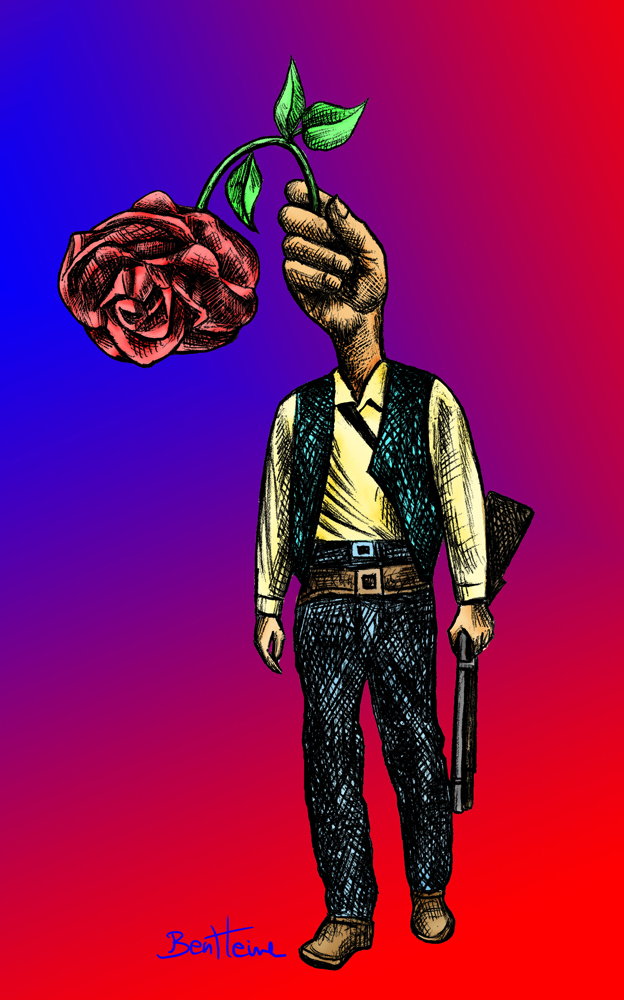
Kill The Opium In Our Heads
Verse
By Nizar Qabbani

Friends
The old word is dead.
The old books are dead.
Our speech with holes like worn-out shoes is dead.
Dead is the mind that led to defeat.

Our poetry has gone sour.
Women's hair, nights, curtains and sofas
Have gone sour.
Everything has gone sour.

My grieved country,
In a flash
You changed me from a poet who wrote love poems
To a poet who writes with a knife

What we feel is beyond words:
We should be ashamed of our poems.

Stirred by Oriental bombast,
By boastful swaggering that never killed a fly,
By the fiddle and the drum,
We went to war,
And lost.

Our shouting is louder than out actions,
Our swords are taller than us,
This is our tragedy.

In short
We wear the cape of civilisation
But our souls live in the stone age

You dont win a war
With a reed and a flute.

Our impatience
Cost us fifty thousand new tents.

Dont curse heaven
If it abandons you,
Dont curse circumstances,
God gives victory to whom He wishes
God is not a blacksmith to beat swords.

It's painful to listen to the news in the morning
It's painful to listen to the barking of dogs.

Our enemies did not cross our borders
They crept through our weaknesses like ants.

Five thousand years
Growing beards
In our caves.
Our currency is unknown,
Our eyes are a haven for flies.
Friends,
Smash the doors,
Wash your brains,
Wash your clothes.
Friends,
Read a book,
Write a book,
Grow words, pomegranates and grapes,
Sail to the country of fog and snow.
Nobody knows you exist in caves.
People take you for a breed of mongrels.

We are a thick-skinned people
With empty souls.
We spend our days practicing witchraft,
Playing chess and sleeping.
Are we the 'Nation by which God blessed mankind'?

Our desert oil could have become
Daggers of flame and fire.
We're a disgrace to our noble ancestors:
We let our oil flow through the toes of whores.

We run wildly through the streets
Dragging people with ropes,
Smashing windows and locks.
We praise like frogs,
Turn midgets into heroes,
And heroes into scum:
We never stop and think.
In mosques
We crouch idly,
Write poems,
Proverbs,
Beg God for victory
Over our enemy

If i knew I'd come to no harm,
And could see the Sultan,
This is what i would say:
'Sultan,
Your wild dogs have torn my clothes
Your spies hound me
Their eyes hound me
Their noses hound me
Their feet hound me
They hound me like Fate
Interrogate my wife
And take down the name of my friends.
Sultan,
When I came close to your walls
and talked about my pains,
Your soldiers beat me with their boots,
Forced me to eat my shoes.
Sultan,
You lost two wars,
Sultan,
Half of our people are without tongues,
What's the use of a poeple without tongues?
Half of our people
Are trapped like ants and rats
Between walls.'
If i knew I'd come to no harm
I'd tell him:
'You lost two wars
You lost touch with children.'

If we hadn't buried our unity
If we hadn't ripped its young body with bayonets
If it had stayed in our eyes
The dogs wouldn't have savaged our flesh.

We want an angry generation
To plough the sky
To blow up history
To blow up our thoughts.
We want a new generation
That does not forgive mistakes
That does not bend.
We want a generation of giants.

Arab children,
Corn ears of the future,
You will break our chains,
Kill the opium in our heads,
Kill the illusions.
Arab children,
Don't read about our suffocated generation,
We are a hopeless case.
We are as worthless as a water-melon rind.
Dont read about us,
Dont ape us,
Dont accept us,
Dont accept our ideas,
We are a nation of crooks and jugglers.
Arab children,
Spring rain,
Corn ears of the future,
You are the generation
That will overcome defeat.
----------------------------------
--> Source : Old Poetry
New artwork by my brother in art,
Marcin Bondarowicz
.
Why Marx is Man of the Moment
.

He had globalization sussed 150 years ago
by Francis Wheen (*)


A penniless asylum seeker in London was vilified across two pages of the Daily Mail last week. No surprises there, perhaps - except that the villain in question has been dead since 1883. 'Marx the Monster' was the Mail's furious reaction to the news that thousands of Radio 4 listeners had chosen Karl Marx as their favorite thinker. 'His genocidal disciples include Stalin, Mao, Pol Pot - and even Mugabe. So why has Karl Marx just been voted the greatest philosopher ever?'

The puzzlement is understandable. Fifteen years ago, after the collapse of communism in Eastern Europe, there appeared to be a general assumption that Marx was now an ex-parrot. He had kicked the bucket, shuffled off his mortal coil and been buried forever under the rubble of the Berlin Wall. No one need think about him - still less read him - ever again.

'What we are witnessing,' Francis Fukuyama proclaimed at the end of the Cold War, 'is not just the ... passing of a particular period of postwar history, but the end of history as such: that is, the end point of mankind's ideological evolution.'

But history soon returned with a vengeance. By August 1998, economic meltdown in Russia, currency collapses in Asia and market panic around the world prompted the Financial Times to wonder if we had moved 'from the triumph of global capitalism to its crisis in barely a decade'. The article was headlined 'Das Kapital Revisited'.

Even those who gained most from the system began to question its viability. The billionaire speculator George Soros now warns that the herd instinct of capital-owners such as himself must be controlled before they trample everyone else underfoot. 'Marx and Engels gave a very good analysis of the capitalist system 150 years ago, better in some ways, I must say, than the equilibrium theory of classical economics,' he writes. 'The main reason why their dire predictions did not come true was because of countervailing political interventions in democratic countries. Unfortunately we are once again in danger of drawing the wrong conclusions from the lessons of history. This time the danger comes not from communism but from market fundamentalism.'

In October 1997 the business correspondent of the New Yorker, John Cassidy, reported a conversation with an investment banker. 'The longer I spend on Wall Street, the more convinced I am that Marx was right,' the financier said. 'I am absolutely convinced that Marx's approach is the best way to look at capitalism.' His curiosity aroused, Cassidy read Marx for the first time. He found 'riveting passages about globalization, inequality, political corruption, monopolization, technical progress, the decline of high culture, and the enervating nature of modern existence - issues that economists are now confronting anew, sometimes without realizing that they are walking in Marx's footsteps'.

Quoting the famous slogan coined by James Carville for Bill Clinton's presidential campaign in 1992 ('It's the economy, stupid'), Cassidy pointed out that 'Marx's own term for this theory was "the materialist conception of history", and it is now so widely accepted that analysts of all political views use it, like Carville, without any attribution.'

Like Molière's bourgeois gentleman who discovered to his amazement that for more than 40 years he had been speaking prose without knowing it, much of the Western bourgeoisie absorbed Marx's ideas without ever noticing. It was a belated reading of Marx in the 1990s that inspired the financial journalist James Buchan to write his brilliant study Frozen Desire: An Inquiry into the Meaning of Money (1997).

'Everybody I know now believes that their attitudes are to an extent a creation of their material circumstances,' he wrote, 'and that changes in the ways things are produced profoundly affect the affairs of humanity even outside the workshop or factory. It is largely through Marx, rather than political economy, that those notions have come down to us.'

Even the Economist journalists John Micklethwait and Adrian Wooldridge, eager cheerleaders for turbo-capitalism, acknowledge the debt. 'As a prophet of socialism Marx may be kaput,' they wrote in A Future Perfect: The Challenge and Hidden Promise of Globalization (2000), 'but as a prophet of the "universal interdependence of nations" as he called globalization, he can still seem startlingly relevant.' Their greatest fear was that 'the more successful globalization becomes the more it seems to whip up its own backlash' - or, as Marx himself said, that modern industry produces its own gravediggers.

The bourgeoisie has not died. But nor has Marx: his errors or unfulfilled prophecies about capitalism are eclipsed and transcended by the piercing accuracy with which he revealed the nature of the beast. 'Constant revolutionizing of production, uninterrupted disturbance of all social conditions, everlasting uncertainty and agitation distinguish the bourgeois epoch from all earlier ones,' he wrote in The Communist Manifesto.

Until quite recently most people in this country seemed to stay in the same job or institution throughout their working lives - but who does so now? As Marx put it: 'All that is solid melts into air.'

In his other great masterpiece, Das Kapital, he showed how all that is truly human becomes congealed into inanimate objects - commodities - which then acquire tremendous power and vigor, tyrannizing the people who produce them.

The result of this week's BBC poll suggests that Marx's portrayal of the forces that govern our lives - and of the instability, alienation and exploitation they produce - still resonates, and can still bring the world into focus. Far from being buried under the rubble of the Berlin Wall, he may only now be emerging in his true significance. For all the anguished, uncomprehending howls from the right-wing press, Karl Marx could yet become the most influential thinker of the 21st century.
------------------------------------------------------------

(*) Francis Wheen is a journalist and author of several books, including a highly acclaimed biography of Karl Marx. His collected journalism, Hoo-Hahs and Passing Frenzies, won the George Orwell prize in 2003. Francis Wheen's new book, How Mumbo-Jumbo Conquered the World: A Short History of Modern Delusions, is published by Fourth Estate.
Buy How Mumbo-Jumbo Conquered the World at Amazon.co.uk

--> Francis Wheen's top 10 modern delusions (Excellent)

--> Source : Commondreams.org (July 2005)


The House of my Mother and Father
.
Syria : Modernity and History
(Ben Heine © Cartoons)

Damascus, What Are You Doing
to Me?

By Nizar Qabbani (*)


My voice rings out, this time, from Damascus
It rings out from the house of my mother and father
In Sham. The geography of my body changes.
The cells of my blood become green.
My alphabet is green.
In Sham. A new mouth emerges for my mouth
A new voice emerges for my voice
And my fingers
Become a tribe


I return to Damascus
Riding on the backs of clouds
Riding the two most beautiful horses in the world
The horse of passion.
The horse of poetry.
I return after sixty years
To search for my umbilical cord,
For the Damascene barber who circumcised me,
For the midwife who tossed me in the basin under the bed
And received a gold lira from my father,
She left our house
On that day in March of 1923
Her hands stained with the blood of the poem…


I return to the womb in which I was formed . . .
To the first book I read in it . . .
To the first woman who taught me
The geography of love . . .
And the geography of women . . .


I return
After my limbs have been strewn across all the continents
And my cough has been scattered in all the hotels
After my mother’s sheets scented with laurel soap
I have found no other bed to sleep on . . .
And after the “bride” of oil and thyme
That she would roll up for me
No longer does any other "bride" in the world please me
And after the quince jam she would make with her own hands
I am no longer enthusiastic about breakfast in the morning
And after the blackberry drink that she would make
No other wine intoxicates me . . .


I enter the courtyard of the Umayyad Mosque
And greet everyone in it
Corner to . . . corner
Tile to . . . tile
Dove to . . . dove
I wander in the gardens of Kufi script
And pluck beautiful flowers of God’s words
And hear with my eye the voice of the mosaics
And the music of agate prayer beads
A state of revelation and rapture overtakes me,
So I climb the steps of the first minaret that encounters me
Calling:
“Come to the jasmine”

--> Read the end of the poem
-------------------------------

(*)Qabbani was revered by generations of Arabs for his sensual and romantic verse. His work was featured not only in his two dozen volumes of poetry and in regular contributions to the Arabic-language newspaper Al Hayat, but in lyrics sung by Lebanese and Syrian vocalists who helped popularize his work.

--> Source : http://oldpoetry.com
Reading Music Leaves
.
(Ben Heine © Cartoons)
.
A poem by Andre de Korvin

Bad music couldn't sit still anymore
so it stood and
started walking, stumbling
like a drunken sailor.
These weren't the beautiful songs
written by people who thought
pianos had wings,
this was guts and guns music.
It was bound to explode
against the surface of progressive thinking,
bound to splatter, like oranges
thrown by angry policemen
at a convention of poets signing
iambic peace petitions.
Those oranges were red
so some warned
there would be pools of blood
wherever you stood.
.
--------------------------------------
--> This Poem originally appeared on A Poetic Justice
--> Warm thanks and welcome to Andre de Korvin

The Lover's Cot


Mart

.
She Walks In Beauty
by George Gordon, Lord Byron
.
She walks in beauty, like the night
Of cloudless climes and starry skies;
And all that's best of dark and bright
Meet in her aspect and her eyes:
Thus mellow'd to that tender light
Which heaven to gaudy day denies.
.
One shade the more, one ray the less,
Had half impair'd the nameless grace
Which waves in every raven tress,
Or softly lightens o'er her face;
Where thoughts serenely sweet express
How pure, how dear their dwelling-place.
.
And on that cheek, and o'er that brow,
So soft, so calm, yet eloquent,
The smiles that win, the tints that glow,
But tell of days in goodness spent,
A mind at peace with all below,
A heart whose love is innocent!
.
.
.
O Mistress Mine
by William Shakespeare
.
O Mistress mine, where are you roaming?
O, stay and hear; your true love's coming,
That can sing both high and low:
Trip no further, pretty sweeting;
Journeys end in lovers meeting,
Every wise man's son doth know.
.
What is love? 'Tis not hereafter;
Present mirth hath present laughter;
What's to come is still unsure:
In delay there lies not plenty;
Then, come kiss me, sweet and twenty,
Youth's a stuff will not endure.
.
Source of the poems : Love Poetry
Titu Maiorescu
.

Titu Maiorescu (1840 - 1917) was a Romanian literary critic and politician, founder of the Junimea Society. A member of the Conservative Party, he was Foreign Minister between 1910 and 1914 and Prime Minister of Romania from 1912 to 1914. He represented Romania at the Peace Conference in Bucharest that ended the Second Balkan War. In politics as in culture he favoured Germany over France. He opposed Romania's entry in World War I against Germany, but he nevertheless refused to collaborate with the German army after they had occupied Bucharest.
Happy St Valentine's Day
Servant Savant


Words Don't Kill, Weapons Do

The Pen is Mightier than the Sword

.
The Evolution of Religious Liberty
as a Universal Human Right
By Derek H. Davis (*)

The 20th century witnessed phenomenal growth in the number of democracies around the world. According to Freedom House, a nongovernmental organization that tracks and promotes the spread of democracy, the number of democracies worldwide has more than tripled (to 120) in the last 30 years. While the essence of democracy is rule by the people, most democracies today are “liberal” democracies, which means that fundamental rights or liberties of the citizens are built into the legal structure of the regime. These rights usually include freedom of speech, freedom of the press, freedom of assembly and freedom of religion.

Corresponding to the 20th century trend toward democratization is the evolution of religious liberty as a fundamental human right. Democracies are structured to accommodate difference and most countries today are populated by people with a range of religious commitments; thus religious liberty now is considered a basic human right, and indeed we can say that democracy over the last century or so has contributed to what could be termed the internationalization of religious human rights.

The Four Pillars of International Religious Freedom

Of the four major international documents that universalized the principle of religious liberty in recent decades, by far the most central is the Universal Declaration of Human Rights, adopted by the United Nations in 1948. This landmark document recognizes several important religious rights. Article 18 is the key text:

Everyone has the right to freedom of thought, conscience and religion; this right includes freedom to change his religion or belief, and freedom, either alone or in community with others and in public or private, to manifest his religion or belief in teaching, practice, worship and observance.

The declaration vigorously asserts that individual religious differences must be respected. It embraces the political principle that a key role of government is to protect religious choice, not to mandate religious conformity. It took centuries, even millennia, of religious wars and religious persecution for the majority of modern nation-states to come to this position, but the principle now is accepted widely, especially in the West. The modern principle of religious liberty, by which governments declare their neutrality on religious questions, leaving each individual citizen, on the basis of his/her own human dignity, to adopt his/her own religious beliefs without fear of reprisal, is an outgrowth of the Enlightenment’s emphasis on human freedom, which in turned helped spawn the rise of democracy. It received universal recognition in the 1948 declaration, undoubtedly the major milestone in the evolution of international religious liberty.

The declaration refers to "a common standard of achievement for all peoples and nations." Written in the aftermath of the unspeakable horrors of World War II, it provides a standard by which the peoples of the world may learn to live in peace and cooperation. If the world enjoys a greater measure of peace in the current millennium than in previous ones, it is possible that future historians will look to 1948 as the beginning of the new era of peace, much as we now look, for instance, to the year 313 (Edict of Milan) as the beginning of the Constantinian union of church and state, or 1517 (Martin Luther's posting of the 95 Theses) as the beginning of the Protestant Reformation. There simply is no way to overstate the significance of the Universal Declaration of Human Rights.

Whereas the declaration imposed a moral obligation upon all signatory nations, later documents went further in creating a legal obligation to comply with its broad principles. The International Covenant on Civil and Political Rights (1966), ratified to date by 144 nations, prohibits religious discrimination, as stated in Article 2 (1), "without distinction of any kind, such as race, color, sex, language, political or other opinion, national or social origin, property, birth or other status." Article 18 guarantees the same rights listed in Article 18 of the Universal Declaration, then adds more, including the right of parents to direct the religious education of their children. Article 20 prohibits incitement of hatred against others because of their religion, and Article 27 protects members of ethnic, religious or linguistic minorities from being denied the enjoyment of their own culture. Moreover, the 1966 covenant provides a broad definition of religion that encompasses both theistic and nontheistic religions as well as "rare and virtually unknown faiths."

The United Nations Declaration on the Elimination of All Forms of Intolerance and of Discrimination Based on Religion or Belief, adopted in 1981, is another key document protecting religious rights. Articles 1 and 6 provide a comprehensive list of rights regarding freedom of thought, conscience and religion. These include the right (1) to worship or assemble in connection with a religion or belief, and to establish and maintain places for these purposes; (2) to establish and maintain appropriate charitable or humanitarian institutions; (3) to make, to acquire and to use to an adequate extent the necessary articles and materials related to the rites or customs of a religion or belief; (4) to write, to publish and to disseminate relevant publications in these areas; (5) to teach a religion or belief in places suitable for these purposes; (6) to solicit and receive voluntary financial and other contributions from individuals and institutions; (7) to observe days of rest and to celebrate holy days and ceremonies in accordance with the precepts of one's religion or belief; and (8) to establish and maintain communications with individuals and communities in matters of religion and belief at the national and international levels.

Finally, the 1989 Vienna Concluding Document contains provisions similar to the 1948, 1966 and 1981 documents, urging respect for religious differences, especially among various faith communities. The participating nations specifically agree to ensure "the full and effective implementation of thought, conscience, religion or belief."

These international documents, in reality, are binding only on those nations that take steps to give them legal status. In other words, they are not self-executing. While the religious liberty protections contained in the international documents do not carry the effect of law, they already are shaping human rights law in participating nations, and they are a key feature of a developing and, one hopes, more peaceful world order. Nevertheless, today's world is one in which religion still is a source of great conflict, and fundamental principles of religious liberty are often more abused than respected. Can more be done to further religious liberty, and can the spread of democracy contribute to the advancement of religious liberty?

Transforming International Obligations into Reality


Religious persecution continues to be a serious problem worldwide despite the significant steps taken by the world community, particularly since World War II, to combat it. This is a sobering reminder that declarations, conventions and other documents do not translate easily into reality. Scholars have stressed at least five areas where broad institutional approaches may be effective in helping to make religious liberty not only a worldwide ideal, but also a worldwide reality.

Treaty Implementation
.
Nations must take seriously the provisions of international human rights treaties by integrating them into their own legal systems. It perhaps is tautologous to say that religious liberty in the world would be a given if all the countries of the world complied with the various conventions and other documents that have been adopted since World War II. That it is not, is reflective of the fact that too many governments afford themselves the luxury of basking in the glow of the ideals they signed on to while failing to take the necessary legal and other actions to make them a reality.

Legislation
.
Governments around the world should enact meaningful legislation designed to curb religious persecution. In 1998, the U.S. Congress passed the International Religious Freedom Act. This act mandates an annual report, prepared by the State Department’s Office of International Religious Freedom, that assesses and describes violations of religious liberty in each country. The department also considers the suggestions of a nine-member U.S. Commission on International Religious Freedom (USCIRF). Based on the annual report, the U.S. president may impose a range of penalties and sanctions on countries found to be violators. The legislation is controversial internationally, but the measure thus far has helped the cause of international religious liberty. The law does not attempt to impose "the American way" on other nations. Rather, it draws on the universally accepted belief in the inviolable dignity of all human beings and of the universal rights that flow from that belief, and the United States encourages other nations to adopt similar oversight measures.

Since the legislation was implemented, several countries repeatedly are cited for serious abuses of religious freedom. Among them are China, Cuba, North Korea, Iran, Saudi Arabia, and Uzbekistan. According to the State Department, in most cases the practice of religion in these countries "is often seen as a threat to the state's ideology or power." A number of countries have improved their records on religious freedom in recent years, however, including India, Georgia, Turkmenistan, the United Arab Emirates, and Vietnam. By way of illustration, "in October 2004 the UAE’s Ministry of Justice, Islamic Affairs, and Awqaf hosted an international conference on religion and terrorism that was designed to encourage moderation in preaching and condemn extremism and terrorism." Also, in June 2005, the United Arab Emirates created a law establishing the Zayed Center for Islamic Culture to promote interreligious tolerance and co-existence and to educate better people in the West on the meaning and practice of Islam. The extent to which such improvements were the result of the State Department's criticism in earlier-year reports is difficult to document, but it is arguable that the reports were strong motivating factors in bringing about some countries' improved records.

Education
.
More needs to be done to make the people of the world aware of the staggering level of religious persecution still prevalent in many parts of the world. More conferences and symposia could highlight this theme, and more support (verbal and monetary) could be provided to human rights nongovernmental organizations such as Human Rights Watch and the International Religious Liberty Association that monitor human rights abuses around the world and report them to governments and other concerned groups.

Separation of Church and State
.
There must be renewed efforts to increase respect by all political, religious and social institutions for the modern view that political society's primary interests are in fostering peace, justice, freedom and equality, not in advancing religion. This is the basic meaning of the separation of church and state. The obvious tension here, of course, is that historically, religion has been the basis for every dimension of life, including the political. As the eminent Quaker William Penn noted in 1692, "government seems to be a part of religion itself, a thing sacred in its institution and end." But of course Penn was a budding church-state separationist, and he increasingly moved to the view that religion is fundamentally a personal, individual concern, and government's role should be the protection of all religious outlooks rather than the advocacy of one. Since Penn's day, nation-states increasingly have adopted this perspective, and the 20th century's human rights documents have done the same. As already suggested, this perspective needs to be taught by educational institutions through a range of curricula that confront the interaction of religion and government in the modern world.

Spread of Democracy

Democracy is structured to accommodate difference, pluralism and diversity, thus promoting religious liberty. Totalitarian regimes often attempt to unify their nations around a common religion; the consequence often is religious repression and persecution of minority religions and a fundamental denial of the principle of freedom of thought and conscience. As democracy spreads, the result is likely to be less religious repression and a greater practice of religious liberty worldwide.

In the final analysis, we, as members of the world community, owe it to ourselves and to our progeny to make religious liberty a reality for everyone. There is no more important task in the 21st century. All nations should improve their commitments to making religious freedom a reality; indeed religious liberty can be promoted and practiced even in nondemocratic regimes. But if democracy is one of the tools to spread religious liberty as a universally recognized human right, then let democracy ring around the world.
-----------------------------------
.
>>> This essay originally appeared on US Info website
.
(*) Derek H. Davis, B.A., M.A., J.D., Ph.D., is a graduate of Baylor University and Baylor Law School and holds a Master of Arts in Church-State Studies from Baylor University and a Doctor of Philosophy in Humanities from the University of Texas at Dallas. He is Professor of Political Science and the Director of the J.M. Dawson Institute of Church-State Studies, Baylor University, Waco, Texas, which offers M.A. and Ph.D. degrees in Church-State Studies, conducts research and publishes books on church-state relations and religious liberty in national and international contexts, maintains the largest research library in the world pertaining to religious liberty and church-state relations, and sponsors conferences and lectureships on various church-state themes. He can be reached at Derek_Davis@baylor.edu

Nicolae Iorga
Nicolae Iorga was a Romanian historian, university professor, literary critic, memorialist, playwright, poet, and politician. He served as a member of Parliament, as President of the post-World-War-I National Assembly, as minister, and (1931-32) as Prime Minister. He was co-founder (in 1910) of the Democratic Nationalist Party and was ultimately assassinated by fascist Iron Guard (legionnaire) commandos.
.
Iorga attended University of Iaşi, where he graduated Magna Cum Laude after completing his undergraduate studies in a single year. He went on to study in Paris, Berlin, and Leipzig, obtaining his doctorate in 1893. A prolific author, he is estimated to have written 1,250 published volumes and 25,000 articles. He traveled extensively throughout Europe, and his written works in many languages bear out the claim that he could read, write, and speak virtually all of the major modern European languages.

Upon receiving his doctorate in 1893, Iorga became a member of the Romanian Academy, becoming a full member in 1911. From 1902 to 1906 he was the editor of the nationalist Sămănătorul review, moving on in 1906 to found the newspaper Neamul românesc. For the rest of his life, even while serving in Parliament or as a minister, he was a daily contributor to that paper.

As part of a group of a group of professors, physicians, soldiers, etc., he helped bring Scouting to Romania.

The co-founder, with Iorga, of the Democratic Nationalist Party was A.C. Cuza, a violent anti-Semite who split off in 1920 to found the National Democratic Christian Party, soon to be the National Christian Union, a precursor of Romanian Fascist groups such as the Iron Guard. Iorga shared Cuza's anti-Semitism, but was not as systematically anti-democratic as Cuza. In 1925, Iorga was briefly a member and honorary president of Iuliu Maniu's National Romanian Party, but left it, declaring it not to be a peasant organization but, according to A.L. Easterman, "a party of small-town lawyers promoting their own petty interests." He returned to his more customary role as a "One Man Opposition".

After General Ion Antonescu came to power upon the abdication of Carol II (September 7, 1940), Iorga was almost alone in publishing any defense of Carol. On the front page of Neamul românesc on September 9 he wrote that "It is an elementary duty of honour to recall the love with which he was summoned, at one time by the entire nation and to recognise the great efforts he made as our ruler to strengthen and develop our country." (Easterman 1942, 269) On September 15, writing of Maniu's role in helping to bring down Carol, he compared him to Robespierre as a politician who "…stands for morality above all else … cannot have committed any sin … can prove to everyone at all times that he has never made a mistake … cold, dominant, and cruel." He also attacked the Iron Guard as "corrupters of the nation".

Months later, on November 27, 1940, Iorga was assassinated by a group of Iron Guard commandos. The Iron Guard considered Iorga responsible for the 1938 death of their charismatic leader, Corneliu Zelea Codreanu: after Iorga (in his capacity as a minister) had backed the claim that Codreanu had slandered him, Codreanu was arrested and imprisoned, then was shot, putatively during an attempted prison escape. After the earthquake of 1940, when Iorga had to leave his damaged home in Vălenii de Munte for another residence in Sinaia, a group of legionnaire commandos from Bucharest took him from his house to the Strejnicu forest near Bucharest, tortured him, shot him in the back, stuffed a copy of the September 9 Neamul românesc in his mouth, desecrated his body, and left it by the side of a road.

In recent years, apologists for the Iron Guard have claimed that the assassination was performed not on the orders of the fascist leadership, but under the command of Soviet leader Joseph Stalin. However, this alternative is generally rejected by historians, especially since the Soviets have not been shown to have had consistent reason for such a move (if Iorga was indeed a vocal opponent of the cession of Bessarabia, Northern Bukovina and Hertza region to the Soviet state, so was the larger part of Romanian society).

Iorga's scientific activities partly reflect his lifelong beliefs. As a moderate nationalist and an advocate of peasant traditionalism (as exemplified by his association with Sămănătorul), Iorga became interested in tracing the history of the rural domains in old Wallachia and Moldavia. Thus, faced with the lack of sources related to Romanian events during the Dark Ages, and attempting to depict the process of transition from Roman Dacia to a Romance-speaking people (see Origin of Romanians), Iorga directed his efforts towards investigating the preservation of Roman customs by the peasantry. He spoke of peasant polities that would have survived to the Middle Ages, giving them the working title of Romanii populare (roughly: "People's Roman-like polities").

Iorga claimed that the Romanii would have served as the basis for relations between Hospodars (deemed peasant-voivodes) and the people (a development that was meant to cut off the medieval states from foreign influences). It got him into a polemic with modernist figure Eugen Lovinescu and Lovinescu's Sburătorul group. Lovinescu pointed out the persistence of external points of reference in early Romanian culture, and the latter's repeated attempts at being integrated in the wider, European, sphere (notably, with the indication that hospodars would usually dress according to Western fashions).

However, Iorga was by no means an advocate of Romanian preeminence and absolute originality. He was an internationally-acclaimed byzantinist (and the very first one in Romania), connecting the Romanian space with the Byzantine Empire and the Southeastern European sphere in general. His work Byzantium after Byzantium (1935) deals with the strong links established between the Empire and the two principalities in today's Romania. It depicts the developments after the Fall of Constantinople (1453), with the hospodars assuming the role of protectors of Eastern Orthodoxy (notably, by becoming the main patrons of Mount Athos), the perpetuation of Byzantine ceremonial customs, and the massive immigration of Byzantine clerks and intellectuals. Iorga moved away from the negative view most Romanian historians had taken of the Phanariotes.

In ample studies that dealt with Southeastern Europe in general, Nicolae Iorga contributed to the history of social and economical Byzantine structures, and investigated the role later Crusades (those of the 1300s and 1400s) played in shaping a common European identity. His other major field of work concentrated on the Ottoman Empire, with Iorga pointing out a reflection of Byzantium after Byzantium in Turkish ideology: he established that Eastern Orthodox institutions would have been given a new purpose after the conquest, since the new overlord was tolerant of them and the last years of Byzantine rule hade seen a forced union with Roman Catholicism (as the step taken by Emperors to ensure Western support for the besieged state). He also argued that the Sultans would have openly continued several essential Imperial policies.
.

Nicolae Iorga

--> Source : Wikipedia

One Another

Lost
Lighter Futures ?


Timeless Jewels

Roland0

Our Destiny Speaks Boldly, not We
.

(Ben Heine © Cartoons)

.
Let destiny speak boldly, loudly, clearly…
So its audience might hear.
Let me speak plainly with a bard’s tongue;
"We are bursting; heavyhearted of war."
.
The place of our end marches not with our beginning;
Crashing planets were not man’s doing,
Creation was and is not ours;
Stars, rain, wind, snow, ice-
None of these are our attainable.
Even in our imagined freedom
We cannot lower or raise them on cue.
.
Our fate rests not with the inescapable mysteries,
For they cannot instill such impending, reckless tragedy.
They bring not our minds `round to staging murderous war.
Of our antagonist stained creature they cannot torture,
Beyond this, we’ve only ourselves.
.
Incapable of stunting our malevolent beast
Or tongueless, limbless horror sleeping in our cave,
Stars shine, rains fall, snows waft, winds blow, ice holds.
.
Does man not see he shall not shape it, the world’s plot?
That the end of its play’s been written in the air?
That nature moves outside our paper and pen?
.
If tomorrow the stage were emptied of killing and war
And McDonalds and Wal-Mart and poets
And boys and girls and men and women
And daughters, sons, mothers and fathers
And fowl and fish and animal and terror,
.
The world would be quite powerless
To impede such a roaring ovation.
.
We’ve set it down to man’s actions, to humanity’s grace,
And only as the curtain drops shall our horror enter the light.
.
Copyright © 2006 mrp / thepoetryman
.

.

Our Anger Fouled
.

Let us take steps to confront our butchered age;
Cross the plains of reason, peering over the chasm.
Do not now upon time’s ripeness wait. It is here;
Black and bleeding, pulsing malevolence most foul,
Most ready… Take heed! Take heed! It is near!
.
Do you not sense its lunging forth of breathing
Like some blood-worn madman stalking gloom?
Bringing hair to mount in mockery our withered will,
Kicking our heels apace in pursuit of indifference,
Chiding our conscience, spurring us toward hell?
.
How can we learn of journeys taken upon this world
If we’re wholly numb inside our vacuous ideals?
How can we be so empty of splendor, we sever this;
Our very thoughts to spite the deadness, rotting flesh?
It is here! Our fetid love! Our anger-fouled civilization!
It is here! Goddamnit! It is here!
.
Holding our linens bleached of blood’s residue
We don the slippery and soiled scabbard of our end…
.
Copyright © 2006 mrp / thepoetryman
.

Crea(c)tivity
.
.
Janette Munoz : How do you define creativity?

Ben Heine : I think there are many definitions. Instinctively, I would say that creativity is a mental process involving ideas, imagination, originality and feelings. Creativity can also be achieved through chance. Creativity is the result of inspiration. The question is where does the inspiration come from? Something is creative when someone considers it creative. Anti creation is also a creative behaviour. When I try to be creative, I want to control what I'm doing and I'm “playing” with my imagination by mixing ideas. I use chance only to discover the qualities of new media I'm working with (for instance the effect of an acrylic colour on a specific type of paper, canvas...)


Do you believe that each person has the capacity to be creative? Why?

Yes, I do believe we all have the same capacity. We all have a creativity potential. We are all creative beings in a small or large scale. Somebody who has nothing (no financial wealth, no time, no artistic background…) can simply have a creative life by acting and speaking in an original way. Next to the technical achievements, the experience and the work, I think that the capacity to be creative has also a lot to do with material access, time, motivation...


How did you find your creative niche?

I always wanted to have my own style and niche. I have been criticized many times for not having a personal approach of creating. I was very disappointed and frustrated with this situation. I definitely think I didn’t find my final niche. I’m sure my works will continue to evolve. I’ll be influenced by other artists, by other styles and niches, by society itself and by my personal mistakes. The thing is that I know that if you want to be seen as a credible artist, you need to follow a single style. That’s a tremendous pressure. Each time I enter in a creative process, I’m a bit torn apart between this “style rule” (which is a stupid convention) and the desire to try different techniques.


Do you think creativity is innate or learned? Explain.

Well that's a good question. Honestly I believe it’s all learned. Creativity is a process that has to be trained. Like biking, when you get the confidence and the technique, then you don’t forget. And when I see the great accomplishments of artists friends, I have the impression that there are as many creativities as there are human beings.

Who or what experiences have inspired your work?

I have always been inspired by German expressionism (I think, for example, about the artwork of Otto Dix), by Belgian surrealism (for instance the famous Magritte and Delvaux) and by American Pop Art. I had a History of Art course when I was in Secondary School. The teacher of this course was a bright and passionate woman. She took us in several Belgian and French museums, explaining us many things. I think my passion started there. Passion is contagious. I began to draw. I remember of visiting an exhibition of the famous Greek-born Italian Surrealist Painter Giorgio de Chirico. I was seduced by his artwork and eccentricity. Then I discovered other artists and museums in my country and abroad. Each visit and each artist had an influence on my personal creations. Later, my journalism studies have brought me the political grounds to draw cartoons.


Have you always wanted to do what you are doing? If not, what made you decide to start?

The passion of painting came at a young age. I have always wanted to “create”, to “produce”. On the contrary, assimilation and imitation have always been hard to me. I started to make political cartoons when I couldn't stand anymore the social and political injustices worldwide.

Does spirituality and culture play a role in your creativity? Explain.

Yes. A lot. Especially when I draw cartoons, which have more political meaning than the paintings. When I paint, I usually use timeless symbols that don’t convey any direct opinion. With the political cartoon, culture is more important. I use cultural codes. Even if it’s not my purpose, some of these codes can hurt people and be misinterpreted by one or another culture.


How important is education to your creative process?

I feel that my artistic background is very important. As I said, I believe creativity is learned. The artistic education I received at school, at university, in the museums and in the company of great artists had and has a deep impact on my creative process. The way I create is also the result of the upraising I received. The fact that I was born in Africa and stayed there several years confronted me at a young age to different and noble values, and helped me to see the world in the way I perceive it. Again, I believe there is nothing “genetical” in the creation process; I rather have the conviction that it’s all “spiritual”. The only thing that may be has to do with genes is healthiness and resistance.


How do you deal with creativity blocks?

I’m lucky, because it almost never happens. When I don’t have ideas for a political realistic subject, or even for a surrealistic piece, then I do an abstract work. I really have no stereotype and I think all kinds of creation are worth. I’m usually not afraid of the “white page or white canvas”. Being creative is surely a challenge, but like in everything, it’s something you get used too. You can do less creative works that are still significant and important in the long term.


What part of you do you share in your creative endeavours?

My cartoons are usually related to day to day facts, political news, portraits of prominent persons… Through my drawings, I also want to defend the oppressed and suffering people. The paintings are certainly more about my personal life, even if I try to give them a "universal" message. I try to view society with different eyes. I try to translate feelings and situations in images and express odours and gestures with lines and colours. The paintings have to do with personal and collective emotions.


Have you had to overcome obstacles (physical, financial, social, etc.) in your creative world? Explain.

The main obstacle is the pressure of time. There are so many important subjects to deal with. This time problem generates other ones: it becomes a social problem. Cartooning is truly a life commitment. The social obstacle becomes a feeling of guiltiness. What is gained in one side is of course lost in the other…


Do you believe that it is important to be accepted by others as being creative or is just doing what you love to do enough to justify your work? Explain.

I don’ believe that’s important to be accepted by others as being creative. For me, it is really not important whether other people consider me to be a creative person or not. I’m rather glad when people don’t like my artworks. I’m even happier when they say it’s because they find them shocking. I just want my works to have concrete effects and influence. I want to interact with people, but I don’t care if they like it or not. I produce art with the hope to make this world a bit better...
----------------------
Interview by Janette Munoz