Showing posts with label poet. Show all posts
Ben by Other Artists
.
Ben Heine by Menekse, Turkish artist
.
Ben Heine by Bacsa, Hungarian artist.
Ben Heine by Zed, Croatian artist
.
Also this very nice poem my soulmate
Peter S. Quinn made for me:
.Through the Sweetness
.

By Peter S. Quinn
.
Through the sweetness of your smile
There is love in every beat
Doesn’t matter what is your style
In its inner most of treat
Feeling changes in what is real
Healing time close and near
You are everything that I did feel
Through emotions they did steer

Inside aching from the changes
Of pretending not to care
Tomorrow an opportunity rearranges
Of all clearances be aware
Time is precious through our waking
With so much to do and like
Never get enough in your making
When fate your beat will strike

Love is climbing through the sky
Every morning when you awake
From the low you will reach on high
With something better in the stake
Open wide like the opening books
You will find what you are looking for
In their prospects and their outlooks
In their layers and fresh metaphor

Through the sweetness of your smile
There is love in every beat
Doesn’t matter what is your style
In its inner most of treat
From the freshness of your inside
Where love pages open up wide
And your feelings are forever a guide
Through the days your emotions glide

You are love to find and give
With the dreams that go on by
Every waking up to again relive
In your realization out and try
Through moments that haven’t had enough
In their search and dialogue feel
When they start to become rough
In your hours that are for real

Love is climbing through the sky
Every morning when you awake
From the low you will reach on high
With something better in the stake
You are love with day and night
Turning on in the set off morning
Everything that the day shall light
Through its ways and in its yearning

Through the sweetness of your smile
There is love in every beat
Doesn’t matter what is your style
In its inner most of treat
Of coming hours and in their go
So much is still there to be seen
Anything that our differences know
And still lies there in between

.
Peter also made this nice melody
.
Thank you all!
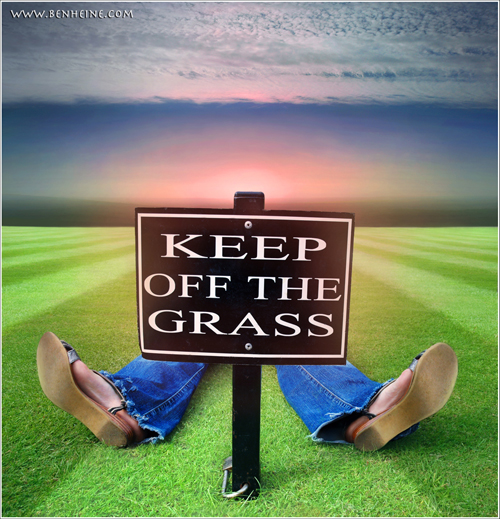
Relaxing On The Grass
.

© 2009 - Ben Heine
.
A picture I took around Oxford in England
.
Engaging
Hands of
Earth


A poem by Peter S. Quinn

Engaging hands of earth - you touch us still
Around and round in every transparent dream
Each bleaching falling glisten in quietness seem
Dear sweet autumn that my yearnings fulfill
Your smooth earthen mixture of shadings to thrill
With stars in your hair of yellow brown stream
Summer of gold is now leaving in gleam
Giving to dim every song in its skill

Withering dark to the changing grass confer
With ground tincturing that dresses the leaves
In the placid of days that are going by
Now is the time of full harvesting year
Just before tomorrow comes in with grieves:
Crack of dawn calm and the red clouded sky
.
Get On Through
.
Always Be a
Beginner to See


A poem by Peter S. Quinn

You, always be a beginner to see
The runaway in motions close from you
The street's not empty if there is a tree
Shadowing your footsteps from the sky blue
Each of your moments is nearly not fed
Like rain bowing colours in cyberspace
The prism of few: yellow, purple, blue, red
Coming and visiting each of your place
Come see a few pictures there in your mind
Experience passing longitude in line
If I'm not wrong and you're not colour-blind
It's hard all those shades clearly to define
Closed book gets open a guide to the way
How you each moment meet with a new day.
.
Lost Girafe on the Highway
.
Daydreaming Is
Often Bad


A poem by Peter S. Quinn

Daydreaming is often bad
Getting you nowhere at time
Living with once that you had
When it was early and prime

With every move and sensation
Giving you much to think
Love in its much tarnation
Into each catch like a blink

Riding on clouds to the far
Into the beguiled of their dark
Knowing sometimes what you are
Before on journeys you embark

When there's time just to know
What it is that you give me?
In every up and air blow
When we on dreams ride free

And if we are lost by a heart
In darker moments than some
Knowing when again then to start
To bring back where good is from

When we dream much of it
It isn't going to hurt us so much
We shall have time then to quit
Before it ever becomes to be such
.
The African Pony
.
Elemental Clouds

A poem by Peter S. Quinn

Elemental clouds now ride the skies alone
Through the bound of the net raindrops falling
I hear a little music from some pebble stone
While the drizzles are splashing and calling
Steams in the wild it’s the forest song
Flowing with its drum drops earth-rending
Something for my heart in harmony to long
Each the flower petals and leaves bending

You and I we had our different ways
Sunshine and the rain songs that we found
In slanting slashing sky like horses that gallop
Tinctures in its shades dyed many plays
To the underneath water lustrous around
A thought in a walloping like the raindrop
.
Peter S Quinn's Poetry
.
.
This Is My Heart

.
This is my heart to the world I carry
And bring every knot to its unleash
To break through the barriers of a worry
And making the peace to mankind with ease
Love song that blows here through the dimly breeze
With every hope that's hard to define
In future's new morning of green leafed trees
That through to the road shall once again shine

The reasons are captiv'd in breaking blow
If love is without its brethren passion
All of its hope shall only be like glow
That proves to be weak and out of fashion
So make harmonious peace that is dearly
And it shall show how big your heart's clearly
.
.
Swing Swing
.
Swing swing on my fortune index finger
Let me be your desiring destiny
Gadgets and opportunities swinger
Every past memories daydreams a b c
Times of wind blowing gathering clouds
And the colorful rainbows from the beyond
Gathering happiness together crowds
Afar oceans and every millpond

Each finger to build on to more treasures
That the air of point might someday fill
To give amount time to mankind's pleasure
When youth and its dreams climb the older hill
Everything from early life floating rays
Those were colors, but now have turned to grays
.
.
Do Not Pull the Trigger
.
Do not pull the trigger
‘Cause I might be much bigger
Than the creation of your thought
That from this gun is brought

My life may be in vain
Because of its struggles and pain
But give me another opportunity
Of what you thought of me

My heart is pulling up hill
In finding the colors to fill
To bring breath its death
And I again down to earth
.
.
Changing Masks
.
Changing masks of myriad subtleties today
In the colorful worlds we all live in
Spiral bounds to its many turning way
Head to head in tomorrow's coming spin
Waves from the sky through emotions of song
To follow your spirits from cloud to cloud
Dreams of your golden thrust spinning headlong
From concrete forests and to the street crowd

Opportunities of living color turn
Jesters of every man's inside juggling
Desiring shades that come to mind and burn
From their work about distances and struggling
Masks like transparent ornamentation
Theater of smiles and sadness sensation
.
All the above poems are by Peter S Quinn
and the illustrations by Ben Heine
.
Waiting For
My Rebirth

.
.
Waiting

.
By Robert Frost

What things for dream there are when specter-like,
Moving amond tall haycocks lightly piled,
I enter alone upon the stubbled filed,
From which the laborers' voices late have died,
And in the antiphony of afterglow
And rising full moon, sit me down
Upon the full moon's side of the first haycock
And lose myself amid so many alike.

I dream upon the opposing lights of the hour,
Preventing shadow until the moon prevail;
I dream upon the nighthawks peopling heaven,
Or plunging headlong with fierce twang afar;
And on the bat's mute antics, who would seem
Dimly to have made out my secret place,
Only to lose it when he pirouettes,
On the last swallow's sweep; and on the rasp
In the abyss of odor and rustle at my back,
That, silenced by my advent, finds once more,
After an interval, his instrument,
And tries once--twice--and thrice if I be there;
And on the worn book of old-golden song
I brought not here to read, it seems, but hold
And freshen in this air of withering sweetness;
But on the memor of one absent, most,
For whom these lines when they shall greet her eye.

(The poem appeared on americanpoems.com)

PS : This is a watercolour study (life drawing)
made at the Académie Royale des
Beaux Arts de Bruxelles
.

Creative Commons License
Aimé Césaire
.
.
Martinican politician, intellectual and
poet who was a founding father
of the négritude movement

.
By James Ferguson
.

Aimé Césaire, the Martinican intellectual and politician who has died aged 94, left his mark in two separate, seemingly contradictory, fields. As a poet, dramatist and essayist, he coined the term "négritude" to define the revolutionary black aesthetic that rallied French-speaking intellectuals in the Caribbean and Africa in the 1930s. His Cahier d'un retour au pays natal (Return to My Native Land), first published in 1939, is considered the undisputed masterpiece of négritude and a poetic milestone of militant anti-colonialism and metaphorical inventiveness.

At the same time, Césaire was a leading architect of departmentalisation, the process that transformed four French colonies - Martinique, Guadeloupe, Guyane (French Guiana) and Réunion - into fully fledged departments of France. While Césaire the poet inveighed against the cultural arrogance of Europe and celebrated a mythic African identity, Césaire the politician tied the mostly African-descended people of Martinique to the assimilationist structure of the French republic.

Césaire was born at Basse-Pointe, a small town on Martinique's north coast. Although in his Cahier he evoked his childhood as poverty-stricken and squalid, his family was part of the island's small, black middle class, with his father employed as a tax inspector. The family moved to the capital, Fort-de-France, where Césaire went to the Lycée Schoelcher. He was a prize-winning student, easily adapting to the elitist French education system which was entirely alien to the great majority of Creole-speaking rural Martinicans. In 1931 he won a place at the Lycée Louis-le-Grand in Paris. Four years later, he was admitted to the prestigious École Normale Supérieure, where he studied literature and philosophy.

Amid the ideological and cultural ferment of 1930s Paris, Césaire discovered a wide range of influences. In the company of African students such as Léopold Senghor (later president of Senegal), he familiarised himself with African culture and the continent's anti-colonialist movement.

He became interested in Marxism (although he was never an orthodox Marxist), read Harlem renaissance writers such as Langston Hughes and Claude McKay, and immersed himself in the various ephemeral journals and movements which proliferated during the inter-war years. In one such journal, L'Étudiant noir, he wrote an article attacking the cultural assimilation of blacks and counterposing négritude as a positive revaluation of African aesthetic values. Yet while Césaire was championing what he saw as a primitivist antidote to stultifying western rationalism, he was also on the treadmill of France's most elite academic institution, studying the classics of the official culture.

After eight years in Paris, Césaire returned to Martinique in August 1939, married to Suzanne Roussi, a fellow Martinican student and enthusiastic exponent of négritude. That same month, the first version of the Cahier appeared in an obscure Parisian journal, Volontés, eliciting no reaction whatsoever. For five years Césaire taught at the Lycée Schoelcher, inspiring a generation of students, among them the revolutionary psychiatrist and writer Frantz Fanon. He also edited a literary review, Tropiques, which popularised négritude themes of African culture and anti-colonialism among the island's intellectuals.

When André Breton, the high priest of the French surrealist movement, visited Martinique in 1941, he was impressed by Césaire's stature and poetry. According to Breton's own recollection, he found a copy of the Cahier in a Fort-de-France haberdashery, recognised it as a work of genius and relaunched the poet's career. In surrealism, moreover, Césaire found an aesthetic of irrationalism which coincided neatly with the anti-Cartesian precepts of négritude.

The war years were particularly harsh for Martinique, which was blockaded by the US navy in 1942-43, its white colonial rulers having sided with Pétain's Vichy regime. The enforced presence of thousands of French sailors encircled by a US fleet doubtless reinforced Césaire's hatred of racism. The emergence of the French Communist party (PCF) as the leading anti-Vichy force was another important development, and by 1942 Césaire was a member. In 1944, he escaped the claustrophobia of Fort-de-France and went on a lecture tour to Haiti. His exposure to the nation which had thrown off French colonial rule through revolution was a dramatic vindication of his négritude and reputedly cured his stammer. The heroic figures of Toussaint L'Ouverture and King Henri Christophe symbolised impoverished Haiti's grandeur and were later to feature prominently in Césaire's writing. He returned to a Martinique in political turmoil, where the PCF was capitalising on long pent-up aspirations for change in the colonial system. In rapid succession, in 1945, Césaire was elected mayor of Fort-de-France and a representative to the French constituent assembly, both on a PCF ticket. He was 32 years old; he held the mayoral office, with a brief interruption, for the next 56 years and, having been elected as deputy for Martinique to the national assembly in Paris in 1946, remained in post until 1993.

With the French colonies stagnating after decades of neglect and the privations of the war, Césaire and his colleagues on the left, both in Paris and the Caribbean, favoured political integration over independence, arguing that a "rational dependence" on France would quickly raise living standards through massive subsidies. The PCF-sponsored legislation creating the union was supported in a 1946 referendum, and Martinique and the other colonies became départements d'outre mer (Doms) or overseas departments of France, theoretically on a constitutional par with any French department.

But the rapid improvements anticipated by Césaire were slow to materialise. A highly centralised system of government from Paris gave too much power to a prefect; the subsidies from France were inadequate to rebuild the run-down island infrastructure. In 1958, Césaire voted in support of President de Gaulle's constitutional reforms which created the fifth republic and replaced the union with the "communauté française". These gave more political autonomy to the doms and also allowed Césaire to elaborate a political position which he held more or less consistently for the rest of his career: increased autonomy within a departmental relationship with France.

By then, moreover, he had shrugged off another form of centralising authority in the form of the PCF. In his Letter to Maurice Thorez (1956), he rejected Stalinism and the mechanistic downgrading of race and culture as diversions from class struggle. In 1958 he formed the Progressive Martinican party (PPM), an organisation which supported departmentalisation but demanded greater freedoms from metropolitan control. Re-elected mayor of Fort-de-France at every subsequent election and a deputy in Paris until his retirement in 1993, he was an efficient administrator and the personification of a status quo which most Martinicans found acceptable.

Despite his enduring electoral support, Césaire came under fire from both advocates of closer assimilation and supporters of independence. For the former, his demands for greater autonomy made Martinique an unjustified "special case" and threatened French goodwill. For the latter, departmentalisation had created a second-class citizenship and an artificial economy, held together only by French subsidies. President François Mitterrand's decentralisation measures in 1983 provided the PPM with some breathing space, allowing Césaire to claim that the doms would have a greater say in their development within a more regional framework of government. However, during the 1980s and 1990s advocates of independence made steady progress among a younger generation of Martinicans, accustomed to the subsidised welfare state and bored with the PPM's official line.

Césaire's literary work has also faced increasing criticism in recent years from younger Martinican writers who see négritude, with its mythic associations of primitivism, as irrelevant to a modern, non-African society. Although the republication of the Cahier in 1947 confirmed his status as a major 20th-century poet, Césaire never really achieved the same international success with subsequent work such as Soleil Cou Coupé (1947), or Ferrements (1960). His plays, dealing with historical aspects of colonialism, are little known outside France. As new Martinican writers stressed the importance of Creole as the medium for exploring the island's real culture, they derided Césaire's attachment to classical French as further evidence of his own assimilation to neo-colonial metropolitan values. The most ambiguous canonisation, meanwhile, took the form of the Cahier being included in the first-year French syllabus at Oxford University in 1996.

The contradictions at the heart of Césaire's career remained unresolved. Despite the massive importation of French consumerism into Martinique, he continued to argue that cultural autonomy could co-exist with departmentalisation. And despite the development of Martinique as a distant outpost of the EU, he persisted in looking to Africa as the source of authenticity. In his last years, he became irascible and would abruptly terminate interviews if the names of his political and literary critics were even mentioned.

Césaire's reputation as a poet rests largely on one epic expression of anti-colonial wrath and surrealist delirium; the Cahier has achieved the immortality that the French literary establishment bestows on certain works. But Césaire's legacy is perhaps more significant in the existence of a French department 7,000km away from France, whose people, for the time being at least, wish it to stay that way. His wife predeceased him; they had four sons and two daughters.

· Aimé Fernand Césaire, poet, playwright and politician, born June 26 1913; died April 17 2008

-------------------

--> This obituary appeared on The Guardian

Creative Commons License

Gilad Benari
photographer gilad benari, drawing by ben heine
Photographer Gilad Benari, drawing by ben heine

Gilad Benari is a talented photographer (conceptual artist more precisely) and poet. He is a big inspiration for me and for my evolution as a photographer. With his astounding photos, he lets us see the simple elements of our world in a different and beautiful way.

Gilad says: "I love to vary my experience in photography. I believe that the real joy in photography is in the trivial, in small things".

Gilad comes from Israel (Tel Aviv). The good thing with his photos is that they show another side of his country, often criticized because of it's offensive policy towards Palestine.

He explains: "Israel suffers an image of being a desert land, or simply a war zone, when showing it all over the world news. Being a photographer and a writer, I have a chance to show otherwise."

See his website,
his Deviant Art page
,
and
his Flick'r page.
Gilad can be contacted at :
giladbenari@walla.com

Below are some of my favorite
photos by him (click to enlarge) :

Tel Aviv Dance
.
Tall City

Azrieli Center
Two Burning Matches
Between Earth and Sky
One Day
Window of Opportunity
Clouds Factory

All above photos :
© Copyrights Gilad Benari

* * *
Narcissus, Photographer

By Erica Jong

Mirror-mad,
he photographed reflections:
sunstorms in puddles,
cities in canals,

double portraits framed
in sunglasses,
the fat phantoms who dance
on the flanks of cars.

Nothing caught his eye
unless it bent
or glistered
over something else.

He trapped clouds in bottles
the way kids
trap grasshoppers.
Then one misty day

he was stopped
by the windshield.
Behind him,
an avenue of trees,

before him,
the mirror of that scene.
He seemed to enter
what, in fact, he left.

(The poem appeared on ericajong.com)

Creative Commons License
Nichita Stanescu
.
.
"The only real things which we take with us in the end are our own feelings, our loves, our hates and adversities. I ask myself: at the end of life, what will we leave outside? I suppose we can leave some feelings, less of hate, some of passion, but... especially of love." (Nichita Stanescu)
.
An animal comes
and eats a boulder.
Then a barking dog comes,
which eats a rock.
Then a sort of nothing comes,
which eats sand.
Then I come and I eat this echo.
Echo of what?
Echo of “don't know what”
.
(Nichita Stanescu)
.

Nichita Stanescu was a Romanian poet and essayist. He is one of the most acclaimed contemporary Romanian poets, beloved by the public and generally held in esteem by literary critics.

Nichita Stanescu finished high school in Ploiesti, then went on to study Romanian language and literature in Bucharest, graduating in 1957. He made his literary debut in the Tribuna literary magazine.

Stanescu married Magdalena Petrescu in 1952, but the couple separated a year later. In 1962 he married Doina Ciurea. In 1982 he married Todoriţa "Dora" Tarita.

For much of his career, Stanescu was a contributor to and editor of Gazeta Literara;, România Literara; and Luceafarul.

His editorial debut was the poetry book Sensul iubirii ("The Aim of Love"), which appeared under the Luceafarul selection, in 1960. The last volume of poetry published in his lifetime was Noduri si semne ("Knots and Signs"), published in 1982.

Nichita Stanescu received numerous poetry awards, of which the most important was the Herder Prize (1975) as well as a Nobel Prize nomination.

Unfortunately, he died of hepatitis relatively young, leaving behind a legendary name and some of the most important poetry in post-war Romanian literature
-----------------------------
.
--> This caricature was sent to the Romanian Website Caricatura,
for the cultural project "Great Romanians 2007"
--> Source of the biography: Wikipedia
.

Tristan Tzara was a Romanian poet and essayist. He was one of the founders of the Dada movement, known best for his manifestos. He was a collaborater with Marcel Janco. It is speculated that the word "Dada" comes from the Romanian "Yes, yes" and is thusly originated from Tzara and Janco's contributions.

Tzara was born in Moinesti, Bacau, Romania to a family of Romanian-speaking Jewish ancestry. Tzara wrote the first Dada texts, La Première Aventure céleste de Monsieur Antipyrine (The First Heavenly Adventure of Mr. Antipyrine) (1916), Vingt-cinq poèmes (Twenty-Five Poems) (1918), and the movement's manifestos, Sept manifestes Dada (Seven Dada Manifestos) (1924).

In Paris he engaged in tumultuous activities with Dadaists André Breton, Philippe Soupault, and Louis Aragon to shock the public and to disintegrate the structures of language.

In late 1929, weary of nihilism and destruction, he joined his friends in the more constructive activities of Surrealism. He devoted much of his time to the reconciliation of Surrealism and Marxism and joined the French Communist Party in 1937. He was active in the French Resistance movement during World War II. He left the Communist Party in 1956, in protest against the Soviet quelling of the Hungarian Revolution.

His political commitments brought him closer to his fellow human beings, and he gradually matured into a lyrical poet. His poems revealed the anguish of his soul, caught between revolt and wonderment at the daily tragedy of the human condition. His mature works started with L'Homme approximatif (The Approximate Man) (1931), and continued with Parler seul (Speaking Alone) (1950), and La Face intérieure (The Inner Face) (1953). In these, the anarchically scrambled words of Dada were replaced with a difficult but humanized language. He died in Paris and was burried there in the famous Cimetière du Montparnasse.

-----------------------

--> Source : Wikipedia

.

Nicolae Iorga
Nicolae Iorga was a Romanian historian, university professor, literary critic, memorialist, playwright, poet, and politician. He served as a member of Parliament, as President of the post-World-War-I National Assembly, as minister, and (1931-32) as Prime Minister. He was co-founder (in 1910) of the Democratic Nationalist Party and was ultimately assassinated by fascist Iron Guard (legionnaire) commandos.
.
Iorga attended University of Iaşi, where he graduated Magna Cum Laude after completing his undergraduate studies in a single year. He went on to study in Paris, Berlin, and Leipzig, obtaining his doctorate in 1893. A prolific author, he is estimated to have written 1,250 published volumes and 25,000 articles. He traveled extensively throughout Europe, and his written works in many languages bear out the claim that he could read, write, and speak virtually all of the major modern European languages.

Upon receiving his doctorate in 1893, Iorga became a member of the Romanian Academy, becoming a full member in 1911. From 1902 to 1906 he was the editor of the nationalist Sămănătorul review, moving on in 1906 to found the newspaper Neamul românesc. For the rest of his life, even while serving in Parliament or as a minister, he was a daily contributor to that paper.

As part of a group of a group of professors, physicians, soldiers, etc., he helped bring Scouting to Romania.

The co-founder, with Iorga, of the Democratic Nationalist Party was A.C. Cuza, a violent anti-Semite who split off in 1920 to found the National Democratic Christian Party, soon to be the National Christian Union, a precursor of Romanian Fascist groups such as the Iron Guard. Iorga shared Cuza's anti-Semitism, but was not as systematically anti-democratic as Cuza. In 1925, Iorga was briefly a member and honorary president of Iuliu Maniu's National Romanian Party, but left it, declaring it not to be a peasant organization but, according to A.L. Easterman, "a party of small-town lawyers promoting their own petty interests." He returned to his more customary role as a "One Man Opposition".

After General Ion Antonescu came to power upon the abdication of Carol II (September 7, 1940), Iorga was almost alone in publishing any defense of Carol. On the front page of Neamul românesc on September 9 he wrote that "It is an elementary duty of honour to recall the love with which he was summoned, at one time by the entire nation and to recognise the great efforts he made as our ruler to strengthen and develop our country." (Easterman 1942, 269) On September 15, writing of Maniu's role in helping to bring down Carol, he compared him to Robespierre as a politician who "…stands for morality above all else … cannot have committed any sin … can prove to everyone at all times that he has never made a mistake … cold, dominant, and cruel." He also attacked the Iron Guard as "corrupters of the nation".

Months later, on November 27, 1940, Iorga was assassinated by a group of Iron Guard commandos. The Iron Guard considered Iorga responsible for the 1938 death of their charismatic leader, Corneliu Zelea Codreanu: after Iorga (in his capacity as a minister) had backed the claim that Codreanu had slandered him, Codreanu was arrested and imprisoned, then was shot, putatively during an attempted prison escape. After the earthquake of 1940, when Iorga had to leave his damaged home in Vălenii de Munte for another residence in Sinaia, a group of legionnaire commandos from Bucharest took him from his house to the Strejnicu forest near Bucharest, tortured him, shot him in the back, stuffed a copy of the September 9 Neamul românesc in his mouth, desecrated his body, and left it by the side of a road.

In recent years, apologists for the Iron Guard have claimed that the assassination was performed not on the orders of the fascist leadership, but under the command of Soviet leader Joseph Stalin. However, this alternative is generally rejected by historians, especially since the Soviets have not been shown to have had consistent reason for such a move (if Iorga was indeed a vocal opponent of the cession of Bessarabia, Northern Bukovina and Hertza region to the Soviet state, so was the larger part of Romanian society).

Iorga's scientific activities partly reflect his lifelong beliefs. As a moderate nationalist and an advocate of peasant traditionalism (as exemplified by his association with Sămănătorul), Iorga became interested in tracing the history of the rural domains in old Wallachia and Moldavia. Thus, faced with the lack of sources related to Romanian events during the Dark Ages, and attempting to depict the process of transition from Roman Dacia to a Romance-speaking people (see Origin of Romanians), Iorga directed his efforts towards investigating the preservation of Roman customs by the peasantry. He spoke of peasant polities that would have survived to the Middle Ages, giving them the working title of Romanii populare (roughly: "People's Roman-like polities").

Iorga claimed that the Romanii would have served as the basis for relations between Hospodars (deemed peasant-voivodes) and the people (a development that was meant to cut off the medieval states from foreign influences). It got him into a polemic with modernist figure Eugen Lovinescu and Lovinescu's Sburătorul group. Lovinescu pointed out the persistence of external points of reference in early Romanian culture, and the latter's repeated attempts at being integrated in the wider, European, sphere (notably, with the indication that hospodars would usually dress according to Western fashions).

However, Iorga was by no means an advocate of Romanian preeminence and absolute originality. He was an internationally-acclaimed byzantinist (and the very first one in Romania), connecting the Romanian space with the Byzantine Empire and the Southeastern European sphere in general. His work Byzantium after Byzantium (1935) deals with the strong links established between the Empire and the two principalities in today's Romania. It depicts the developments after the Fall of Constantinople (1453), with the hospodars assuming the role of protectors of Eastern Orthodoxy (notably, by becoming the main patrons of Mount Athos), the perpetuation of Byzantine ceremonial customs, and the massive immigration of Byzantine clerks and intellectuals. Iorga moved away from the negative view most Romanian historians had taken of the Phanariotes.

In ample studies that dealt with Southeastern Europe in general, Nicolae Iorga contributed to the history of social and economical Byzantine structures, and investigated the role later Crusades (those of the 1300s and 1400s) played in shaping a common European identity. His other major field of work concentrated on the Ottoman Empire, with Iorga pointing out a reflection of Byzantium after Byzantium in Turkish ideology: he established that Eastern Orthodox institutions would have been given a new purpose after the conquest, since the new overlord was tolerant of them and the last years of Byzantine rule hade seen a forced union with Roman Catholicism (as the step taken by Emperors to ensure Western support for the besieged state). He also argued that the Sultans would have openly continued several essential Imperial policies.
.

Nicolae Iorga

--> Source : Wikipedia