.
28 February 2007
27 February 2007
The Nobel Peace Prize winner has been deeply involved in Middle East policies for the past three decades. As president he negotiated the Camp David Accords - which secured a lasting peace between Israel and Egypt.
In his new book, Jimmy Carter writes, "Israel's continued control and colonization of Palestinian land have been the primary obstacles to a comprehensive peace agreement in the Holy Land." Carter criticizes Israel for building what he describes as an imprisonment wall through the West Bank. He accuses Israel of strangling the residents of Gaza where the poverty rate has reached 70 percent and where the malnutrition rate mirrors countries in Sub-Saharan Africa.
Some of the most vocal critics of Carter's book have been fellow Democrats. Incoming House Speaker Nancy Pelosi said, "It is wrong to suggest that the Jewish people would support a government in Israel or anywhere else that institutionalizes ethnically based oppression, and Democrats reject that allegation vigorously."
John Conyers, the incoming chair of the House Judiciary Committee, urged Carter to change the title of the book, which he described as "offensive and wrong."
Meanwhile, the nation's newspapers have largely ignored Jimmy Carter's book since its publication two weeks ago. The book hasn't even been mentioned in the news pages of the New York Times, Washington Post, Wall Street Journal, USA Today, Boston Globe or Los Angeles Times.
Interview of Jimmy Carter,
Secondly, the words “Palestine: Peace Not Apartheid” were carefully chosen by me. First of all, it's Palestine, the area of Palestinians. It doesn't refer to Israel. I’ve never and would imply that Israel is guilty of any form of apartheid in their own country, because Arabs who live inside Israel have the same voting rights and the same citizenship rights as do the Jews who live there.
And the next word is “peace.” And my hope is that the publication of this book will not only precipitate debate, as I’ve already mentioned, but also will rejuvenate an absolutely dormant or absent peace process. For the last six years there's not been one single day of good faith negotiations between Israelis and their neighbors, the Palestinians. And this is absolutely a departure from what has happened under all previous presidents since Israel became a nation. We’ve all negotiated or attempted to negotiate peace agreements. That has been totally absent now for six years. So “peace.”
And then the last two words, “not apartheid.” The alternative to peace is apartheid, not inside Israel, to repeat myself, but in the West Bank and Gaza and East Jerusalem, the Palestinian territory. And there, apartheid exists in its more despicable forms, that Palestinians are deprived of basic human rights. Their land has been occupied and then confiscated and then colonized by the Israeli settlers. And they have now more than 205 settlements in the West Bank itself. And what has happened is, over a period of years, the Israelis have connected settlements with highways, and those highways make the West Bank look like a honeycomb and maybe a spider web. You can envision it. And in many cases, most cases, the Palestinians are prevented from using the highways at all, and in many cases, even from crossing the highways.
I’d like to make one other point. When Israel was founded back in 1948 by the United Nations, Israel was allocated 56% of what we would call “the holy land” between Jordan and the Mediterranean Sea. After the wars, when the Arabs tried to destroy Israel, treaties were worked out, and Israel wound up with 77% of the holy land. 22% was designated as the West Bank, and 1% only, Gaza. So at the optimum case, as recognized by all the United Nations resolutions, Israel would wind up with 77% of the area, and the Palestinians only 23%, including Gaza and the West Bank. And remember that Gaza is on the sea coast, where the Philistines lived during the time of King David, and it’s separated by 40 kilometers, about 30 miles, from the rest of Palestinian territory. So in order for a Palestinian to go from Gaza to the West Bank, they have to go through 30 miles of Israeli land, though that’s just a geographical description.
This book is designed to restimulate the prospect for peace. And I’m going to just read three options that Israelis face. And I’d like to say at the beginning that none of them are completely acceptable to all Israelis. But for the last 40 years, a strong majority of Israelis have preferred to relinquish Arab land in return for peace. And this sentiment prevailed until the time when Prime Minister Rabin was assassinated by an irate Israeli who didn't like what Rabin and Shimon Peres had done at Oslo in negotiating a peace agreement for which they both received the Nobel Peace Prize.
Although a clear majority of Israelis are persistently willing to accept terms that are tolerable to most of their Arab neighbors, it is clear that none of the options is attractive for all of the Israelis. And these are the three options. First one has been discussed quite extensively and most persistently by the present prime minister of Israel, Ehud Olmert, who presented this thesis quite early in his career as a young member of the Israeli parliament -- he's now the prime minister -- a forceful annexation of Palestine and its legal absorption into Israel, which would give large numbers of non-Jewish citizens the right to vote and live as equals under the law. So, a large sectarian nation involving both Israelis and Palestinians is this option.
This would directly violate international standards and the Camp David Accords, which are the basis for peace with Egypt. At the same time, non-Jewish citizens would immediately make up a powerful swing vote if other Israelis were divided. In other words, if Israelis, who now have a majority, were divided 60-40 or 50-50, as you could see, then if the Palestinians voted as a bloc, they would prevail in establishing the basic policies of Israel, if other Israelis were divided.
It would also maybe constitute an outright majority in the new greater Israel. This is because of demographic trends. The Palestinians have a much higher birthrate than do the Israelis, the Israeli Jews. In fact, in Gaza, which I describe, the Palestinian birthrate is 4.7% annually, which is the highest in the world. And that means that in Gaza at this time, half their citizens are 15 years old or less. Israel would be further isolated and condemned by the international community. So I think within 20 years or less, in a combined Israel and Palestinian land, the Arabs would actually have a majority, more than the Jews.
Second, a system of apartheid -- this is, remember, in Palestine -- with two peoples occupying the same land but completely separated from each other, with Israelis totally dominant and suppressing violence by depriving Palestinians of their basic human rights. This is a policy now being followed, although many citizens of Israel deride the racist connotation, which I certainly don’t imply, of prescribing permanent second-class status for the Palestinians. As one prominent Israeli stated, quote, “I am afraid that we are moving toward a government like that of South Africa, with a dual society of Jewish rulers and Arab subjects with few rights of citizenship. The West Bank,” this Israel said, “is not worth it.” And that’s a majority -- that’s the opinion of a majority of Israelis.
An unacceptable modification of this choice now being proposed is the taking of substantial portions of the occupied territory with the remaining Palestinians completely surrounded by walls, fences and Israeli checkpoints, living as prisoners within the small portion of land left to them. I think you can quickly see the unacceptability of both of those options.
There's only one option left, and that is withdrawal to the 1967 border, as specified in UN Resolution 242 and as promised legally by the Israeli government in the Camp David Accords and the Oslo Agreement and prescribed in the Road Map of the International Quartet. You remember, the Quartet consists of the United States and Russia and the United Nations and the European Union. Those four comprise a Quartet. And they have devised the latest proposal, known as the Road Map for Peace, which has been enthusiastically endorsed by President Bush, as you know. This is the most attractive option and the only one that can ultimately be acceptable as a basis for peace. Good faith negotiations can lead to mutually agreeable exchanges of land, perhaps permitting a number of Israeli settlers to remain in their present homes near Jerusalem inside Palestinian territory.
One version of this choice was spelled out in the Geneva Initiative. The Geneva Initiative is described in a separate chapter. I was involved, in some ways, in the preparation of the Geneva Initiative, and I was there and made the keynote speech in Geneva when this initiative was prescribed. But what it does do is work out a compromise between the Palestinians and the Israelis through which about half of the total Israelis who live now in the West Bank could stay where they are, and the others would withdraw, which would still leave the Palestinians with a contiguous -- that is, a constant -- area of land over which they could have a united government of Palestinians.
And also a part of that was a swap of land. Whenever the Palestinians would give up part of their land, where the large Jewish settlements are built, then the Israelis would give up an equal amount of land that might lie just west of Gaza or some parts -- relatively uninhabited parts -- of Israel. So it was a swap of land for land.
The other step was the right of return. This is a very important thing for Palestinians, none of whom would give this up. It's guaranteed in United Nations Resolution 194. The right of Palestinians to return to their homeland, or either to be compensated for their property if they can prove that they actually have title to that property. And a compromise worked out in the Geneva Initiative was, okay, the Palestinians can return, but they can return only to Palestine. They cannot return to Israel, the new nation of Israel, unless Israelis approve each application for return. But they would still be -- have available to them some kind of compensation.
And the third major issue -- I’m summarizing very quickly -- is the settlement of the property, about who controls or owns East Jerusalem. And this is covered quite extensively throughout the book. But a very good compromise was reached, where the holy places would be under the complete control of the Arabs, on the one hand, and the Jews, on the other, including the Wailing Wall and the adjacent land. And then the rest of East Jerusalem would be administered by a joint commission that would take care of housing and schools and garbage collection and water and electricity and that sort of thing. So it was a very good compromise. In my opinion, ultimately something very close to the Geneva Initiative described in this book is the only avenue toward permanent peace for Israel, with justice and peace for their Palestinian neighbors.
So the book is deliberately -- I wouldn't say controversial, but it's deliberately designed to be provocative, because, as I said earlier, in Israel and in Europe, these kind of issues are debated every day, in a most vehement way, particularly in Israel. Pros and cons, arguing back and forth, in the news media, television, radio, the major newspapers. Never, in this country, do you hear any of these issues proposed publicly by an elected member of the House or the Senate or in the White House or NBC or ABC or CBS, New York Times, Washington Post, LA Times. Never. And I think it's time for Americans to start looking at the facts about the Mid-East situation. And only then, and based on the knowledge of the facts, will we ever have a chance to move forward and consummate a peace agreement that would give Israel what they need and what they deserve -- permanent peace, recognized by their neighbors and all Arab countries and the rest of the world -- and the Palestinians to have their human rights, their land and a chance to have their own state, side by side, living in peace with their Israeli neighbors.
Afterward President Jimmy Carter spoke about his book, "Palestine: Apartheid Not Peace," he took questions from the audience. He was asked to outline what a balanced US-Middle East policy would look like.
JIMMY CARTER: Yeah, the word “balance” is one that's almost unacceptable in our country. If you had a candidate for Congress running either Democratic or Republican and they announced to the general public, “I’m going to take a balanced position between the Israelis and the Palestinians,” they would never be elected. That's an impossibility in our country. But that doesn't preclude an incumbent administration from demonstrating with their own actions and words that they are concerned about Israeli peace, they are also concerned about peace and justice for the Palestinians. And that's what I did. It’s what Richard Nixon did. It’s what Ronald Reagan did after I left office. It’s what George Bush, Sr. did. It’s what Bill Clinton did. But it's not being done now.
There is a general feeling throughout the Arab world, throughout Europe, not even noticed in this country, that our present administration has not given any consideration, in my opinion, to the plight of the Palestinians. And you don't have to be anti-Israel to protect the rights of the Palestinians to have their own land and to live in peace and without being subjugated by an occupying power.
So I think that that is a proper approach. If it is impossible during the next two years of President Bush's administration for him to take that, to use your word, “balanced” approach, then as a fallback, it may be possible for the International Quartet to take that role. And that would obviously be the United States playing a major role, but not the only role, and for it to involve the United Nations and Russia and the European Union. And I think they could say, okay, let us orchestrate peace talks based on United Nations resolutions, based on the Camp David Agreement that I worked out, based on the Oslo Agreement, and based on the will of a majority of Israeli citizens, and based on the Road Map that we ourselves have prescribed.
By the way, every element of the Road Map has been adopted enthusiastically by the Palestinian side. None of the key elements in the Road Map have been adopted by the Israeli side. They have rejected all of them. And I have the actual action of the Israeli cabinet in the appendix to this book.
So, to summarize, the international group of leaders, the Quartet, could take strong action to implement the terms of the Road Map.
------------------------------------------
Carter's presidency saw the creation of two cabinet-level departments: the Department of Energy and the Department of Education. He bolstered the Social Security system by introducing a staggered increase in the payroll tax. In foreign affairs, Carter pursued the Camp David Accords, the Panama Canal Treaties, and the second round of the Strategic Arms Limitation Talks. The final year of his term was dominated by Iran hostage crisis, during which the United States struggled to rescue diplomats and American citizens held hostage in Tehran.
After leaving office, Carter founded the Carter Center to promote global health, democracy and human rights. He has traveled extensively to monitor international elections, conduct peace negotiations and establish relief efforts. As of 2007, he is the earliest living president and the second-oldest living president. (Source : Wikipedia)
25 February 2007
.
Friends
The old word is dead.
The old books are dead.
Our speech with holes like worn-out shoes is dead.
Dead is the mind that led to defeat.
Our poetry has gone sour.
Women's hair, nights, curtains and sofas
Have gone sour.
Everything has gone sour.
My grieved country,
In a flash
You changed me from a poet who wrote love poems
To a poet who writes with a knife
What we feel is beyond words:
We should be ashamed of our poems.
Stirred by Oriental bombast,
By boastful swaggering that never killed a fly,
By the fiddle and the drum,
We went to war,
And lost.
Our shouting is louder than out actions,
Our swords are taller than us,
This is our tragedy.
In short
We wear the cape of civilisation
But our souls live in the stone age
You dont win a war
With a reed and a flute.
Our impatience
Cost us fifty thousand new tents.
Dont curse heaven
If it abandons you,
Dont curse circumstances,
God gives victory to whom He wishes
God is not a blacksmith to beat swords.
It's painful to listen to the news in the morning
It's painful to listen to the barking of dogs.
Our enemies did not cross our borders
They crept through our weaknesses like ants.
Five thousand years
Growing beards
In our caves.
Our currency is unknown,
Our eyes are a haven for flies.
Friends,
Smash the doors,
Wash your brains,
Wash your clothes.
Friends,
Read a book,
Write a book,
Grow words, pomegranates and grapes,
Sail to the country of fog and snow.
Nobody knows you exist in caves.
People take you for a breed of mongrels.
We are a thick-skinned people
With empty souls.
We spend our days practicing witchraft,
Playing chess and sleeping.
Are we the 'Nation by which God blessed mankind'?
Our desert oil could have become
Daggers of flame and fire.
We're a disgrace to our noble ancestors:
We let our oil flow through the toes of whores.
We run wildly through the streets
Dragging people with ropes,
Smashing windows and locks.
We praise like frogs,
Turn midgets into heroes,
And heroes into scum:
We never stop and think.
In mosques
We crouch idly,
Write poems,
Proverbs,
Beg God for victory
Over our enemy
If i knew I'd come to no harm,
And could see the Sultan,
This is what i would say:
'Sultan,
Your wild dogs have torn my clothes
Your spies hound me
Their eyes hound me
Their noses hound me
Their feet hound me
They hound me like Fate
Interrogate my wife
And take down the name of my friends.
Sultan,
When I came close to your walls
and talked about my pains,
Your soldiers beat me with their boots,
Forced me to eat my shoes.
Sultan,
You lost two wars,
Sultan,
Half of our people are without tongues,
What's the use of a poeple without tongues?
Half of our people
Are trapped like ants and rats
Between walls.'
If i knew I'd come to no harm
I'd tell him:
'You lost two wars
You lost touch with children.'
If we hadn't buried our unity
If we hadn't ripped its young body with bayonets
If it had stayed in our eyes
The dogs wouldn't have savaged our flesh.
We want an angry generation
To plough the sky
To blow up history
To blow up our thoughts.
We want a new generation
That does not forgive mistakes
That does not bend.
We want a generation of giants.
Arab children,
Corn ears of the future,
You will break our chains,
Kill the opium in our heads,
Kill the illusions.
Arab children,
Don't read about our suffocated generation,
We are a hopeless case.
We are as worthless as a water-melon rind.
Dont read about us,
Dont ape us,
Dont accept us,
Dont accept our ideas,
We are a nation of crooks and jugglers.
Arab children,
Spring rain,
Corn ears of the future,
You are the generation
That will overcome defeat.
----------------------------------
--> Source : Old Poetry

--> Thanks to MWC News to have published my images to illustrate this beautiful poem by Nizar Qabbani.
| He had globalization sussed 150 years ago
The puzzlement is understandable. Fifteen years ago, after the collapse of communism in 'What we are witnessing,' Francis Fukuyama proclaimed at the end of the Cold War, 'is not just the ... passing of a particular period of postwar history, but the end of history as such: that is, the end point of mankind's ideological evolution.' But history soon returned with a vengeance. By August 1998, economic meltdown in Even those who gained most from the system began to question its viability. The billionaire speculator George Soros now warns that the herd instinct of capital-owners such as himself must be controlled before they trample everyone else underfoot. 'Marx and Engels gave a very good analysis of the capitalist system 150 years ago, better in some ways, I must say, than the equilibrium theory of classical economics,' he writes. 'The main reason why their dire predictions did not come true was because of countervailing political interventions in democratic countries. Unfortunately we are once again in danger of drawing the wrong conclusions from the lessons of history. This time the danger comes not from communism but from market fundamentalism.' In October 1997 the business correspondent of the New Yorker, John Cassidy, reported a conversation with an investment banker. 'The longer I spend on Wall Street, the more convinced I am that Marx was right,' the financier said. 'I am absolutely convinced that Marx's approach is the best way to look at capitalism.' His curiosity aroused, Cassidy read Marx for the first time. He found 'riveting passages about globalization, inequality, political corruption, monopolization, technical progress, the decline of high culture, and the enervating nature of modern existence - issues that economists are now confronting anew, sometimes without realizing that they are walking in Marx's footsteps'. Quoting the famous slogan coined by James Carville for Bill Clinton's presidential campaign in 1992 ('It's the economy, stupid'), Cassidy pointed out that 'Marx's own term for this theory was "the materialist conception of history", and it is now so widely accepted that analysts of all political views use it, like Carville, without any attribution.' Like Molière's bourgeois gentleman who discovered to his amazement that for more than 40 years he had been speaking prose without knowing it, much of the Western bourgeoisie absorbed Marx's ideas without ever noticing. It was a belated reading of Marx in the 1990s that inspired the financial journalist James Buchan to write his brilliant study Frozen Desire: An Inquiry into the Meaning of Money (1997). 'Everybody I know now believes that their attitudes are to an extent a creation of their material circumstances,' he wrote, 'and that changes in the ways things are produced profoundly affect the affairs of humanity even outside the workshop or factory. It is largely through Marx, rather than political economy, that those notions have come down to us.' Even the Economist journalists John Micklethwait and Adrian Wooldridge, eager cheerleaders for turbo-capitalism, acknowledge the debt. 'As a prophet of socialism Marx may be kaput,' they wrote in A Future Perfect: The Challenge and Hidden Promise of Globalization (2000), 'but as a prophet of the "universal interdependence of nations" as he called globalization, he can still seem startlingly relevant.' Their greatest fear was that 'the more successful globalization becomes the more it seems to whip up its own backlash' - or, as Marx himself said, that modern industry produces its own gravediggers. The bourgeoisie has not died. But nor has Marx: his errors or unfulfilled prophecies about capitalism are eclipsed and transcended by the piercing accuracy with which he revealed the nature of the beast. 'Constant revolutionizing of production, uninterrupted disturbance of all social conditions, everlasting uncertainty and agitation distinguish the bourgeois epoch from all earlier ones,' he wrote in The Communist Manifesto. Until quite recently most people in this country seemed to stay in the same job or institution throughout their working lives - but who does so now? As Marx put it: 'All that is solid melts into air.' In his other great masterpiece, Das Kapital, he showed how all that is truly human becomes congealed into inanimate objects - commodities - which then acquire tremendous power and vigor, tyrannizing the people who produce them. The result of this week's BBC poll suggests that Marx's portrayal of the forces that govern our lives - and of the instability, alienation and exploitation they produce - still resonates, and can still bring the world into focus. Far from being buried under the rubble of the Berlin Wall, he may only now be emerging in his true significance. For all the anguished, uncomprehending howls from the right-wing press, Karl Marx could yet become the most influential thinker of the 21st century. (*) Francis Wheen is a journalist and author of several books, including a highly acclaimed biography of Karl Marx. His collected journalism, Hoo-Hahs and Passing Frenzies, won the George Orwell prize in 2003. Francis Wheen's new book, How Mumbo-Jumbo Conquered the World: A Short History of Modern Delusions, is published by Fourth Estate. --> Francis Wheen's top 10 modern delusions (Excellent) --> Source : Commondreams.org (July 2005) |
24 February 2007
.
Syria : Modernity and History(Ben Heine © Cartoons)
Damascus, What Are You Doing
to Me?
By Nizar Qabbani (*)My voice rings out, this time, from Damascus
It rings out from the house of my mother and father
In Sham. The geography of my body changes.
The cells of my blood become green.
My alphabet is green.
In Sham. A new mouth emerges for my mouth
A new voice emerges for my voice
And my fingers
Become a tribe
I return to Damascus
Riding on the backs of clouds
Riding the two most beautiful horses in the world
The horse of passion.
The horse of poetry.
I return after sixty years
To search for my umbilical cord,
For the Damascene barber who circumcised me,
For the midwife who tossed me in the basin under the bed
And received a gold lira from my father,
She left our house
On that day in March of 1923
Her hands stained with the blood of the poem…
I return to the womb in which I was formed . . .
To the first book I read in it . . .
To the first woman who taught me
The geography of love . . .
And the geography of women . . .
I return
After my limbs have been strewn across all the continents
And my cough has been scattered in all the hotels
After my mother’s sheets scented with laurel soap
I have found no other bed to sleep on . . .
And after the “bride” of oil and thyme
That she would roll up for me
No longer does any other "bride" in the world please me
And after the quince jam she would make with her own hands
I am no longer enthusiastic about breakfast in the morning
And after the blackberry drink that she would make
No other wine intoxicates me . . .
I enter the courtyard of the Umayyad Mosque
And greet everyone in it
Corner to . . . corner
Tile to . . . tile
Dove to . . . dove
I wander in the gardens of Kufi script
And pluck beautiful flowers of God’s words
And hear with my eye the voice of the mosaics
And the music of agate prayer beads
A state of revelation and rapture overtakes me,
So I climb the steps of the first minaret that encounters me
Calling:
“Come to the jasmine”
--> Read the end of the poem
-------------------------------
(*)Qabbani was revered by generations of Arabs for his sensual and romantic verse. His work was featured not only in his two dozen volumes of poetry and in regular contributions to the Arabic-language newspaper Al Hayat, but in lyrics sung by Lebanese and Syrian vocalists who helped popularize his work.
--> Source : http://oldpoetry.com
22 February 2007
Reporters Without Borders issues its 2007 annual press freedom survey.
The survey reports on press freedom in 98 countries and includes the main violations of journalists’ rights in 2006 and regional aspects of media and Internet freedom.
“The report lists the worst violations in repressive countries, including major culprits North Korea, Eritrea, Cuba and Turkmenistan, but also looks at democracies, where progress needs to be made too,” the organisation says.
“A disturbingly record number of journalists and media workers were killed or thrown in prison around the world in 2006 and we are already concerned about 2007, as six journalists and four media assistants have been killed in January alone,” the report’s introduction says.
“But beyond these figures is the alarming lack of interest (and sometimes even failure) by democratic countries in defending the values they are supposed to incarnate."
“Almost everyone believes in human rights these days but amid the silences and behaviour on all sides, we wonder who now has the necessary moral authority to make a principled stand in favour of these freedoms.”
The publication by a Danish newspaper of cartoons of the Prophet Mohamed focused the world’s attention in 2006 on the issue of freedom of expression and respect for religious beliefs. Democratic countries did not defend Denmark, whose embassies were attacked, or the journalists who were threatened and arrested. Europe especially seemed to choose silence for fear of offending Arab or Muslims regimes.
Media workers in the Middle East were once again the victims of the region’s chronic instability. 65 journalists and media assistants were killed in Iraq and kidnappings were more frequent there and in the Palestinian Territories. Despite repeated promises, the region’s governments have not introduced significantly greater democracy.
In Latin America, the murder of nearly a dozen journalists in Mexico with virtual impunity, the continued imprisonment of more than a score in Cuba and the deteriorating situation in Bolivia (nevertheless the best-ranked country of the South in the Reporters Without Borders annual press freedom index) are all signals to the international community to be very vigilant.
Press freedom violations in Asia peaked with 16 media workers killed, at least 328 arrested, 517 physically attacked or threatened and 478 media outlets censored in 2006. Censorship is very widespread and complete freedom to speak and write is rare in Asia.
Many African governments, especially those in the Horn of Africa, distrust media workers. The killers of journalists are also not being punished and are still being protected by governments and all-powerful politicians in Gambia and Burkina Faso.
Dictatorships also seem to be tightening their grip on the Internet and at least 60 people are in prison for posting criticism of the government online. China, the leading offender, is being copied by Vietnam, Syria, Tunisia, Libya and Iran and more and more bloggers and cyber-dissidents are in jail.
------------------------------
--> Source : RSF
--> Annual report 2006
--> Annual report 2005
--> Annual report 2004
insult people or represent
things that do not exist..."
Murat Yilmaz is a Turkish illustrator and director of Karikaturevi. He was born in
.
1) How did you become a cartoonist?
I decided once to send my drawings to some magazines and newspapers. Most of them liked my works. Then I started to draw more and more. I have never stopped until now.
.
2) Which papers, magazines or websites do you work for?
I have been working for almost three years for a magazine named Semerkand. I’m also the founder of Karikaturevi, which means “The House of Cartoon” in Turkish. Karikaturevi is an interactive Website that gathers the drawings of worldwide cartoonists.
.
3) What elements usually strike you and inspire you in the political news?
Religion, countries’ history, people. Actually all kinds of dreadful injustice done to human beings interest me a lot. I try to show my indignation through my cartoons.
.
4) Do you think there should be limits to the cartoonist’s freedom of expression? If so, what are the « redlines »?
Yes, there should be. The cartoonists shouldn’t insult people or represent things that do not exist or that are not true in reality.
.
5) Is there only one freedom of expression or are there several ones? (Regarding the cultural differences from one country to another)
Each country and each people has its own culture. If there are different cultures then obviously there are different behaviours.
.
6) What do you think about the Holocaust cartoon contest organized by the Iranian newspaper Hamshari, in response to the caricatures of Muhammad published in several Europeans papers?
I think the persons who launched this contest could have rather organized an alternative competition about Muslim culture and about love between all human beings. Such an event would have broken the negative stereotypes towards Muslim. Artists around the world would have been encouraged to find more information about Muslim culture and realities to realize their artwork. They would have discovered by themselves what is true and what is not and they would have produced new reliable and correct cartoons about Muslims. Such a contest would have been a peaceful substitute to the growing hatred between West and East.
.
7) Have some of your drawings been censored? In which circumstances?
Yes, but the circumstances always change; it depends on the time and the country’s type of government.
.
8) Do you have any self-censorship? What are the most difficult subjects to represent?
Yes, I do have self-censorship.
If I cannot find enough information about the subject I’m working on, it becomes very difficult for me.
.
10) Do you think that the cartoonist is an artist or rather a journalist, or may be both?
It can be both of them.
.
11) According to you, does he have to make people laugh or to make them think?
According to me, it can be both at the same time. These purposes can also be separate.
.
12) What is for you the most difficult situation or person to draw?
It’s hard for me to draw about cartoons and cartoonists, because I belong to this world. So I don’t have an objective way of seeing things.
------------------------------------
--> Interview by Benjamin Heine
--> Visit Karikaturevi
21 February 2007
so it stood and
started walking, stumbling
like a drunken sailor.
These weren't the beautiful songs
written by people who thought
pianos had wings,
this was guts and guns music.
It was bound to explode
against the surface of progressive thinking,
bound to splatter, like oranges
thrown by angry policemen
at a convention of poets signing
iambic peace petitions.
Those oranges were red
so some warned
there would be pools of blood
wherever you stood.
.
--> This Poem originally appeared on A Poetic Justice
--> Warm thanks and welcome to Andre de Korvin
Sarkozy backs Charlie Hebdo
.A lawyer acting for Charlie Hebdo read out a letter in the Paris court where the case is being heard from Mr Sarkozy, who noted that he is often targeted by the magazine's cartoonists, but said he preferred "too many caricatures to an absence of caricature".
A representative for the French Council of the Muslim Faith, an umbrella organization of Muslim groups, branded interior minister Mr Sarkozy's support of the magazine "unacceptable".
"It's out of the question for a minister for religious affairs to take such a position. There's no neutrality," Abdallah Zekri said. In France, religious affairs fall under the mandate of the interior minister.
Two French Muslim organisations, the Great Mosque of Paris and the Union of Islamic Organisations of France, are suing Charlie Hebdo for "public insults against a group of people because they belong to a religion".
The case concerns an edition of Charlie Hebdo from February last year, a special issue on the Danish cartoons, in which it reprinted the 12 drawings first published in the Nordic daily Jyllands-Posten.
Charlie Hebdo also included its own cartoons lampooning other religious figures. The magazine and its publications director, Philippe Val, face the defamation charge, which carries a possible six-month prison sentence and a fine of up to €22,000 (£14,500).
In opening arguments in the defamation trial today Mr Val defended publication of the cartoons, saying they were aimed "at ideas, not men".
"If we no longer have the right to laugh at terrorists, what arms are citizens left with?" he added. "How is making fun of those who commit terrorist acts throwing oil on the fire?"
The leader of the French Socialist Party, Francois Hollande, and a centre-right candidate in the country's forthcoming presidential elections, Francois Bayrou, are also expected to testify on behalf of Charlie Hebdo.
The trial continues.
-----------------------------------------
--> This article originally appeared on MediaGuardian.co.uk
.
The Lover's Cot
.

In lasting grasp the lovers tongue’s promptly faded
And the stroke of burning desire’s a thrashing ache.
Their damp lips an ogre’s tapering,
Like the impulse to kill.
Outside our kingdom where the bough’s toss in the gale,
The shadows shift sudden radiance over stunned lovers,
The interruption comes loud and banging greedily
Through awkward fingers dancing on youthful breath
Seized with living.
There’s just one small cot for their sessions,
No room to operate,
No medicine or drugs
And no physician’s god-hand.
Our groping of liberation felled; belated, squandered.
Their lover’s face haggard, hollow eyes open, no remedy,
Limbs broken up and away... unable to reach one another.
19 February 2007
(Ben Heine © Cartoons).
Tension remains high in Gaza because of clashes between Fatah and Hamas militants, which increased when Mahmoud Abbas decided to hold new presidential and parliamentary elections. One of the main sticking points is Hamas’s refusal to recognise Israel formally.
.
By Paul Delmotte (*)
.
The failure to form a Palestinian coalition government again raises the question of why Hamas persists, despite considerable pressure at home and abroad, in refusing to recognise Israel officially and explicitly. The first answer, which is rarely discussed, is that Hamas is convinced that recognition would be a pointless concession.
It has not forgotten that for decades the international community pressured the Palestine Liberation Organisation (PLO) and Fatah, both secular bodies, to make the same concession: they were given nothing in return, neither a Palestinian state nor a capital in East Jerusalem. Worse, Israel did not accept any responsibility for the Palestinian exodus of 1947-49 nor did it recognise the right of return (or the entitlement to compensation) of some 5 million refugees.
In March 2006 the Israeli prime minister, Ehud Olmert, announced a unilateral programme of withdrawal from occupied territory, stipulating that Israel intended to keep 36.5% of the West Bank, not including East Jerusalem and the Jordan valley. This represented almost half of the 22% of the post-1949 Palestine on which Yasser Arafat had hoped to build a Palestinian state. Hamas consequently seems to have decided to stick to the position the PLO defended in the 1970s and 1980s, keeping recognition for Israel in reserve, while making a succession of minor statements reflecting de facto recognition of Israel.
Many commentators maintain that Hamas’s radical stance is due entirely to its Islamist world view. As the researchers Bruno Guigue (1) and Khaled Hroub (2) have often pointed out, this analysis of Hamas policy is based only on its charter, published in August 1988.
Hroub has analysed in detail three key documents published by Hamas since the charter: its autumn 2005 election manifesto, Change and Reform; its March 2006 draft programme for a government of national unity; and the government programme presented by the Palestinian prime minister, Ismail Haniyeh, to the new parliament on 27 March 2006. Hroub points out that Hamas is now a different organisation from the Hamas that took shape at the beginning of the first intifada in December 1987.
.
Democratic concerns
.
According to Hroub, Hamas now claims to be concerned about political freedom: freedom of expression, press and association; pluralism; the separation of powers; and due electoral process. It also wants to build a proper civil society and uphold minority rights. Between the first and third documents, the number of religious references decreases and the theme of armed struggle disappears almost completely (3) to make room for matters of governance and civil reform. There is also a noticeable change towards the “two states for two peoples” solution and in the attitude of Hamas towards international agreements on Palestine.
Western media and government bodies have not publicised any of these documents. Hroub notes that of the 13 items in the manifesto addressing legislative and judicial policy, only the first, which stipulates that Islamic law should be the principal source of legislation, has attracted any public attention; it prompted fears of an Islamic society. The 12 other items, which do not mention Islam, have gone unnoticed.
Guigue writes: “On an issue as essential as the Islamic status of Palestine it is striking that the election manifesto makes passing reference to Qur’anic tradition, without dwelling on the topic.” He also finds it significant that the manifesto should refer to United Nations resolutions when condemning Israel’s illegal occupation. He writes that this does not mean that Hamas is ready officially to recognise the state of Israel, a requirement that also features in several UN resolutions. But explicit appeals for compliance with international law “will sooner or later lead to accepting all the [attendant] consequences”.
As for the programme for a national unity government, its preamble recalls the need to preserve non-negotiable national imperatives: an end to occupation; the right of return; the right to resistance in all forms; the construction of an independent and fully sovereign Palestinian state with Jerusalem as its capital; and the rejection of partial solutions.
Setting aside the fact that these priorities are common to all Palestinian organisations, including those that the international community is prepared to endorse, many clauses in the programme reflect the efforts of Hamas to make allowance for international demands, even if they fall short of fulfilling all its requirements.
Hroub maintains that the programme as a whole hinges on a two-state solution, referring to territory occupied in 1967 without any mention of liberating the whole of Palestine or destroying Israel, as was the case in the charter. He notes that the government platform of 27 March shows no sign of backtracking on the ideas outlined in the programme of national unity. This is significant, for by this stage the other political organisations had rejected plans for a coalition. The platform consequently only concerned Hamas, which had no further need for concessions.
.
Stifling Palestine
.
The silence that has greeted the texts published by Hamas should prompt questions about the international community and the European Union. The obsession with Hamas’s Islamist leanings was not the only the justification for the decision to impose economic sanctions on the Palestinians unless they unilaterally renounced their part in the violence and officially recognised Israel (without any gesture being demanded of Israel), but it made it easier to convince public opinion of the need for sanctions.
Commentators in the United States and Europe have been quick to condemn the shocking remarks about Israel and the Holocaust made by the Iranian president, Mahmoud Ahmadinejad (4), since October 2005. But their swift response has distracted attention from the positive reception that his words enjoyed in the Middle East, and farther afield. What Ahmadinejad made explicit with these remarks (at least as they were understood by some in his Arab and Muslim audience) was that recognition or denial of the reality of the Holocaust was less important than the idea that, 60 years after the Nazi genocide, the West still uses it, along with Zionism, to justify the fate of the Palestinian Arabs.
Several years ago the Israeli historian Dan Diner identified three orders of legitimacy for Israel, to which he allocated degrees of universality (5). He classified Zionist legitimacy as unilateral, because it was only valid for Jews, being based on a promise by God to the Jews (6). He acknowledged that Jewish legitimacy, rooted in the horror of the Holocaust, was only partly universal. He rated Israeli legitimacy as universal since, in his view, it was based on Israel’s irrevocable right to exist because it already did exist.
We may acknowledge this Israeli legitimacy and conclude, as Maxime Rodinson did, that “the rights derived from making good use of land, from work done and from personal sacrifice are the only ones that may be validly invoked” (7). In which case, we may ask why Palestinians are not entitled to such rights.
.
Recogition is a two-way street
.
The legitimacy of Israel is only likely to be recognised, particularly in the Arab and Muslim world, if it is unbreakably linked with universal legitimacy for Palestine. In resolution 181 of 29 November 1947, on the partition of Palestine under the British mandate, the UN General Assembly jointly recognised the legitimacy of two independent states.
It might be helpful to recall the legitimacy granted by the UN to Israel. The international community seems to be suffering from amnesia in demanding that Hamas recognise Israel unconditionally. There is no longer any question at the UN of the 44% of the territory covered by the mandate, offered (8) to the Arab state of Palestine under resolution 181. Nor yet of resolution 194 covering the Palestinian refugees’ right of return and entitlement to compensation.
By locking itself in this omission and making de jure recognition of Israel an obligation the EU is digging itself deeper into a hole. It will soon be unable to frame an overall strategy, backed by political proposals, to convince Palestinians, Arabs and Muslims that the West has decided to end double standards.
The Israeli journalist Amira Hass once joked that Hamas extremists think that Allah will give Palestine back to the Arab world and Islam in 50 years, whereas their more moderate brothers think it will take five centuries. As long ago as 1995 Sheikh Ahmed Yassin (9) offered Israel a long-term truce in exchange for a Palestinian state on the West Bank and in Gaza. In 2004 he added that, if this was achieved, he would leave the rest of the occupied territories to history.
Senior Hamas leaders have repeated this offer since and allowance should be made for such statements. They seem to confirm Guigue’s view that Hamas has come to “tacitly accept a share-out of Palestine on the basis of the borders as they stood before the 1967 war”.
It took Fatah 20 years to make this acceptance official. Europe’s lack of political courage since Hamas first made these concessions is partly to blame for the collapse of subsequent negotiations. Given Israel’s persistently intransigent attitude and the worsening tension in the Middle East, it is urgent that the international community act and work towards a solution based on Hamas’s de facto recognition of Israel.
“The international community,” writes Guigue, “must finally show that its resolutions are serious, after 40 years of conniving with Israel”.
.
Notes
.
(1) http://www.oumma.com, 27 March 2006. Bruno Guigue is the author of Proche-Orient: la guerre des mots, L’Harmattan, Paris, 2003.
(2) “A new Hamas through its new documents”, Journal of Palestine Studies, vol. XXXV, n° 4, Washington, DC, summer 2006. Khaled Hroub is a specialist on Hamas and author of Hamas: Political Thought and Practice, Institute for Palestine Studies, Washington DC, 2000.
(3) In Change and Reform, only a few passages mention “armed struggle” and they lump it together with all the means Hamas considers legitimate to end the occupation. In the government platform of March 2006, Hroub points out that it is highly significant that the main reference to resistance underlines its importance in the past.
(4) On 11-12 December the Iranian authorities organised a conference in Tehran emphasising denials that the Holocaust happened. During it Ahmadinejad said that Israel “would soon disappear”.
(5) See “Les trois légitimités d’Israël”, Le Monde, 18‑19 August 2002. Diner teaches history at the Hebrew University of Jerusalem, and Jewish history and culture at Leipzig University.
(6) It is simplistic to consider a “divine promise” as the basis for the Zionist movement, which was secular at the outset.
(7) Maxime Rodinson, Peuple juif ou problème juif?, La Découverte, Paris, 1997.
(8) The Arabs of Palestine accounted for 66% of the total population. The UN allocated 56% of the land to the Jewish community which then numbered 650,000. In 1948-9 Israel seized half of the remaining 44%.
(9) Founder of Hamas in 1987. He was killed in a deliberate Israeli attack on 22 March 2004.
-----------------------------------------------
--> Source : Le Monde Diplomatique (January 2007)
--> Translated by Harry Forster
(*)Paul Delmotte teaches international politics at the Brussels Institute of Social Communication Studies and lectures at Brussels Free University (ULB). He is a Middle East expert and a member of the Belgo Palestinian Association.
18 February 2007
What would thou want us hear;
.Blind demons squat above us eyeing this sacred world,
..Barefoot giants swim our streets and forests unnoticed,
...Gigantic godheads kneel `tween our standing worlds,
....Medusa rises to greet us with a droll, frowning death,
......Arab snakes coil `round snowballs along the Tigris,
.......The deceased will shake themselves upright again,
..........The bloodthirsty saints stride near our latent sleep,
............The shadows of beasts come too distant our own,
..............The knotted rope hangs slack in the rigid wind,
................The weapons of destruction are pointed inward,
..................That another madman’s `bout to happily kill,
....................Stone horses mount the fury of passive death,
.....................Day’s light looms large upon our darkness,
.......................Or is't that the blue faces of deceit are smiling
.........................upside down?
.
Poem : copyright 2006 thepoetryman
.
Open letters to the president George W. Bush
from his ardent admirer Belacqua Jones
.
Sunday, February 18, 2007
Dear George,
The lubricant that speeds a country’s descent into Hell is hubris. To strut a deluded strut and to dream deluded dreams of glory is to slather globs of grease on the rails. Posturing is all. To be a toothless tiger calling for raw flesh to tear asunder, to claim victory in defeat and strength in weakness brings a nation even closer to the precipice.
Hell is such fun! No responsibilities, no thinking, no changing course, the hormones kick in and a man is a man again, kicking ass and taking names, living out a fantasy of domination even as he grows progressively weaker.
Continue to plunge us into chaos, George. Nuke Iran! Invade Syria; spin more fantasies of potency. The hard-on is a hell of a lot more fun than the handshake.
Hell is a beach party and it belongs to the people who know how to boogie.
Your admirer,
Belacqua Jones
.
----------------------------------------
Saturday, February 17, 2007
Dear George,
Today, I sing the praises of an unsung hero of the Corporatist State—the American schoolteacher. Yet, I must abstain from singing too loudly, because the well-ordered State needs subservient teachers, perpetually under paid and under appreciated. People who spend time on the pity pot, pissing and moaning about how unappreciated they are, rarely cause trouble.
That not withstanding, we must acknowledge that they perform a valuable service—they teach America’s schoolchildren how to adapt. Adaptability produces political numbness, which is how the state maintains the status quo. Political awareness always brings with it the danger of change and upheaval. Look at all the trouble the civil rights movement caused.
Our nation’s teachers bring to the classroom a high degree of professionalism, professionalism being a synonym for dehumanization, which is precisely what our educational system excels at.
In school, children learn good citizenship. The good citizen manifests a well-defined set of behaviors: he never questions (he is polite); he never opposes (he plays by the rules); he follows orders (he doesn’t talk back); he moves with the herd (he plays well with others); he is anxious to win the approval of his betters (he smiles and nods a lot).
Those who refuse to behave like good citizens are labeled and warehoused in the nearest special education classroom, where they enjoy more freedom than their mainstream peers.
Our children learn one other skill as they move through the system, and that is how to live by industrial time. You see, George, there is a sharp distinction between industrial time and agrarian time.
Agrarian time is task oriented. When there is a specific task to be done, the farmer works from dawn to dusk, and even longer when the full moon is up. When the task, be it tilling, sowing or reaping, is done, the farmer kicks back and relaxes until the next task. Farmers don’t need watches.
Industrial time, on the other hand, is clock oriented. The poor sots work from nine to five, regardless of the number of tasks needing to be done. Empty time between tasks is filled with mind numbing make work. Those living by industrial time need watches since punctuality is all.
Children learn industrial time in the classroom where lateness is a cardinal sin. The day is divided into discrete learning periods, each with a beginning, middle, and an end irrespective of the amount of material covered or how well the children understand the material.
Industrial time is the milieu of the automaton. The mantras of the disciplined drone are: stay in your seat; raise you hand and don’t speak until you are given permission; don’t run in the halls; remain in a state of passive attentiveness.
Yes, George, our teachers perform an invaluable service. Let us praise them—but not too much.
Your admirer,
Belacqua Jones
.
----------------------------------------
Friday, February 16, 2007
Dear George,
Consistency is an early symptom of madness. I’m not talking about the madness one finds in the asylum, or curled up in an empty doorway. I’m speaking of the madness one finds in the world’s movers and shakers. It’s the “stay the course” madness that gives life its zest and keeps us all from dying of boredom. It’s the madness of being unwilling to change course even though the ship is on a collision course with the rocks for fear the rocks will think the ship lack sufficient “resolve”.
Consistency confronts a life force characterized by the nonlinear paradox and tries to force upon it a linear matrix. This yields a lock-step if-then progression that ends in chaos and destruction. The solution to this chaos is simply another linear matrix that also ends in even more chaos.
Linear madness enables us to entertain the delusion that if a given method fails, the solution is more of the same method, as with your surge in Iraq. Our movers and shakers are as the man who steps on a nail and decides the best way to heal the injury is to drive more nails into his foot. It is this consistency that defines leadership.
No leader can appear to be weak by adapting to changing circumstances. Consistency demands an unchanging approach no matter how obsolete is has become. The weak adapt; the strong throw themselves into the jaws of defeat. Strength is the captain going down with his ship; weakness is the crewman smart enough to head for the nearest lifeboat.
You are our captain, O George, resolutely standing on deck as the waters swirl around you ankles. Be resolute, dear leader, that you may be an inspiration to our next generation of rational lunatics.
Your admirer
Belacqua Jones
.
----------------------------------------
Thursday, February 15, 2007
Dear George,
All deities are carnivores, eaters of flesh and drinkers of blood. The more innocent the flesh, the sweeter is its taste. The flesh of the reprobate is rancid and stringy; the flesh of the child is tender and sweet. This is why war is a sacred act: the blood of the innocent fertilizes the fields of the future.
Of all the acts of sacred violence, none is bloodier or crueler than those committed by the three religions that draw their faith from Jehovah. You see, Jehovah has a problem: the other deities despise him for his cosmic wimp out when he spared Isaac. Jehovah tried to atone for this by sacrificing Jesus, but the gods said, “Not enough!” So Jehovah saddled his followers with a set of absolutist dogmas that guaranteed eternal bloodshed and slaughter.
To love Thanatos is to love Jehovah; to love Eros is to blasphemy Jehovah. This is why the faithful get more spastic over sex than over slaughter. The agony of the innocent is their anthem to the Greater Glory of God.
Technology has nothing to do with the ascent of man and everything to do with increasing sacrificial productivity. The deities demanded bodies, and Jehovah has given them millions.
Peace offends the gods. They go hungry and grow testy, which is why the ennui of peace prepares the way for more sacred slaughter. Jehovah’s children cry and gnash their teeth; they pray for peace; they cry out in their pain and agony. But, in the end, they accept their role as sacrificial lambs.
So, take heart, George. It doesn’t matter if the world thinks you are a scum-sucking pig. Every death you cause with your delusive dreams of glory brings Jehovah that much closer to atonement. When the corpses form a pyramid that touches the heavens, the gods will forgive Jehovah and He will take His proper place in the pantheon of the immortals. For your contribution to his atonement, He will place you on a golden throne in a place where they think global warming is a cold snap.
Your admirer,
Belacqua Jones
----------------------------------------
--> Read other open letters to George W. Bush from Belacqua Jones
.
upload : http://yeniakrep.org/files/yeni_akrep_55.pdf
.
Hrant Dink (September 15, 1954 – January 19, 2007) was a Turkish-Armenian editor, journalist and columnist.
As editor-in-chief of the bilingual Turkish-Armenian newspaper Agos, Dink was a prominent member of the Armenian minority in Turkey. He was best known for his open and critical approach, in public statements and writings, to the issues of Armenian identity and the official Turkish version of the 1915-17 massacres of Armenians in the Ottoman Empire which he referred to as genocide. Regarding these statements Dink was prosecuted three times for insulting Turkishness and received numerous death threats from Turkish nationalists who accused him of treachery.
Hrant Dink was assassinated in Istanbul on January 19, 2007, allegedly by Ogün Samast, an ultra-nationalist Turk. While Samast has since been taken into custody, pictures of Dink's alleged killer holding up a Turkish flag, flanked by smiling government employees, have since surfaced, triggering a wave of investigations and the removal from office of those involved.
Despite his complaints, Dink never formally asked for protection from the authorities stating that he didn't want to lead a life being protected all the time. This was also confirmed by his lawyer, Erdal Doğan. A week before the assassination, Dink wrote that he felt "nervous and afraid" because of the intensity of hate mail and threats he had been receiving. In his column in Agos he had written: "I see myself as frightened, the way a dove might be, but I know that the people in this country would never harm a dove."
Dink was assassinated around 12:00 GMT on 19 January 2007 as he was returning to the offices of Agos after having run some errands at a nearby bank. According to a Turkish news TV channel, the killer introduced himself as a student of Ankara University, and wanted to meet with Mr. Dink, but his request was rejected. It has been later understood that after rejection, he waited in front of a nearby bank for a while. According to eye witnesses, Dink was shot by a man of 25–30 years of age, who fired three shots at Dink's head from the back at point blank range before fleeing the scene on foot. According to the police, the assassin was a man of 18–19 years of age. Two men had been taken into custody in the first hours of the police investigation, but were later released. Another witness, the owner of a restaurant near the Agos office, said the assassin looked about 20, wore jeans and a cap and shouted "I shot the infidel" as he left the scene and Dink's close friend Orhan Alkaya claimed that the three-shot assassination technique was a signature mark of the Turkish Hezbollah.
One day after the assassination, the police announced that the shooter had been identified in video footage collected through both Istanbul MOBESE electronic surveillance network (4000+ cameras throughout the city) and local security cameras. They later released photos to the public while urging every citizen to aid with the investigation. On the same evening, Istanbul Governor Muammer Güler addressed the press to state that special investigation committees were pursuing nearly two dozen leads and the police were analyzing ten thousand phone calls made from the vicinity of the crime scene.
During a ceremony in front of the Agos office in Osmanbey, Rakel Dink, Hrant Dink's widow, read a letter she had written, addressed to her murdered husband. Afterwards the crowd walked for eight kilometres to Yenikapı via Taksim and Aksaray, while from Taksim Square onwards the coffin was taken directly to Kumkapı for a church service. During the march, many in the crowd carried placards reading "We are all Armenian" and "We are all Hrant Dink" in Turkish, Kurdish and Armenian, and also placards stating "301 is the murderer". As the crowd passed in front of the party offices of MHP and BBP, catcalls were heard. All leave for police in Istanbul had been cancelled, and the funeral and march proceeded without incidents.
The service was attended by members of the Turkish government, representatives from the Armenian diaspora as well as religious leaders. Although Turkey has no official diplomatic relations with Armenia, upon the invitation Turkish Minister of Foreign Affairs Abdullah Gül, the Armenian Deputy Foreign Minister Arman Kirakosian was present at the funeral.[47][48] Prime Minister Erdoğan was not present at the funeral, because he had to attend the scheduled inauguration of the Mount Bolu Tunnel.
After the church services, the hearse made a final tour for the thousands of marchers still gathered at Yenikapı, before proceeding to Balıklı Armenian Cemetery in Istanbul's Zeytinburnu neighborhood, where Dink's body was laid to rest. At the cemetry Rev. Krikor Agabaloglu (Pastor of the Armenian Evangelical Church of Gedikpaşa) and Rev. Rene Levonian (Armenian Evangelical World Council's representative) delivered short speeches in Turkish and in Armenian.
---------------------------------------------
-->Source : Wikipedia
17 February 2007
.
.
16 February 2007
.
---------------------------------------
.
15 February 2007
The Greatest Generation?
They tell me I am a member of the greatest generation. That's because I saw combat duty as a bombardier in World War II, and we (I almost said "I") won the war against fascism. I am told this by Tom Brokaw, who wrote a book called The Greatest Generation, which is all about us. He is an anchorman for a big television network, meaning that he is anchored to orthodoxy, and there is no greater orthodoxy than to ascribe greatness to military valor.
And what of the abolitionist generation-the leaders of slave revolts, the conductors of the underground railroad, the speakers and writers, the likes of David Walker and Harriet Tubman and Frederick Douglass? It was they who gave honor to the decades leading up to the Civil War, they who pressured Lincoln and the Congress into ending slavery.
O! In these times, this infant land; in our sour belly, the warriors
14 February 2007
13 February 2007
1) How did you become a professional cartoonist?
It began with a cartoon magazine in Turkey, Girgir, where young amateurs had a chance to be published. Girgir was one of the most important humor magazines in Turkey around the 1990’s. It was also an important publication worldwide since it was the third best selling humor magazine after the American MAD and the Russian Crocodile. Girgir is almost a myth in Turkey. I was lucky enough to be published a few times in that magazine.
I have always believed that there was society and there was my brain. Creating humorous cartoons was an effective way to express myself. Even if I went to university to graduate as a mathematician and Industrial Engineer, I always felt comfortable with the artistic expression. I wanted to have the chance to change my life after I graduated with two university diplomas. I managed to be chosen in Apply Art School in Oslo where I actually came to continue my master degree in Computer Science. After that I became a professional illustrator and graphic designer and I never stopped drawing political cartoons.
2) For which papers, magazines or websites do you work for?
I usually work as a freelancer. I feel freer by doing so. My drawings are published in different countries. The only magazine that regularly uses my works is Amnesty International monthly magazine in Norway. Before I immigrated to Norway, I was working in a Turkish newspaper that published my comic strips. There are several web sites that use my works. Most of them can be seen at www.kutal.com/cartoon.html. Freedom of Expression against censorship magazines, London Review of News in London have also used my artworks. Many Norwegian newspapers use them too when it suits them.
3) What elements usually strike you and inspire you in the political news?
There is no single case or news that strikes or inspires me. I come from a country which had an important position in many historical events. This country connects the East and the West. So I know both cultures. After I immigrated to Norway it became clear to me that there were a lot of double standards in political areas. For example, I was shocked to see how people have racial stereotypes when they interpret things. I also realized that racism had roots in Europe. It actually originated from there, not from where I come from. Even if there was a lot of conflicts and differences in Turkey I could live in the same street with Armenians, Orthodox Greeks, Jews, Muslims and nationalist. In Istanbul we had on one corner Mosques and on the other corner we found Synagogues and Churches.
It was the same situation in my classes: My friends were Kurdish, Turkish, Armenian, Assyrian, American (some even came from Africa and Asia). It is not the same situation where I live now. But anyway I always support the oppressed groups and suppressed ideologies. 30 years of my life I was also a partisan of human rights. Especially after September the 11th 2001. It seems that many nations have decided to create more borders rather than being more “global”. This generated many ugly human rights’ violations. The Guantanamo prison, that shocked many of us, is a terrible example. It is a shame for our civilization. I feel that we do not need this kind of “big brother” places to be safer. On the other hand I know that the dream of millions of people who stand on the street and ask for another world is still achievable. These movements and people give me hope and inspire my works.
4) Do you think there should be limits to the cartoonist’s freedom of expression? If so, what are the « redlines »?
Freedom of expression is related with Freedom in general. The words don't kill people, weapons do. The people we don't like should find room to express themselves too. We cannot kill everybody because they have other ways of saying things. This is something many people believe after the historical achievement that was called the French Revolution. But this revolution also showed that some people were freer than the others. This was a principle that can also be violated by authorities who have power to suppress and to eliminate everything on their way. A person who draws cartoons can go-further than what our moral accepts, but freedom of speech is enshrined in the United Nations Universal Declaration of Human Rights and is recognized by most of the world nations. But authoritarian approaches in the nations and governments usually enforce censorship.
Personally I don’t believe in any limits to the cartoonists' freedom of expressions. Limits are usually rules implemented to protect something. Limits help other benefits than our own. Limits should not come from above. If we have to have limits we should have open and tolerated discussions about it to find a consensus. We have to give more credit to the people, instead of operating in their name. Instead of limits, we, as cartoonist seek tolerance in the peoples’ minds…and in our own mind too. Because I believe (even though I didn’t succeed yet) that cartoonists can make differences by using their imagination, their sense of humor and their love of critical humor. Just in the sake of Freedom. We can learn something positive about it.
By the way the most successful book who was telling about humor and which I like the most was Roses name by Umberto Eco. For me it was a nice book that made us think about humor and status quo.
5) Is there only one freedom or expression or are there several ones? (Regarding the cultural differences from one country to another)
There is only one. Freedom to communicate, freedom to express, freedom to show something that people usually don’t focus on, is all one Freedom. It has nothing to do with cultural differences. In all cultures you can find somehow a cartoonist who makes use of his free expression and there are always people who won’t like it.
Some people say their culture is “more privileged” and they need to recall others about the “cultural differences”…
As I can say many Scandinavians are very much cultivated, civilized. You can see all the wealth system of these countries in the behavior of their citizens. People like myself who immigrated to one of these countries can change their behavior and become very polite too. I will take a simple example : taking the bus. You learn easily to not push the others and you can easily learn to wait in the queue with the native Scandinavians. But why is it so? I believe that this is a “generalization”. First of all there are not many people in the Scandinavian countries in comparison to other countries. And the buses come exactly at the minute written on the time schedules. In this case, I think it is easy to be “cultivated, civilized and supportive of this system”. But after many years living here I happened to witness how my native Scandinavian friends changed their behaviors quickly when the situation around them changed. If you travel to one of the Greek islands, Ioas, Naxos, Santorini, etc. you will notice how all tourists from Western Europe become even more Turkish and Greek than the Turkish and Greeks themselves. Why? Because busses never come at the time they say they would come. Even if a bus finally comes, it often happens that two hours delay is nothing for the bus-driver and he can close the doors and can take a twenty minutes pause. So in this kind of situations where there is no guaranty that the next bus will be there again, all civilized people learn very easily to push others, to cheat to come in the bus. This is human.
6) What do you think about the holocaust cartoon contest organized by the Iranian newspaper Hamshari, in response to the caricatures of Muhammad published in several Europeans papers?
I participated to this contest with a very open mind. And I did many cartoons that criticized Danish Muhammad Cartoon initiative. I was convinced that there was everything except ''freedom of expression'' in the Danish Cartoons. These cartoons’ purpose (I prefer to just call them “sketches”) was to provoke war, distraction and wanted the viewer to take part of it. Religion and beliefs are also a human right. You are a believer or not. We should learn to respect others’ decisions. To respect others’ decisions is mainly to respect yourself (unless you meet some kind of open attack directly at your principals). But these Danish cartoons only provoked Muslim people and served only to justify the theory ''us against the others'' and divide the world.
In the beginning Iranian Cartoon Contest was understandable. We, who supported the contest, intended to test the Western interpretation of the concept ''freedom of expression''. At the same time Israel launched an attack against Palestinians civilians. This was an outrageous initiative and it seems that they did it with the support of the USA. Many Palestinian civilians died. Now again, there are ceasefires and peace conversations. How long will it last? Certainly until the next Israeli force demonstration to show who has more power in the region...
Iranian officials used this cartoon contest to justify the Iranian government’s allegation: ''genocide on Jews never existed'' and the result of it was that even KKK-Ku Klux Klan has sent representatives to Iran to celebrate this ideology. KKK’s participation on this concept was purely enough for me to cancel my participation to this contest. I never talked in any case about ''Jews elimination''. The Holocaust was a historical fact. Today what Israel does can be defined in many ways, but denying historical facts was and is not a solution. Even if the chairman of the Iranian contest agrees with that, this contest is being used as a weapon because it carries a dangerous ideology.
As in the Danish Cartoon scandal, this has nothing to do with freedom of expression. According to me, people on both sides play the same ugly game. The consequence of that is more confusion of the public.
7) Have some of your drawings been censored? In which circumstances?
Yes some of my drawings have been censored. The first one in Turkey when a military coup d'Etat happened in Turkey. It was in 1980. I was working in a newspaper called Cumhuriyet and I did a draw about the local politicians of those days. We could see them moving very cautiously, walking on their toes and controlling all the others while their main focus was the chair that represents the power.
The second drawing that was censored was in Norway. Even if Norway is one of the most open systems worldwide, there are also some censored subjects. I did a cover of a book about cultural differences. The book was published in 1994 and still sells very well. The authors were two young writers and I loved their way of describing their own society. I was commissioned for 6 drawings but as I loved the articles I actually made more than asked. I did illustrations for the 17 chapters. On the cover, I drew two families, one from a Muslim country and another from the West. I showed their genital organs: the men from the West had smaller penis than Arabic men. The cover came out for the first edition with red strips on the organs but was never used again for the next editions.
8) Do you have any self-censorship? What are the most difficult subjects to represent?
I think every cartoonist has self-censorship in a way or in another. If you choose to operate your life in the system you live in, then you create justifications for your existence. I believe everybody has self-censorship. Not necessarily on political subjects, but may be on religion, on genders, on relatives, on sex. Yes, honestly I also have self-censorship. On religious subjects: I did for instance a cartoon with a crucified Muslim. On sexual subjects: I stopped drawing about children. I always found myself in trouble when I drew on child-porno and rape-issues.
9) Do you think the cartoon is a political force that can make people change their behavior?
I don’t think that. Art is mostly about feelings. May be the purpose of art is to encourage you to think, but only the reader of your cartoon will choose what he thinks is worth according to the point of view you have. Cartoon is just a channel, not the river itself. Cartoons can change people’s opinion, not their behaviors. These are two different things, I guess.
10) Do you think that the cartoonist is an artist or rather a journalist, or may be both?
I don’t have any thought about this. As a cartoon producer I feel sometimes like an artist. Because I have to draw and tell and show something I have in my head. I live like that. Without making gags, sarcasms, marks and humor, I am nothing. But sometimes I feel also as a political animal, I want to learn, ask, react, protest, support, share, disagree, and mostly be part of what is changing in society. Sometimes I feel that the cartoonist is journalist, I’m always interested to follow the news not when a dog barks at a man, but rather when a man barks at a dog. I have noticed that some cartoonists are also psychologists, anthropologists, sociologists, or sometimes just funny persons.
11) According to you, does he have to make people laugh or to make them think?
I always wished people spent more time reading my works. I did daily comic strips and cartoons. It is OK; sometimes a cartoonist should not take his work too seriously even if it is deals with important matters. Most cartoons appear on daily papers which go to the garbage. This is actually not bad at all. Even if 8 people read what a cartoon tells us, it is already a success. In the way we live in the 21st century we are used to live with thousands images everyday and even if our brain “prints” them unconsciously, we even don't see them consciously. “Seeing” means “believing”. Now I believe that what I collect as an importance.
Cartoons that make me think and laugh in the same time have always been my favourite ones. But when time went by I realized that making humor, making people laugh was a very difficult task. You don’t find many Charlie Chaplin. I guess I love cleverness inside a cartoon but I don’t want to say that graphical cartoons are nicer than funny cartoons. Every cartoon has its place sometime.
Personally it happens that a cartoon doesn’t make me smile, even if it seems very funny. Many cartoons degrade values about women. I found them ideological and they make me think not about the cartoon, but about the cartoonist who stands behind the drawing. These cartoons do not make me shake. I just stand there a little stupid. I become a train stop, a boat that doesn’t sail. May be it is just a question of taste. Cartoons as I put it need many layers, platforms and subtlety to touch the reader.
For example, I may like a cartoon showing Bush with two or more mouths on his face and I could dislike a drawing showing him like a funny chimpanzee. Even if the last one is funny it doesn’t make the reader take the Bush administration seriously.
12) What is for you the most difficult situation or person to draw?
Everybody can be drawn. Even if they can be difficult, you can then focus on what they are famous with and make them recognizable, I guess. I usually have problems with the women faces. But we don’t have them much in politics.
----------------------------------------
--> Interview : Benjamin Heine
--> This interview also appeared on www.tlaxcala.es
11 February 2007
By Derek H. Davis (*)
The 20th century witnessed phenomenal growth in the number of democracies around the world. According to Freedom House, a nongovernmental organization that tracks and promotes the spread of democracy, the number of democracies worldwide has more than tripled (to 120) in the last 30 years. While the essence of democracy is rule by the people, most democracies today are “liberal” democracies, which means that fundamental rights or liberties of the citizens are built into the legal structure of the regime. These rights usually include freedom of speech, freedom of the press, freedom of assembly and freedom of religion.
Corresponding to the 20th century trend toward democratization is the evolution of religious liberty as a fundamental human right. Democracies are structured to accommodate difference and most countries today are populated by people with a range of religious commitments; thus religious liberty now is considered a basic human right, and indeed we can say that democracy over the last century or so has contributed to what could be termed the internationalization of religious human rights.
The Four Pillars of International Religious Freedom
Of the four major international documents that universalized the principle of religious liberty in recent decades, by far the most central is the Universal Declaration of Human Rights, adopted by the United Nations in 1948. This landmark document recognizes several important religious rights. Article 18 is the key text:
Everyone has the right to freedom of thought, conscience and religion; this right includes freedom to change his religion or belief, and freedom, either alone or in community with others and in public or private, to manifest his religion or belief in teaching, practice, worship and observance.
The declaration vigorously asserts that individual religious differences must be respected. It embraces the political principle that a key role of government is to protect religious choice, not to mandate religious conformity. It took centuries, even millennia, of religious wars and religious persecution for the majority of modern nation-states to come to this position, but the principle now is accepted widely, especially in the West. The modern principle of religious liberty, by which governments declare their neutrality on religious questions, leaving each individual citizen, on the basis of his/her own human dignity, to adopt his/her own religious beliefs without fear of reprisal, is an outgrowth of the Enlightenment’s emphasis on human freedom, which in turned helped spawn the rise of democracy. It received universal recognition in the 1948 declaration, undoubtedly the major milestone in the evolution of international religious liberty.
The declaration refers to "a common standard of achievement for all peoples and nations." Written in the aftermath of the unspeakable horrors of World War II, it provides a standard by which the peoples of the world may learn to live in peace and cooperation. If the world enjoys a greater measure of peace in the current millennium than in previous ones, it is possible that future historians will look to 1948 as the beginning of the new era of peace, much as we now look, for instance, to the year 313 (Edict of Milan) as the beginning of the Constantinian union of church and state, or 1517 (Martin Luther's posting of the 95 Theses) as the beginning of the Protestant Reformation. There simply is no way to overstate the significance of the Universal Declaration of Human Rights.
Whereas the declaration imposed a moral obligation upon all signatory nations, later documents went further in creating a legal obligation to comply with its broad principles. The International Covenant on Civil and Political Rights (1966), ratified to date by 144 nations, prohibits religious discrimination, as stated in Article 2 (1), "without distinction of any kind, such as race, color, sex, language, political or other opinion, national or social origin, property, birth or other status." Article 18 guarantees the same rights listed in Article 18 of the Universal Declaration, then adds more, including the right of parents to direct the religious education of their children. Article 20 prohibits incitement of hatred against others because of their religion, and Article 27 protects members of ethnic, religious or linguistic minorities from being denied the enjoyment of their own culture. Moreover, the 1966 covenant provides a broad definition of religion that encompasses both theistic and nontheistic religions as well as "rare and virtually unknown faiths."
The United Nations Declaration on the Elimination of All Forms of Intolerance and of Discrimination Based on Religion or Belief, adopted in 1981, is another key document protecting religious rights. Articles 1 and 6 provide a comprehensive list of rights regarding freedom of thought, conscience and religion. These include the right (1) to worship or assemble in connection with a religion or belief, and to establish and maintain places for these purposes; (2) to establish and maintain appropriate charitable or humanitarian institutions; (3) to make, to acquire and to use to an adequate extent the necessary articles and materials related to the rites or customs of a religion or belief; (4) to write, to publish and to disseminate relevant publications in these areas; (5) to teach a religion or belief in places suitable for these purposes; (6) to solicit and receive voluntary financial and other contributions from individuals and institutions; (7) to observe days of rest and to celebrate holy days and ceremonies in accordance with the precepts of one's religion or belief; and (8) to establish and maintain communications with individuals and communities in matters of religion and belief at the national and international levels.
Finally, the 1989 Vienna Concluding Document contains provisions similar to the 1948, 1966 and 1981 documents, urging respect for religious differences, especially among various faith communities. The participating nations specifically agree to ensure "the full and effective implementation of thought, conscience, religion or belief."
These international documents, in reality, are binding only on those nations that take steps to give them legal status. In other words, they are not self-executing. While the religious liberty protections contained in the international documents do not carry the effect of law, they already are shaping human rights law in participating nations, and they are a key feature of a developing and, one hopes, more peaceful world order. Nevertheless, today's world is one in which religion still is a source of great conflict, and fundamental principles of religious liberty are often more abused than respected. Can more be done to further religious liberty, and can the spread of democracy contribute to the advancement of religious liberty?
Transforming International Obligations into Reality
Religious persecution continues to be a serious problem worldwide despite the significant steps taken by the world community, particularly since World War II, to combat it. This is a sobering reminder that declarations, conventions and other documents do not translate easily into reality. Scholars have stressed at least five areas where broad institutional approaches may be effective in helping to make religious liberty not only a worldwide ideal, but also a worldwide reality.
Treaty Implementation
Legislation
Since the legislation was implemented, several countries repeatedly are cited for serious abuses of religious freedom. Among them are China, Cuba, North Korea, Iran, Saudi Arabia, and Uzbekistan. According to the State Department, in most cases the practice of religion in these countries "is often seen as a threat to the state's ideology or power." A number of countries have improved their records on religious freedom in recent years, however, including India, Georgia, Turkmenistan, the United Arab Emirates, and Vietnam. By way of illustration, "in October 2004 the UAE’s Ministry of Justice, Islamic Affairs, and Awqaf hosted an international conference on religion and terrorism that was designed to encourage moderation in preaching and condemn extremism and terrorism." Also, in June 2005, the United Arab Emirates created a law establishing the Zayed Center for Islamic Culture to promote interreligious tolerance and co-existence and to educate better people in the West on the meaning and practice of Islam. The extent to which such improvements were the result of the State Department's criticism in earlier-year reports is difficult to document, but it is arguable that the reports were strong motivating factors in bringing about some countries' improved records.
Education
Separation of Church and State
Spread of Democracy
Democracy is structured to accommodate difference, pluralism and diversity, thus promoting religious liberty. Totalitarian regimes often attempt to unify their nations around a common religion; the consequence often is religious repression and persecution of minority religions and a fundamental denial of the principle of freedom of thought and conscience. As democracy spreads, the result is likely to be less religious repression and a greater practice of religious liberty worldwide.
In the final analysis, we, as members of the world community, owe it to ourselves and to our progeny to make religious liberty a reality for everyone. There is no more important task in the 21st century. All nations should improve their commitments to making religious freedom a reality; indeed religious liberty can be promoted and practiced even in nondemocratic regimes. But if democracy is one of the tools to spread religious liberty as a universally recognized human right, then let democracy ring around the world.
-----------------------------------
.
10 February 2007
.
Upon receiving his doctorate in 1893, Iorga became a member of the Romanian Academy, becoming a full member in 1911. From 1902 to 1906 he was the editor of the nationalist Sămănătorul review, moving on in 1906 to found the newspaper Neamul românesc. For the rest of his life, even while serving in Parliament or as a minister, he was a daily contributor to that paper.
As part of a group of a group of professors, physicians, soldiers, etc., he helped bring Scouting to Romania.
The co-founder, with Iorga, of the Democratic Nationalist Party was A.C. Cuza, a violent anti-Semite who split off in 1920 to found the National Democratic Christian Party, soon to be the National Christian Union, a precursor of Romanian Fascist groups such as the Iron Guard. Iorga shared Cuza's anti-Semitism, but was not as systematically anti-democratic as Cuza. In 1925, Iorga was briefly a member and honorary president of Iuliu Maniu's National Romanian Party, but left it, declaring it not to be a peasant organization but, according to A.L. Easterman, "a party of small-town lawyers promoting their own petty interests." He returned to his more customary role as a "One Man Opposition".
After General Ion Antonescu came to power upon the abdication of Carol II (September 7, 1940), Iorga was almost alone in publishing any defense of Carol. On the front page of Neamul românesc on September 9 he wrote that "It is an elementary duty of honour to recall the love with which he was summoned, at one time by the entire nation and to recognise the great efforts he made as our ruler to strengthen and develop our country." (Easterman 1942, 269) On September 15, writing of Maniu's role in helping to bring down Carol, he compared him to Robespierre as a politician who "…stands for morality above all else … cannot have committed any sin … can prove to everyone at all times that he has never made a mistake … cold, dominant, and cruel." He also attacked the Iron Guard as "corrupters of the nation".
Months later, on November 27, 1940, Iorga was assassinated by a group of Iron Guard commandos. The Iron Guard considered Iorga responsible for the 1938 death of their charismatic leader, Corneliu Zelea Codreanu: after Iorga (in his capacity as a minister) had backed the claim that Codreanu had slandered him, Codreanu was arrested and imprisoned, then was shot, putatively during an attempted prison escape. After the earthquake of 1940, when Iorga had to leave his damaged home in Vălenii de Munte for another residence in Sinaia, a group of legionnaire commandos from Bucharest took him from his house to the Strejnicu forest near Bucharest, tortured him, shot him in the back, stuffed a copy of the September 9 Neamul românesc in his mouth, desecrated his body, and left it by the side of a road.
In recent years, apologists for the Iron Guard have claimed that the assassination was performed not on the orders of the fascist leadership, but under the command of Soviet leader Joseph Stalin. However, this alternative is generally rejected by historians, especially since the Soviets have not been shown to have had consistent reason for such a move (if Iorga was indeed a vocal opponent of the cession of Bessarabia, Northern Bukovina and Hertza region to the Soviet state, so was the larger part of Romanian society).
Iorga's scientific activities partly reflect his lifelong beliefs. As a moderate nationalist and an advocate of peasant traditionalism (as exemplified by his association with Sămănătorul), Iorga became interested in tracing the history of the rural domains in old Wallachia and Moldavia. Thus, faced with the lack of sources related to Romanian events during the Dark Ages, and attempting to depict the process of transition from Roman Dacia to a Romance-speaking people (see Origin of Romanians), Iorga directed his efforts towards investigating the preservation of Roman customs by the peasantry. He spoke of peasant polities that would have survived to the Middle Ages, giving them the working title of Romanii populare (roughly: "People's Roman-like polities").
Iorga claimed that the Romanii would have served as the basis for relations between Hospodars (deemed peasant-voivodes) and the people (a development that was meant to cut off the medieval states from foreign influences). It got him into a polemic with modernist figure Eugen Lovinescu and Lovinescu's Sburătorul group. Lovinescu pointed out the persistence of external points of reference in early Romanian culture, and the latter's repeated attempts at being integrated in the wider, European, sphere (notably, with the indication that hospodars would usually dress according to Western fashions).
However, Iorga was by no means an advocate of Romanian preeminence and absolute originality. He was an internationally-acclaimed byzantinist (and the very first one in Romania), connecting the Romanian space with the Byzantine Empire and the Southeastern European sphere in general. His work Byzantium after Byzantium (1935) deals with the strong links established between the Empire and the two principalities in today's Romania. It depicts the developments after the Fall of Constantinople (1453), with the hospodars assuming the role of protectors of Eastern Orthodoxy (notably, by becoming the main patrons of Mount Athos), the perpetuation of Byzantine ceremonial customs, and the massive immigration of Byzantine clerks and intellectuals. Iorga moved away from the negative view most Romanian historians had taken of the Phanariotes.
In ample studies that dealt with Southeastern Europe in general, Nicolae Iorga contributed to the history of social and economical Byzantine structures, and investigated the role later Crusades (those of the 1300s and 1400s) played in shaping a common European identity. His other major field of work concentrated on the Ottoman Empire, with Iorga pointing out a reflection of Byzantium after Byzantium in Turkish ideology: he established that Eastern Orthodox institutions would have been given a new purpose after the conquest, since the new overlord was tolerant of them and the last years of Byzantine rule hade seen a forced union with Roman Catholicism (as the step taken by Emperors to ensure Western support for the besieged state). He also argued that the Sultans would have openly continued several essential Imperial policies.
Nicolae Iorga
--> Source : Wikipedia
(Ben Heine © Cartoons)
.
Condi briefs the lobby on the
"threats Palestinian unity"
(Introduction : DesertPeace)
09 February 2007
08 February 2007
07 February 2007
05 February 2007
04 February 2007
.
.
Let destiny speak boldly, loudly, clearly…
So its audience might hear.
Let me speak plainly with a bard’s tongue;
"We are bursting; heavyhearted of war."
.
The place of our end marches not with our beginning;
Crashing planets were not man’s doing,
Creation was and is not ours;
Stars, rain, wind, snow, ice-
None of these are our attainable.
Even in our imagined freedom
We cannot lower or raise them on cue.
.
Our fate rests not with the inescapable mysteries,
For they cannot instill such impending, reckless tragedy.
They bring not our minds `round to staging murderous war.
Of our antagonist stained creature they cannot torture,
Beyond this, we’ve only ourselves.
.
Incapable of stunting our malevolent beast
Or tongueless, limbless horror sleeping in our cave,
Stars shine, rains fall, snows waft, winds blow, ice holds.
.
Does man not see he shall not shape it, the world’s plot?
That the end of its play’s been written in the air?
That nature moves outside our paper and pen?
.
If tomorrow the stage were emptied of killing and war
And McDonalds and Wal-Mart and poets
And boys and girls and men and women
And daughters, sons, mothers and fathers
And fowl and fish and animal and terror,
.
The world would be quite powerless
To impede such a roaring ovation.
.
We’ve set it down to man’s actions, to humanity’s grace,
And only as the curtain drops shall our horror enter the light.
.
Copyright © 2006 mrp / thepoetryman
.

Let us take steps to confront our butchered age;
Cross the plains of reason, peering over the chasm.
Do not now upon time’s ripeness wait. It is here;
Black and bleeding, pulsing malevolence most foul,
Most ready… Take heed! Take heed! It is near!
.
Do you not sense its lunging forth of breathing
Like some blood-worn madman stalking gloom?
Bringing hair to mount in mockery our withered will,
Kicking our heels apace in pursuit of indifference,
Chiding our conscience, spurring us toward hell?
.
How can we learn of journeys taken upon this world
If we’re wholly numb inside our vacuous ideals?
How can we be so empty of splendor, we sever this;
Our very thoughts to spite the deadness, rotting flesh?
It is here! Our fetid love! Our anger-fouled civilization!
It is here! Goddamnit! It is here!
.
Holding our linens bleached of blood’s residue
We don the slippery and soiled scabbard of our end…
.
Copyright © 2006 mrp / thepoetryman
.
02 February 2007
The Kiss of Political Death
By Daphna Baram (*)
As media consumers we sway towards the political grim existence. Gossip is seen as the domain of celebrities, and politicians are hardly celebrities. Any attempt to break these rules has failed. Magazines or newspapers that tried to replace the politics on their front pages with soft, or hard, gossip were doomed to sudden death. Here and there journalists would hear a really juicy story, about a minister who is insistent on hiring only very attractive female parliamentary assistants and having his way with them in the Knesset's toilets, or of an ambassador who was found dead in the compromising presence of prostitutes - but such stories never make it into print.
Strangely enough, it is the politicians themselves who sometimes express disappointment about this. During the election campaign of 1996 Likud's candidate for prime minister, Binyamin Netanyahu, sat himself comfortably in a television studio, stared the nation in the eye, and confessed to having had an affair. Netanyahu asked for the forgiveness of his wife and the public. Sara, his wife, was almost perfect in her role as a forgiving partner. The public was mainly puzzled. "Why the hell is he telling us?" was the general response. Netanyahu argued that he was being blackmailed by political opponents who threatened to make public a videotape that documented his fling.
But everybody knew that, whether this is true or not, no editor would allow such a tape to go public in newspaper reports nor on television. The general conclusion was that Netanyahu, a somewhat childish politician with a flare for Americanisms, was inspired by the alleged Bill Clinton/Jennifer Flowers affair, and decided to grab some dubious fame as a naughty boy and a remorseful husband. It didn't help his career, nor had it hurt it. We are very likely to be doomed to having him as out next prime minister - but what turns this into a grim prospect is not his bedroom adventures, but rather those in the West Bank.
Thankfully, things are very different when it comes to sexual offences. The Israeli courts, like the British ones, have often been accused (justly) of being too forgiving on sex offenders. However, this is not the case with offending political figures. Yitzhak Mordechai, a high-flying candidate for prime minister and a decorated army officer, was crushed in mid-flight in 2001 when allegations of sexual harassment and rape were raised against him. He was convicted in court. President Moshe Katsav is about to stand trial on allegations of rape. If convicted, he is likely to serve time in prison.
Yesterday, a scandal that seemed to have been sitting on the fence between crime and the gossip came to an end. Haim Ramon, a former minister of justice, was convicted of sexual assault, after he forced a kiss on a young female soldier without her consent during a visit to the prime minister's office. The media closed ranks behind Ramon, the golden boy. "He may have been an idiot but that doesn't make him a sex offender," was the most ubiquitous line. Ramon denied at first, then said that he does not remember whether his tongue actually penetrated the soldier's mouth, then admitted that it may well have "slipped in", but that it was the soldier who lured him into the deed. The public, puzzled again, couldn't decide whether Ramon was a criminal, or just a disgrace. The courts had their say yesterday. Three judges, two female and one male, ruled that Ramon had committed a sex offence, and convicted him as charged.
It often happens in Israel that the courts are more progressive than the political system, but they are rarely more progressive than the media. To the great shame of Israel's media, such was the case this time. Israel's only broadsheet, Ha'aretz, internationally praised for its liberalism, published a shameful leader article today, condemning the court for its ruling. "Defining a kiss without consent as a sex offence opens too wide a door for convictions and might blur the boundaries between inappropriate behaviour to an actual crime."
The paper also quoted Shulamit Aloni, a veteran feminist and human rights hero, whose stance now would seem to disgrace her younger self. Aloni said that men would now be afraid to employ women, let alone make legitimate advances on them. Indeed, sticking one's tongue down the throat of a stranger half your age may be the only way of acceptable sexual advance known to Aloni and Ha'aretz, but maybe it is time they learnt better. The court set the standards high; it will no doubt make President Katsav's forthcoming trial even more interesting.
01 February 2007
.
Ben Heine : I think there are many definitions. Instinctively, I would say that creativity is a mental process involving ideas, imagination, originality and feelings. Creativity can also be achieved through chance. Creativity is the result of inspiration. The question is where does the inspiration come from? Something is creative when someone considers it creative. Anti creation is also a creative behaviour. When I try to be creative, I want to control what I'm doing and I'm “playing” with my imagination by mixing ideas. I use chance only to discover the qualities of new media I'm working with (for instance the effect of an acrylic colour on a specific type of paper, canvas...)
Do you believe that each person has the capacity to be creative? Why?
Yes, I do believe we all have the same capacity. We all have a creativity potential. We are all creative beings in a small or large scale. Somebody who has nothing (no financial wealth, no time, no artistic background…) can simply have a creative life by acting and speaking in an original way. Next to the technical achievements, the experience and the work, I think that the capacity to be creative has also a lot to do with material access, time, motivation...
How did you find your creative niche?
I always wanted to have my own style and niche. I have been criticized many times for not having a personal approach of creating. I was very disappointed and frustrated with this situation. I definitely think I didn’t find my final niche. I’m sure my works will continue to evolve. I’ll be influenced by other artists, by other styles and niches, by society itself and by my personal mistakes. The thing is that I know that if you want to be seen as a credible artist, you need to follow a single style. That’s a tremendous pressure. Each time I enter in a creative process, I’m a bit torn apart between this “style rule” (which is a stupid convention) and the desire to try different techniques.
Do you think creativity is innate or learned? Explain.
Well that's a good question. Honestly I believe it’s all learned. Creativity is a process that has to be trained. Like biking, when you get the confidence and the technique, then you don’t forget. And when I see the great accomplishments of artists friends, I have the impression that there are as many creativities as there are human beings.
Who or what experiences have inspired your work?
I have always been inspired by German expressionism (I think, for example, about the artwork of Otto Dix), by Belgian surrealism (for instance the famous Magritte and Delvaux) and by American Pop Art. I had a History of Art course when I was in Secondary School. The teacher of this course was a bright and passionate woman. She took us in several Belgian and French museums, explaining us many things. I think my passion started there. Passion is contagious. I began to draw. I remember of visiting an exhibition of the famous Greek-born Italian Surrealist Painter Giorgio de Chirico. I was seduced by his artwork and eccentricity. Then I discovered other artists and museums in my country and abroad. Each visit and each artist had an influence on my personal creations. Later, my journalism studies have brought me the political grounds to draw cartoons.
Have you always wanted to do what you are doing? If not, what made you decide to start?
The passion of painting came at a young age. I have always wanted to “create”, to “produce”. On the contrary, assimilation and imitation have always been hard to me. I started to make political cartoons when I couldn't stand anymore the social and political injustices worldwide.
Yes. A lot. Especially when I draw cartoons, which have more political meaning than the paintings. When I paint, I usually use timeless symbols that don’t convey any direct opinion. With the political cartoon, culture is more important. I use cultural codes. Even if it’s not my purpose, some of these codes can hurt people and be misinterpreted by one or another culture.
How important is education to your creative process?
I feel that my artistic background is very important. As I said, I believe creativity is learned. The artistic education I received at school, at university, in the museums and in the company of great artists had and has a deep impact on my creative process. The way I create is also the result of the upraising I received. The fact that I was born in Africa and stayed there several years confronted me at a young age to different and noble values, and helped me to see the world in the way I perceive it. Again, I believe there is nothing “genetical” in the creation process; I rather have the conviction that it’s all “spiritual”. The only thing that may be has to do with genes is healthiness and resistance.
How do you deal with creativity blocks?
I’m lucky, because it almost never happens. When I don’t have ideas for a political realistic subject, or even for a surrealistic piece, then I do an abstract work. I really have no stereotype and I think all kinds of creation are worth. I’m usually not afraid of the “white page or white canvas”. Being creative is surely a challenge, but like in everything, it’s something you get used too. You can do less creative works that are still significant and important in the long term.
What part of you do you share in your creative endeavours?
My cartoons are usually related to day to day facts, political news, portraits of prominent persons… Through my drawings, I also want to defend the oppressed and suffering people. The paintings are certainly more about my personal life, even if I try to give them a "universal" message. I try to view society with different eyes. I try to translate feelings and situations in images and express odours and gestures with lines and colours. The paintings have to do with personal and collective emotions.
Have you had to overcome obstacles (physical, financial, social, etc.) in your creative world? Explain.
The main obstacle is the pressure of time. There are so many important subjects to deal with. This time problem generates other ones: it becomes a social problem. Cartooning is truly a life commitment. The social obstacle becomes a feeling of guiltiness. What is gained in one side is of course lost in the other…
Do you believe that it is important to be accepted by others as being creative or is just doing what you love to do enough to justify your work? Explain.
I don’ believe that’s important to be accepted by others as being creative. For me, it is really not important whether other people consider me to be a creative person or not. I’m rather glad when people don’t like my artworks. I’m even happier when they say it’s because they find them shocking. I just want my works to have concrete effects and influence. I want to interact with people, but I don’t care if they like it or not. I produce art with the hope to make this world a bit better...
Carlos Latuff is a political cartoonist , born in November 30, 1968, in Rio de Janeiro, Brazil. In 2006, Latuff placed second and won $4,000 in the Iranian International Holocaust Cartoon Competition with an image comparing the Israeli West Bank barrier with the Nazi concentration camps.
.
B. Heine : How did you become a professional cartoonist?
Carlos Latuff : I used to make drawings since I was a child. I always dreamed to become a professional artist. However my family thought it would be hard to achieve this goal because, for them, you could only be an artist if you had influent people supporting you. And since my family was poor and with no influent friends, my chances would be scarce. I grew up doing different jobs, nothing related to art, until 1989, when I find a job as an illustrator in a small advertisement agency in downtown Rio de Janeiro. After one year working there, I left my job and started a freelancer career as illustrator for Leftist trade union papers.
Which papers, magazines or websites do you work for?
I make cartoons for local trade union papers, that's what I do for a living. But people know me more for my voluntary non-profit artistic supporting socio-political movements, making artworks which are freely reproduced in many ways (papers, magazines, t-shirts, posters, stickers, etc.) all around the world.
.
What elements usually strike you and inspire you in the political news?
Just pick one: Capitalism, Imperialism, state terrorism, submission of the weak to the strong, war, human rightsviolations, unpunished crimes...
Do you think there should be limits to the cartoonist’s freedom of expression? If so, what are the « redlines » according to you?
.
.
Is there only one freedom of expression or are there several ones? (Regarding the cultural differences from one country to another)
.
What do you think about the Holocaust cartoon contest organized by the Iranian newspaper Hamshari, in response to the caricatures of Muhammad published in several Europeans papers?
For me it was a chance for making cartoons dealing with the West's double standards (OK for making Mohammed caricatures but outrage when drawing Holocaust cartoons) and expose the new Holocaust against Palestinian people.
.
Have some of your drawings been censored? In which circumstances?
Yes, sometimes, mostly on the Internet. For more than once I had anti-Zionist cartoons labelled as "anti-Semitic" and banned from some pages. Fortunately it's not that frequent, and on the Internet you can always mislead the censorship. If I have a cartoon removed from one page, I will find 10 more pages whereI can publish it. The Web is the theatre for virtual guerrilla tactics.
.
Do you have any self-censorship? What are the most difficult subjects to represent?
.
.
Do you think the cartoon is a political force that can make people change their behaviour?
.
That's what I hope.
.
Do you think that the cartoonist is an artist or rather a journalist, or may be both?
Both, I am sure about that. And I can tell you more. When a cartoonist is also an activist, then he isn’t only beinga witness of events, but an active participant of History.
According to you, does he have to make people laugh or to make them think?
Better if making them laugh AND think. A good satire is the most powerful explosive in the world.

.jpg)
.jpg)
.jpg)


.jpg)


.jpg)
.jpg)
.jpg)
.jpg)

.jpg)
.jpg)
.jpg)

.jpg)
.jpg)
.jpg)
.jpg)
.jpg)
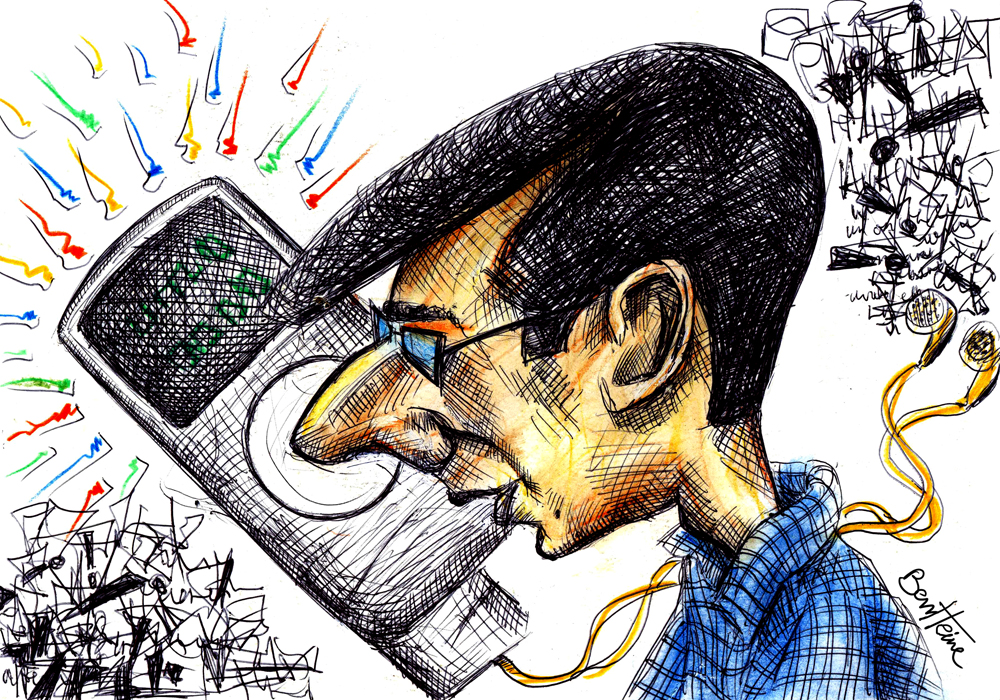
.jpg)
.jpg)


![new bondarowicz's_website 2008 [banner 1]](http://farm3.static.flickr.com/2208/2184895861_3fe47c84a8_m.jpg)